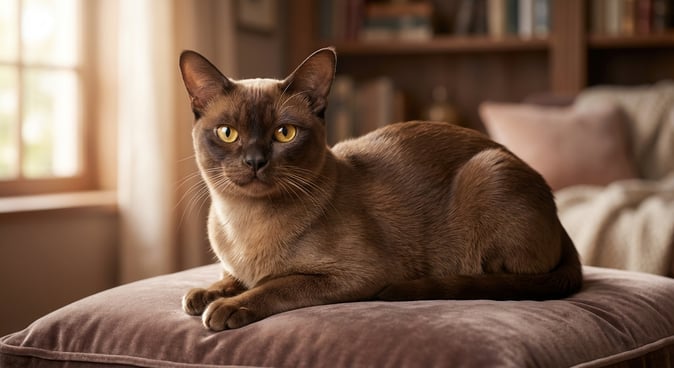
The Burmese is a breed of domestic cat, originating in Burma, believed to have its roots near the Thai-Burma border and developed in the United States and Britain.
Article
Journey from ancient Burmese temples to modern living rooms—discover how a tiny copper cat named Wong Mau became the golden-eyed ancestor of today’s affectionate, people-loving Burmese.
With their mesmerizing golden eyes and satin-soft coats, Burmese cats have captivated cat lovers for decades. These charming felines from Myanmar are renowned for their dog-like loyalty and playful personalities that remain kitten-like well into adulthood. Often described as 'bricks wrapped in silk,' Burmese cats combine a muscular build with an incredibly affectionate nature, making them one of the most people-oriented breeds in the feline world.
History & Origin
The Burmese breed's journey began in Southeast Asia, specifically in Myanmar (formerly Burma), near the Thai-Burma border. Legend tells of these copper-colored cats being kept as sacred temple companions for centuries. The modern Burmese breed we know today emerged in the 1930s when Dr. Joseph Thompson of San Francisco imported a small, dark brown cat named Wong Mau. Through careful breeding programs in both the United States and Britain, Wong Mau became the foundation of today's Burmese breed.
The breed's development took slightly different paths in America and Britain, resulting in two distinct types. American Burmese tend to have a rounder head and stockier build, while British Burmese feature a more wedge-shaped head and elegant body. Despite these variations, both types maintain the breed's signature traits: that incredible personality and those stunning golden eyes.
Physical Characteristics
Burmese cats are medium-sized felines weighing between 3-5 kg (6-11 pounds), with males typically larger than females. Their compact, muscular bodies measure 25-30 cm in length, giving them a surprisingly heavy feel when picked up – hence the nickname 'bricks wrapped in silk.' This solid build reflects their heritage as working cats in their native Myanmar.
The breed's short, satin-like coat lies close to the body, requiring minimal grooming but offering maximum pet-ability. While the original sable (dark brown) remains the most recognized color, Burmese cats come in four stunning varieties: champagne (warm beige), blue (soft gray with fawn undertones), and platinum (pale gray with fawn undertones). Each color variation showcases those spectacular eyes that range from golden yellow to chartreuse green.
Their heads feature rounded contours with wide-set, expressive eyes and a distinctive 'break' or stop at the nose. The ears are medium-sized, tilting slightly forward as if perpetually interested in what you're saying. Their tails are straight, medium-length, and taper to a rounded tip, completing their balanced appearance.
Temperament & Personality
Ask any Burmese owner about their cat, and you'll likely hear the same refrain: 'They're more like dogs than cats!' This breed's exceptional affection level (5/5) manifests in their constant desire to be involved in human activities. They'll follow you from room to room, 'help' with household tasks, and greet visitors at the door with characteristic enthusiasm.
Their intelligence (5/5) makes them quick learners who can master tricks, fetch toys, and even walk on leashes. Many Burmese cats learn to open doors, turn on faucets, and solve puzzle toys with impressive speed. This mental sharpness requires regular stimulation – they're not content to lounge all day without interaction.
The breed's playful nature (5/5) remains strong throughout their 15-18 year lifespan. Even senior Burmese retain a kitten-like enthusiasm for play, often initiating games with their humans. Their energy level (4/5) means they need regular play sessions but aren't as hyperactive as some breeds. They're equally happy chasing a feather wand or curling up in your lap for a Netflix marathon.
Burmese cats are exceptionally vocal (4/5), but their voices are softer and sweeter than their Siamese relatives. They'll hold entire conversations with you, using a range of chirps, trills, and soft meows to express their opinions about everything from dinner timing to your choice of TV shows.
Care Requirements
Despite their short coats, Burmese cats do shed moderately (2/5), though much less than long-haired breeds. A weekly brushing session helps remove loose hair and distributes skin oils for a healthy shine. Their grooming needs (2/5) are minimal – regular nail trims, ear cleaning, and dental care complete their beauty routine.
Exercise needs (4/5) are higher than average for this active breed. Interactive play sessions twice daily help burn energy and strengthen your bond. Puzzle feeders, climbing trees, and window perches provide mental stimulation when you're away. Many Burmese enjoy learning tricks or playing fetch, making exercise feel like playtime.
These social butterflies don't thrive when left alone for long periods. They do best in homes where someone is around most of the day or with another pet companion. Their pet-friendly nature (4/5) means they usually get along well with cat-friendly dogs and other cats, though proper introductions are essential.
Health Considerations
While generally healthy, Burmese cats face several breed-specific health challenges. Hypokalemia, a condition causing low potassium levels, can lead to muscle weakness. Responsible breeders test for this genetic condition, and affected cats can manage it with potassium supplements.
Cranial deformities, though rare in well-bred lines, can occur due to the breed's rounded head structure. Diabetes mellitus appears more frequently in Burmese cats than many other breeds, making weight management crucial. Their love of food combined with a stocky build means portion control is essential to prevent obesity.
Gingivitis and dental issues are common, so establishing a dental care routine early is important. Regular veterinary dental cleanings, combined with daily tooth brushing or dental treats, help maintain oral health. Their average lifespan of 15-18 years means a long-term commitment to their health care needs.
Is This Breed Right For You?
Burmese cats make exceptional companions for families, singles, and seniors who want an interactive, affectionate pet. Their kid-friendly nature (5/5) makes them excellent family cats, though young children should be taught gentle handling. They adapt well to apartment living but need vertical space and interactive play.
These cats aren't ideal for people who work long hours or travel frequently unless they have another pet companion. They crave human interaction and can become depressed or destructive when lonely. Their intelligence means they need mental stimulation – a bored Burmese might reorganize your sock drawer or explore kitchen cabinets.
Consider your lifestyle carefully. If you want a cat that greets you at the door, sleeps in your bed, and supervises your daily activities, the Burmese is perfect. If you prefer an independent cat who entertains themselves and seeks attention on their terms, look elsewhere.
The Burmese breed offers an unparalleled combination of beauty, brains, and boundless affection. These golden-eyed companions bring joy, laughter, and unconditional love to households lucky enough to share their lives with them. While they require significant time and attention, the reward is a devoted friend who will enrich your life for nearly two decades. For those seeking a true feline companion rather than just a pet, the Burmese cat stands in a class of its own.
4/5
Health Issues
Prone to hypokalemia (low potassium), cranial deformities, diabetes mellitus, and gingivitis.
family pets
Myanmar cats
short hair cats
intelligent cats
vocal cats
lap cats
Cat's Doctor
Get AI-powered advice about your cat's health and care. Enter your cat's information and start a conversation with our veterinary assistant.
Get expert advice about cat care, behavior, nutrition, grooming, and training. Ask our AI cat care expert anything about your cat and receive professional guidance.