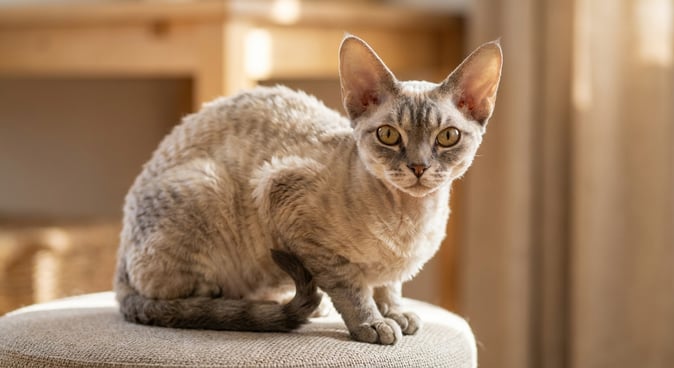
The Devon Rex is a breed of intelligent, short-haired cat that emerged in Devon, England during the late 1950s. They are known for their slender bodies, soft wavy coat, and oversized low-set ears that give them an elfin appearance.
Article
Discover how a single curly-coated kitten from 1960s Devon sparked the birth of the elf-eared Devon Rex—a mischievous, pixie-faced clown whose rare rex gene sets it apart from every other breed.
With oversized ears set low on an impish face and a coat that feels like crushed velvet, the Devon Rex looks like it stepped out of a fairy tale—and behaves like it’s starring in a comedy. These pixie-like cats are pure joy wrapped in soft waves, ready to ride your shoulder, play fetch till midnight, and spoon under the blankets at dawn.
History & Origin
The Devon Rex story begins in 1960 in Devon, England, when a curly-coated kitten named Kirlee was born to a straight-haired stray. Breeders initially thought Kirlee shared the Cornish Rex mutation, but test matings proved otherwise—this was an entirely new rex gene. By the late 1960s, dedicated breeding programs preserved the unique Devon gene, and the breed earned championship status in Britain (1967) and the CFA (1979). Today, the Devon Rex remains a rare gem outside Europe, but its fan base is fiercely loyal.
Devons are petite powerhouses: 2.5–4.5 kg of muscle and mischief wrapped in a 30–35 cm frame. Their most striking features are those low-set, bat-wing ears—so large they almost outsize the wedge-shaped head. Large, oval eyes come in every imaginable shade: gold, green, blue, or even odd-eyed. The short, wavy coat is marvelously sparse, lying in ripples that feel like suede to the touch. Whiskers and eyebrows are often kinked or broken off, adding to the perpetual "I-know-something-you-don't" grin. All coat colors and patterns are permitted, from solid seal point to tortoiseshell smoke.
Temperament & Personality
If cats had theater kids, the Devon Rex would be the star. Affection level, playfulness, intelligence, energy, friendliness—every one scores a perfect 5/5. These cats insist on being involved in every aspect of human life: they'll perch on your shoulder while you cook, supervise your Zoom calls, and greet guests at the door like a wagging dog. Devons love children, other cats, and polite dogs; isolation is their kryptonite. Expect games of fetch, acrobatic leaps to the highest bookshelf, and a soft purr that never seems to switch off. They aren't overly vocal (3/5), but when they do speak, it's a delicate chirp that means "Look at me—now!"
Care Requirements
Despite the hypoallergenic reputation (they produce lower Fel d 1 protein), no cat is truly allergy-free. Devons shed minimally—just a 2/5—so a quick weekly wipe with a damp cloth or soft brush is enough to remove dead hairs and distribute skin oils. Those huge ears can collect wax, so check them bi-weekly. High metabolism means they eat more per kilo than most cats; provide quality, protein-rich food and puzzle feeders to satisfy their 5/5 exercise needs. A cat wheel, climbing wall, and daily interactive play sessions are essential. Devons hate cold; they'll appreciate heated beds and sweaters in winter.
Health Considerations
Devons are generally robust, but the breed carries some hereditary concerns. Congenital hypotrichosis can cause patchy or total baldness in extreme lines. Malassezia dermatitis, a yeast skin infection, can flare in the warm folds of ears and armpits—regular cleaning prevents overgrowth. Orthopedic issues include patellar luxation and mild hip dysplasia; keep them lean to reduce stress on joints. Hypertrophic cardiomyopathy (HCM) appears occasionally, so choose breeders who screen their kings and queens annually via echocardiogram. Average lifespan is 10–15 years, though many thrive into their late teens with proper care.
Is This Breed Right For You?
Ideal Devon guardians want a full-time companion, not a décor accessory. If you work long hours away from home, consider two Devons or opt for a more independent breed. Their high energy can overwhelm very young toddlers, but school-age kids who enjoy interactive play will find a perfect partner. Apartment dwellers rejoice: Devons adapt well to indoor life as long as you provide vertical space and daily stimulation. Finally, budget for quality food and routine veterinary screenings; their faster metabolism and potential skin issues require proactive care.
The Devon Rex is a living contradiction—an elegant imp, a heat-seeking mischief-maker, a dog-like pixie who steals hearts and sandwiches with equal enthusiasm. If you crave a playful shadow that doubles as a hot-water bottle and conversation starter, this curly-coated clown might just be your perfect match.
3/5
Health Issues
Prone to congenital hypotrichosis (hereditary baldness), Malassezia dermatitis (yeast skin infection), patellar luxation, hip dysplasia, and hypertrophic cardiomyopathy (HCM).
mischievous cats
low shedding cats
Cat's Doctor
Get AI-powered advice about your cat's health and care. Enter your cat's information and start a conversation with our veterinary assistant.
Get expert advice about cat care, behavior, nutrition, grooming, and training. Ask our AI cat care expert anything about your cat and receive professional guidance.