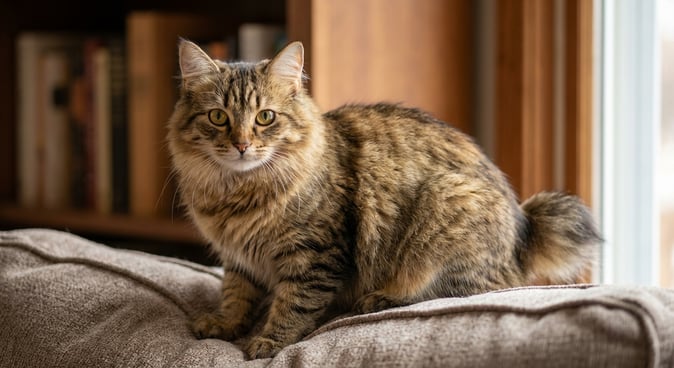
The American Bobtail is an uncommon breed of domestic cat which was developed in the late 1960s. It is most notable for its stubby 'bobbed' tail about one-third to one-half the length of a normal cat's tail.
Article
Discover how a chance encounter on an Arizona reservation sparked the American Bobtail, the wild-looking feline whose stubby tail and rugged charm hide an affectionate, dog-like devotion. This article traces the breed’s serendipitous origins, celebrates its golden personality, and reveals why these “bobbed” beauties make unforgettable companions.
If you’ve ever dreamed of sharing your home with a miniature lynx who greets guests at the door, plays fetch, and still curls up on your lap at night, the American Bobtail might be your perfect match. Developed in the late 1960s, this rare American original combines a wild appearance with an affectionate, almost canine personality. From their unmistakable bobbed tail to their sparkling eyes and plush coat, American Bobtails turn heads—and hearts—wherever they go.
History & Origin
The American Bobtail’s story begins on an Indian reservation in Arizona during the late 1960s. A young couple, John and Brenda Sanders, found a short-tailed brown tabby kitten and brought him home to Iowa. When this rugged tom—aptly named Yodie—was bred with the family’s seal-point Siamese, the resulting kittens all sported the same abbreviated tail. Breeders quickly realized they had stumbled upon a naturally occurring genetic mutation, not a deformity. Selective breeding with longhaired and shorthaired domestics, Himalayans, and later Ragdolls refined the look while keeping the signature tail and sturdy body. By 1989 the breed earned championship status with TICA, and today it remains one of North America’s best-kept feline secrets.
Breed Details
Property
Value
ID
23addb33-b50d-4411-94b8-fd65dbef9614
Name
American Bobtail
Origin
United States
Temperament
Intelligent, Interactive, Lively, Playful, Social
Life Span
13-18
Weight
3.5-7 kg
Length
45-60 cm
Coat Length
Medium
Coat Colors
All colors and patterns
Eye Colors
Gold, Copper, Green, Blue
Hypoallergenic
No
Shedding Level
4/5
Grooming Needs
3/5
Exercise Needs
4/5
Affection Level
4/5
Friendliness
4/5
Kid Friendly
4/5
Pet Friendly
4/5
Playfulness
4/5
Energy Level
4/5
Intelligence
4/5
Vocalization Level
Tags
American Bobtailbobbed tail catdog-like catfamily-friendly catplayful breedrare cat breed
American Bobtail - Cat Breeds
Physical Characteristics
American Bobtails are medium-to-large cats, with males typically weighing 5–7 kg (11–15 lb) and females a slightly smaller 3.5–5 kg (8–11 lb). Their bodies measure 45–60 cm from nose to the base of their unique tail, giving them a rectangular, athletic silhouette. The star attraction—the tail—is one-third to one-half the length of an ordinary cat’s tail, flexible and expressive, sometimes curved, kinked, or bumped like a string of beads. No two tails are identical, and breeders prize the “perfect” bob that balances with the cat’s frame.
The double coat can be medium or long, dense enough to survive harsh winters yet silky to the touch. Every color and pattern is acceptable, from classic brown tabby to shimmering shaded silver, pointed, tortoiseshell, and even solid white. Eyes are large, almond-shaped, and can be gold, copper, green, or blue—often echoing coat tones. Heavy brows and a prominent whisker pad create the breed’s characteristic wild expression, often compared to that of a bobcat or lynx.
Temperament & Personality
American Bobtails score a consistent 4/5 across almost every personality trait: affectionate, friendly, kid-friendly, pet-friendly, playful, energetic, and intelligent. They are the quintessential “dog-like” cat, happily learning to walk on a leash, ride on shoulders, or play fetch for hours. Despite their high energy (4/5), they are remarkably gentle—tail-chasing toddlers won’t send them into hiding, and most get along famously with dogs, other cats, and even respectful pocket pets.
Vocalization sits at a polite 2/5; instead of loud yowls, Bobtails communicate with soft chirps and trills, making them ideal apartment companions. Their social nature means they dislike being left alone all day; pairs or multi-pet households keep them content. Expect your Bobtail to shadow you from room to room, offering commentary and the occasional head-butt of approval.
Care Requirements
Grooming needs are moderate (3/5). A weekly brushing removes dead hair and reduces the 4/5 shedding that occurs seasonally. Longhaired individuals may need twice-weekly sessions to prevent tangles behind the ears and on the britches. Bathing is rarely necessary unless you plan to show your cat, but routine nail trimming, ear cleaning, and dental care keep them in top form.
Exercise needs rank high (4/5). Provide sturdy cat trees, puzzle feeders, and daily interactive play—wand toys, laser pointers, or even a game of fetch down a hallway. Because they are intelligent problem-solvers, rotate toys weekly to stave off boredom. Leash-training is surprisingly easy; many Bobtails proudly patrol backyards on harnesses, soaking up sunshine and attention.
Health Considerations
Overall, the American Bobtail is a robust, healthy breed with a generous 13–18-year lifespan. Responsible breeders screen for hip dysplasia, a condition that can arise in heavier, large-boned lines. Extremely short tails can occasionally be linked to spinal deformities, so ethical breeders avoid mating two very short “rumpy” individuals. Routine veterinary care, balanced nutrition, and maintaining a lean body weight are usually all that’s required for a long, happy life.
Is This Breed Right For You?
Choose an American Bobtail if you want an interactive, outgoing companion who thrives on family chaos rather than hides from it. They excel in households with children, other pets, and owners who enjoy training and play sessions. If you travel frequently or prefer a quiet, ornamental cat, the Bobtail’s need for companionship and activity may be overwhelming. Likewise, those with severe cat allergies should note that the breed is not hypoallergenic and does shed moderately year-round. For everyone else, the reward is a devoted, playful partner who greets you at the door, follows you like a puppy, and still manages to look gloriously wild while purring on your pillow.
The American Bobtail proves that you can have it all: the rugged allure of a wild feline and the affectionate heart of a family dog in one enchanting package. With minimal grooming demands, robust health, and an ever-wagging stub of a tail, these rare beauties bring laughter, loyalty, and a touch of the American frontier into any home ready for their playful spirit.
2/5
Health Issues
Generally healthy; may have occasional hip dysplasia or tail-related spinal issues in lines with very short tails.
United States cat
intelligent cat
medium-haired cat
good with kids
Cat's Doctor
Get AI-powered advice about your cat's health and care. Enter your cat's information and start a conversation with our veterinary assistant.
Get expert advice about cat care, behavior, nutrition, grooming, and training. Ask our AI cat care expert anything about your cat and receive professional guidance.