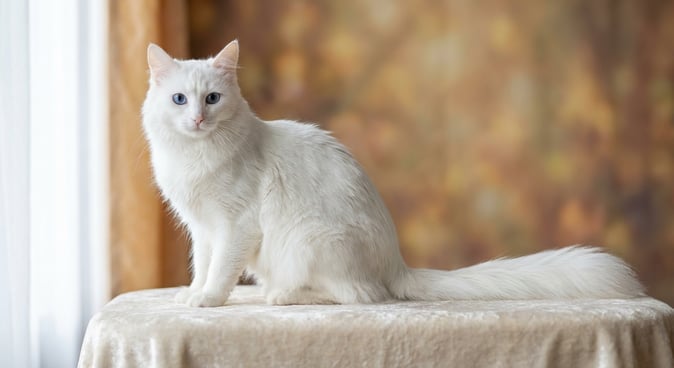
The Turkish Angora is an elegant, ancient natural breed from central Anatolia, Turkey. Fine-boned and graceful, these cats are prized for their silky, shimmering long coat, plumed tail, almond-shaped eyes, and large, tufted ears. They are intelligent, playful, affectionate, and often form a strong bond with one chosen person while remaining friendly to all.
Article
Descended from the snowy mountains of Ankara, the Turkish Angora once graced royal courts and narrowly escaped extinction—discover how a Turkish zoo preserved this silky, aristocratic feline for the world.
Few breeds embody feline grace quite like the Turkish Angora. Hailing from the mountains of central Anatolia, this naturally occurring aristocrat has captivated sultans and cat lovers for over a millennium. With a shimmering plumed tail, fine-boned silhouette, and sparkling almond eyes, the Angora is as clever as it is beautiful, often choosing one special human to shadow with dog-like devotion.
History & Origin
The Turkish Angora’s story begins in the snow-capped Ankara region, where harsh winters forged a resilient, silky-coated cat as early as the 15th century. Islamic manuscripts praise white "Ankara kedisi" for purity, while European travelers returned home with gifts for royalty—Marie Antoinette reportedly sent her Angoras to Maine ahead of her ill-fated escape. By the early 1900s the breed neared extinction outside Turkey, saved only by the Ankara Zoo’s meticulous breeding program that safeguarded pure white lines. Exports resumed in the 1960s, and today every pedigree Turkish Angora traces back to those zoo guardians.
Weighing a delicate 2.5–4.5 kg and stretching 35–45 cm, the Angora appears weightless when it leaps. The single-layer coat lies flat yet glistens like spun silk, rarely matting and coming in every color from classic white to smoke, shaded silver, tortoiseshell, and calico. The trademark plumed tail arches proudly over the back, often flicking expressively during conversation. Large, tufted ears sit high on a wedge-shaped head, framing almond eyes that glow blue, green, amber—or one of each in odd-eyed individuals. Fine-boned legs end in dainty oval paws that seem to prance rather than walk, giving the breed its perpetual air of ballet-like elegance.
Temperament & Personality
Intelligence is the Angora’s calling card: puzzle feeders are solved in minutes, door handles are learned by observation, and games of fetch can last until your arm tires. Playfulness scores a perfect 5/5; they chase feather wands with acrobatic mid-air twists, then suddenly curl on your lap, purring louder than many cats twice their size. While friendly to visitors and respectful children, most Angoras devote themselves to one chosen person, following them room-to-room like a shadow and answering with soft, melodic chirps. Expect conversational exchanges at a moderate vocal level—neither silent nor Siamese-loud—delivered with head bumps and gentle paw taps for emphasis.
Care Requirements
Despite the glamorous coat, grooming is surprisingly moderate: a 3/5 rating means two quick comb-throughs each week remove loose hairs and keep the silky strands gleaming. The single coat lacks heavy underfur, so shedding stays low (2/5) and hairballs are infrequent. Energy demands are higher: 4/5 exercise needs translate to daily interactive play, tall cat trees for climbing, and even leash walks if introduced young. Puzzle toys prevent boredom and associated mischief such as unrolling toilet paper or opening cabinets. A high-protein diet maintains muscle tone on the slender frame, while fresh water supports urinary health.
Health Considerations
Robust overall, the breed carries a few inherited caveats. White Angoras with two blue eyes have a higher incidence of congenital deafness; reputable breeders BAER-test kittens and place hearing-impaired pets only in safe indoor homes. Hypertrophic cardiomyopathy (HCM) can surface, so annual cardiac screening and DNA testing of breeding stock are advised. Rare lines may exhibit hereditary ataxia, a neurological condition detectable in kittenhood—again, careful screening minimizes risk. With proper veterinary care, expect 12–18 years of companionship, often on the higher end thanks to the breed’s natural vigor.
Is This Breed Right For You?
Ideal guardians are those who want an interactive, elegant companion without the grooming marathon required by thicker-coated longhairs. Families with respectful children, singles working from home, or retirees ready for daily play sessions will find the Angora’s devotion deeply rewarding. Apartment dwellers succeed if vertical space and window perches are provided, but households gone 10+ hours daily may leave these social cats lonely. If you crave a cat that glides through rooms like a fashion model, then curls on your pillow to guard your dreams, the Turkish Angora may be your perfect match.
Whether draped over the back of a sofa like a silk scarf or leaping after a feather with Olympic grace, the Turkish Angora brings centuries of elegance and heart-stealing devotion into any home. Give them love, play, and a warm lap, and this living piece of Anatolian history will reward you with shimmering beauty and unwavering loyalty for years to come.
Vocalization Level
3/5
Health Issues
White-coated, blue-eyed cats prone to congenital deafness; DNA screening for hypertrophic cardiomyopathy (HCM) recommended; rare hereditary ataxia in some lines
Ankara cats
family pets
hypoallergenic myths
cat history
Cat's Doctor
Get AI-powered advice about your cat's health and care. Enter your cat's information and start a conversation with our veterinary assistant.
Get expert advice about cat care, behavior, nutrition, grooming, and training. Ask our AI cat care expert anything about your cat and receive professional guidance.