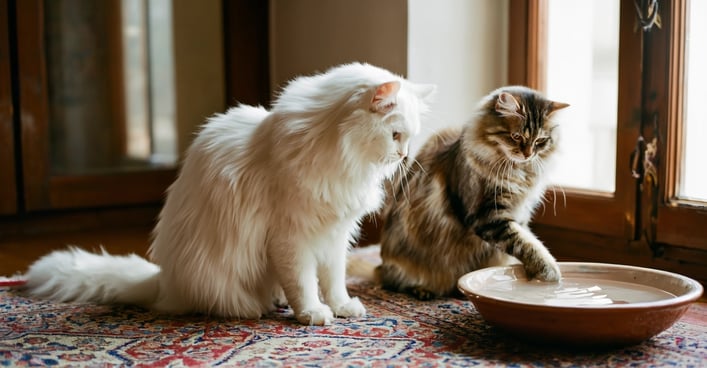
Turkish Angora vs Turkish Van Cat: The 2026 Complete Comparison Guide
Discover the key differences between two ancient Turkish cat breeds. Learn which elegant, active companion—the graceful Angora or the water-loving Van—is the perfect fit for your home.
Share this page
Turkish Angora vs Turkish Van Cat: The 2026 Complete Comparison Guide
By Dr. Michael Torres, Veterinary Geneticist | Updated: 2026 | Reading Time: 13 minutes
Introduction
The Turkish Angora and Turkish Van are two magnificent, ancient cat breeds hailing from Turkey. While they share a common ancestry in the Anatolian region and possess silky coats and athletic builds, they are distinct in personality, appearance, and care needs. This comprehensive 2026 guide provides a detailed comparison to help you understand their unique histories, traits, and which breed might be your ideal feline companion.
Historical Origins
Turkish Angora Origins
Ancient Anatolian Breed:
Origin: Ankara (historically Angora), Turkey
Historical Period: Ancient breed, documented since the 15th century
Turkish Angora vs Turkish Van Cat: The 2026 Complete Comparison Guide - Articles
Historical Significance:
The Turkish Angora is one of the world's oldest natural cat breeds, originating in the Ankara region. Revered by Turkish royalty and considered sacred, their existence was threatened in the early 20th century when they were extensively used in Persian breeding programs. A dedicated preservation effort by the Ankara Zoo in the mid-20th century saved the breed from decline.
Recognition:
The breed gained recognition in Europe during the late 1800s and was officially accepted by the Cat Fanciers' Association (CFA) in 1972.
Turkish Van Origins
Lake Van Region:
Origin: The isolated Lake Van region in eastern Turkey
Historical Period: Ancient breed
Distinctive Feature: The "Van" pattern (color restricted to the head and tail)
Type: Natural breed from a specific geographic area
Discovery Story:
Though ancient in Turkey, the Turkish Van was introduced to the Western world in 1955 by two British photographers who were gifted two kittens. The breed was subsequently developed in England and imported to the United States in the 1980s.
The Van Pattern:
This breed's signature pattern—a predominantly white body with colored markings only on the head and tail—is named after it. This unique look results from the combination of the piebald spotting gene and a temperature-sensitive colorpoint restriction.
Physical Characteristics Comparison
Size and Build
Feature
Turkish Angora
Turkish Van
Key Difference
Male Weight
8-12 lbs (3.6-5.4 kg)
10-20 lbs (4.5-9 kg)
Turkish Vans are significantly larger and more substantial.
Female Weight
5-8 lbs (2.3-3.6 kg)
7-12 lbs (3.2-5.4 kg)
Turkish Vans have a heavier build.
Body Type
Fine-boned, slender, and graceful
Substantial, muscular, and powerful
Angoras are delicate; Vans are robust athletes.
Overall Build
Elegant and refined
Strong and athletic
They represent different spectrums of feline structure.
Coat Characteristics
Turkish Angora Coat:
Length & Texture: Medium-long, single coat with a fine, silky texture. It lacks an undercoat, feeling similar to cashmere.
Colors: All colors and patterns are accepted, though the pure white variety is historically iconic.
Maintenance: Weekly brushing is sufficient. The coat is water-resistant and mats rarely due to the absence of an undercoat.
Shedding: Seasonal.
Turkish Van Coat:
Length & Texture: Semi-longhaired with a unique, soft "cashmere" or "rabbit-like" texture. It is also a single coat with no undercoat.
Pattern: The Van pattern is required for show cats: a white body with colored markings confined to the head (a "cap") and tail.
Colors: Accepted colors on the markings include red, cream, black, blue, and various tabby patterns.
Maintenance: Weekly brushing. The coat is also water-resistant, and many Vans enjoy water.
Shedding: Seasonal.
Head and Facial Features
Turkish Angora:
Head: Wedge-shaped, fine, and elegant.
Ears: Large, pointed, and set high on the head.
Eyes: Large, almond-shaped. Any color is accepted; blue, green, gold, or odd-eyed (one blue, one amber) are common, especially in white cats.
Turkish Van:
Head: Broad, modified wedge shape, giving a strong impression.
Ears: Medium-sized, set fairly high and upright, often with lynx-like tufts.
Eyes: Large, oval to walnut-shaped. Colors are typically amber, blue, or odd-eyed.
Distinctive Physical Traits
Turkish Angora:
An air of elegant, refined beauty.
A plume-like tail carried gracefully.
Historically associated with a pure white coat.
Turkish Van:
Known as the "swimming cat" due to a common fascination with water.
A powerful, muscular body built for activity.
The unique and required Van pattern coloration.
Temperament & Personality Comparison
Personality Overview
Trait
Turkish Angora
Turkish Van
Activity Level
High
Very High / Energetic
Playfulness
Very Playful
Extremely Playful
Intelligence
High; curious problem-solvers
High; inventive and observant
Affection Level
Selective; bonds deeply with family
Very affectionate; often "dog-like" in devotion
Independence
Moderate; enjoys interaction but can entertain itself
Lower; thrives on constant companionship and interaction
Vocalization
Moderate; communicative but not overly loud
Moderate; will "talk" to their owners
Turkish Angora Personality
Key Characteristics:
Active, athletic, and loves to climb to the highest point in a room.
Highly intelligent and inquisitive, often getting into mischief.
Forms a strong, loyal bond with their chosen person or family but can be reserved with strangers.
Playful and kitten-like well into adulthood.
They are often described as graceful, gentle, and sometimes possessing an "alpha" cat confidence.
Turkish Van Personality
Key Characteristics:
Energetic, athletic, and requires substantial daily play and interaction.
Famously known for a dog-like personality: devoted, social, and often following owners from room to room.
Many exhibit a unique fascination with water—playing in it, patting at faucets, or even joining you in the bath.
Highly affectionate, demanding of attention, and thrives in an engaging environment.
They are intelligent, strong-willed, and can be taught tricks like fetching.
Care Requirements Comparison
Exercise & Enrichment Needs
Turkish Angora:
Requires daily interactive play sessions (15-20 minutes, twice daily).
Essential: Ample vertical space via cat trees, shelves, and perches.
Enjoys puzzle toys and games that challenge their intelligence.
Turkish Van:
Has very high energy needs requiring extensive, vigorous daily play (30+ minutes, multiple times a day).
Benefits from interactive toys, fetch games, and even supervised water play (e.g., a shallow basin).
Can become bored and destructive without adequate stimulation.
Grooming Comparison
Aspect
Turkish Angora
Turkish Van
Brushing Frequency
Weekly
Weekly
Bathing
Rarely needed; most dislike water.
May be enjoyed due to water fascination; easier if required.
Matting Potential
Very low (no undercoat).
Very low (no undercoat).
Shedding
Seasonal, typically heavier in spring/fall.
Seasonal, typically heavier in spring/fall.
Overall Maintenance
Surprisingly low for a longhaired cat.
Surprisingly low for a longhaired cat.
Note: Both breeds benefit immensely from their single coats, making grooming far easier than for double-coated longhaired breeds.
Health & Lifespan Comparison
Turkish Angora Health
General Health: A robust and generally healthy natural breed.
Average Lifespan: 12-18 years.
Primary Health Concerns:
Deafness: Associated with the dominant white gene, particularly in white cats with two blue eyes. Not all blue-eyed white Angoras are deaf.
Hypertrophic Cardiomyopathy (HCM): A form of heart disease that can affect the breed. Responsible breeders screen their breeding stock.
Ataxia: A rare, hereditary neurological condition found in some lines, causing lack of coordination.
Turkish Van Health
General Health: Known for a hardy constitution and natural breed vigor.
Average Lifespan: 12-17 years.
Primary Health Concerns:
Hypertrophic Cardiomyopathy (HCM): As with many breeds, HCM is a concern. Screening by breeders is recommended.
The breed is otherwise notably free of major genetic disorders.
Cost of Ownership Comparison
Initial Acquisition Cost (2026 Estimates)
Source
Turkish Angora
Turkish Van
Pet Quality Kitten
$800 - $2,000
$700 - $1,500
Show/Breeding Quality
$2,000 - $4,000+
$1,500 - $3,000+
Adoption/Rescue
Very Rare
Very Rare
Important Note: Both breeds are relatively uncommon. Finding a reputable breeder may involve joining a waitlist. Always prioritize breeders who perform health screenings and raise kittens in a home environment.
Estimated Annual Care Costs
Expense Category
Turkish Angora
Turkish Van
High-Quality Food
$400 - $700
$500 - $900 (due to larger size & higher energy)
Routine Veterinary Care
$300 - $600
$300 - $600
Toys, Scratching Posts, Enrichment
$150 - $300
$200 - $400 (higher need for stimulation)
Grooming Supplies/Professional
$0 - $150
$0 - $150
Pet Insurance
$300 - $600/year
$300 - $600/year
Total Annual Estimate
$1,150 - $2,350
$1,300 - $2,650
Ideal Living Environment
Best Home for a Turkish Angora
Thrives In:
Homes with active individuals or families who appreciate interactive play.
Environments with plenty of vertical space (cat trees, shelves).
Households wanting an elegant, intelligent, and engaging but not overly demanding companion.
Indoor-only living is strongly recommended for safety.
May Struggle In:
Extremely quiet, sedentary households.
Homes where the owner is absent for very long hours daily.
With owners who expect a constant lap cat.
Best Home for a Turkish Van
Thrives In:
Very active, engaging households where someone is home often.
Families with respectful children or individuals wanting a "shadow" or dog-like companion.
Homes that can provide extensive daily play sessions and mental stimulation.
Environments where their water curiosity can be safely explored (e.g., with a cat fountain).
May Struggle In:
Homes where owners work long hours away from home.
Small apartments without space for vigorous play.
With owners who prefer a low-energy, independent cat.
Which Breed Is Right For You?
Choose a Turkish Angora if you:
Desire a cat of elegant, refined beauty and graceful movement.
Want an active and playful companion but with slightly more manageable energy than a Van.
Can provide ample vertical territory for climbing and perching.
Appreciate a highly intelligent cat that forms a deep, selective bond.
Are prepared for potential grooming and deafness considerations with white, blue-eyed individuals.
Choose a Turkish Van if you:
Seek an extremely active, playful, and almost tireless companion.
Want a profoundly affectionate, social, and dog-like cat that follows you everywhere.
Are fascinated by the unique Van pattern and their legendary love of water.
Have significant time daily for interactive play and engagement.
Desire a robust, muscular cat with a big personality.
Conclusion
Both the Turkish Angora and Turkish Van are captivating breeds offering a blend of ancient heritage, striking beauty, and dynamic personalities. Your choice ultimately hinges on your lifestyle and preferences.
The Turkish Angora is the graceful ballerina: intelligent, elegant, and actively affectionate on its own terms.
The Turkish Van is the athletic adventurer: exuberant, water-loving, and devotedly attached to its people.
By providing the appropriate environment, engagement, and care, either of these Turkish treasures will reward you with years of loyal, entertaining, and beautiful companionship.
Get expert advice about cat care, behavior, nutrition, grooming, and training. Ask our AI cat care expert anything about your cat and receive professional guidance.