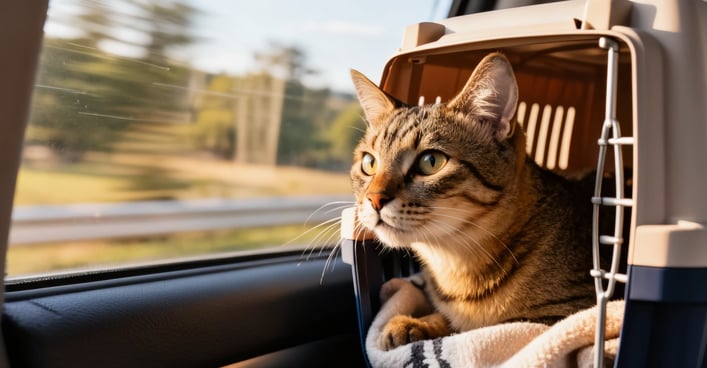
Traveling with Cats in 2026: The Complete Guide for Road Trips & Air Travel
A comprehensive, stress-reducing guide to traveling with your cat. Learn expert tips for carrier training, airline policies, calming strategies, and safety for both car and air travel.
Share this page
Traveling with Cats in 2026: The Complete Guide for Road Trips & Air Travel
Meta Description: Master cat travel with this definitive guide. Learn expert strategies for carrier training, airline navigation, stress reduction, and safety for both car trips and air travel in 2026.
Introduction
Traveling with cats presents unique challenges distinct from traveling with dogs or other pets. As territorial creatures who thrive on routine and familiar environments, cats often find travel inherently stressful. However, whether you're relocating, taking a vacation with your feline companion, or traveling for specialized veterinary care, meticulous preparation can transform the experience into a manageable one for both you and your cat.
This comprehensive guide covers everything from selecting the perfect carrier and managing anxiety to navigating the latest airline regulations and ensuring your cat's safety and comfort on any journey. With the right planning and approach, traveling with your cat can become a feasible—and sometimes even smooth—experience.
Traveling with Cats in 2026: The Complete Guide for Road Trips & Air Travel - Articles
Pre-Travel Preparation
Health and Documentation
Veterinary Requirements:
Timing:
Schedule a veterinary visit 7-10 days before travel.
This allows time for health certificate processing.
Ensures all vaccinations are current.
Permits a trial run of any prescribed sedation or calming medications.
Health Certificate:
Required for interstate and international travel.
Must be issued by an accredited veterinarian.
Valid for a specific period (varies by destination).
Must include proof of a current rabies vaccination.
Vaccinations:
Rabies (required virtually everywhere).
FVRCP (core vaccines for feline viral rhinotracheitis, calicivirus, and panleukopenia).
Additional vaccines based on your destination's specific requirements.
Medical Considerations:
Condition
Travel Implications
Chronic Illness
May require specific travel clearance from your vet.
Medications
Bring a sufficient supply for the entire trip, plus extra.
Anxiety
Discuss pharmaceutical and non-pharmaceutical calming options.
Motion Sickness
Ask about anti-nausea medication.
Senior Cats
Requires extra monitoring and potentially shorter travel days.
Carrier Selection
Airline-Approved Carriers:
In-Cabin Requirements:
Must fit under the seat in front of you.
Soft-sided carriers are usually preferred.
Dimensions vary by airline (typically 18"L × 11"W × 11"H).
Waterproof bottom is essential.
Adequate ventilation on at least two sides.
Secure, escape-proof zipper closures.
Cargo Requirements:
Hard-sided, airline-approved kennel.
Appropriate size (cat must be able to stand, turn around, and lie down comfortably).
Secure door latches.
Attached food and water dishes.
Clearly visible "Live Animal" labels.
Current identification on the crate and your cat.
Recommended Carrier Features:
Feature
Importance
Notes
Size
Essential
Must be large enough for the cat to turn around.
Ventilation
Essential
Multiple mesh panels for optimal airflow.
Security
Essential
Escape-proof zippers or latches are non-negotiable.
Padding
Important
Comfortable bedding for long trips.
Visibility
Moderate
Some cats feel safer with less visibility; choose accordingly.
Access
Important
Top and front openings make loading and comforting easier.
Washable
Important
Accidents happen; easy cleaning is a must.
Carrier Training:
Timeline: Begin 2-4 Weeks Before Travel
Week 1-2: Positive Association
Place the carrier in your cat's favorite area with the door removed or propped open.
Add familiar bedding, toys, and catnip inside.
Feed treats and meals inside the carrier.
Allow voluntary exploration without pressure.
Week 3: Door Training
Begin closing the door for brief periods (seconds, then minutes).
Gradually extend the time while your cat is calm.
Always reward calm behavior with high-value treats.
Never use the carrier as punishment.
Week 4: Movement Training
Lift the carrier and walk short distances around the house.
Progress to short car rides around the block.
Reward your cat after each successful session.
Goal: Your cat enters the carrier voluntarily and remains calm during movement.
Car Travel
Preparation
Vehicle Setup:
Carrier Placement:
Always secure the carrier with a seatbelt.
The most stable location is on the floor behind the front passenger seat.
Never place a carrier in an open truck bed or allow a cat to roam loose in the vehicle.
Climate Control:
Maintain a comfortable temperature (68-72°F / 20-22°C).
Never leave your cat in a parked car, even for "quick" stops. Temperatures can become fatal in minutes.
Use sunshades to avoid direct sunlight on the carrier.
Emergency Supplies Kit:
Health certificate and vaccination records.
All medications with instructions.
Collapsible water bowl and bottled water.
A small amount of your cat's regular food.
Paper towels, waste bags, and enzymatic cleaner.
Spare bedding and a familiar blanket.
A recent photo of your cat.
Contact information for your vet and emergency vets along your route.
During the Journey
Schedule Management:
Trip Duration
Recommended Strategy
Under 2 hours
Direct travel with no stops.
2-6 hours
Plan for brief stops to offer water.
6-12 hours
Plan for elimination needs and longer breaks.
Over 12 hours
Book an overnight stay at a pet-friendly hotel.
Feeding & Hydration Guidelines:
Offer a light meal 3-4 hours before departure.
Provide small amounts of water during long trips.
Avoid heavy meals immediately before or during travel to reduce motion sickness risk.
Rest Stops (Every 4-6 hours on long trips):
Keep your cat securely in the carrier.
Offer small amounts of water.
Never leave your cat unattended in the vehicle.
Clean the carrier immediately if soiled.
Reducing Motion Sickness:
Face the carrier forward in the direction of travel.
Ensure stable positioning to minimize sway.
Provide fresh air ventilation.
Limit food before travel.
Use veterinarian-prescribed medication if needed.
Recognizing and Responding to Distress:
Signs: Excessive vocalization, panting, drooling, vomiting, agitation, or unusual lethargy.
If Distress Occurs:
Pull over safely when possible.
Check the temperature inside the car.
Offer a small amount of water.
Use a calm, reassuring voice.
Consider shortening your travel day.
Air Travel
Airline Selection
Pet Policies Vary Greatly—Always Confirm Directly with the Airline:
Airline
In-Cabin Pets?
Cargo Pets?
Approx. Fee (2026)
Key Notes
Delta
Yes
Yes
~$125-$200
Breed & temperature restrictions apply.
American
Yes
Yes
~$125-$200
Strict temperature embargo policies.
United
Yes
Yes (PetSafe)
~$125-$250
Has a dedicated PetSafe program for cargo.
Alaska
Yes
Yes
~$100
Generally excellent reputation for pet travel.
Southwest
No*
No
N/A
*Service/emotional support animals only with documentation.
JetBlue
Yes (JetPaws)
No
~$125
Limited space; book early.
In-Cabin Travel
Advantages:
Your cat stays with you in the climate-controlled cabin.
Generally less stressful than cargo travel.
Allows for immediate monitoring and reassurance.
The strongly preferred method when possible.
Requirements & Strategy:
Advance reservation is mandatory (spaces are limited).
Carrier must fit under the seat.
Cat must remain in the carrier for the entire flight.
Book your pet's spot immediately after purchasing your ticket.
Call to confirm 24-48 hours before departure.
Arrive early at the airport.
Request a window seat for slightly more footroom.
Cargo Travel
Consider Only When Necessary:
Cat is too large for in-cabin requirements.
Mandatory for some international routes.
On certain aircraft types.
Preparation is Critical:
Acclimate your cat to the hard-sided cargo crate well in advance.
Book direct flights whenever possible.
Travel during mild weather (airlines have temperature embargoes).
Ensure the crate is properly labeled with "Live Animal" stickers and your contact info.
Attach clear feeding/watering instructions.
Concerns & Risk Mitigation:
Primary Risks: Temperature extremes, handling stress, and travel delays.
Mitigation: Choose airlines with reputable pet programs (e.g., United PetSafe).
Sedation is generally not recommended for cargo travel due to monitoring difficulties.
Exhaust all alternatives before choosing cargo travel.
Airport Procedures
Security Screening:
The TSA requires you to remove your cat from the carrier. The carrier goes through the X-ray; you carry your cat through the metal detector.
Practice this at home using a secure harness and leash.
You can request a private screening room for more privacy and security.
Stay calm—your cat will mirror your anxiety.
At the Gate and In-Flight:
Board early if the airline permits.
Store the carrier securely under the seat in front of you.
Keep the carrier closed during the entire flight.
Place your hand near the carrier opening and speak softly to reassure your cat.
Avoid feeding during the flight to minimize nausea.
Sedation and Calming Options
Medication Options
When to Consider:
History of severe travel anxiety.
Prior traumatic travel experiences.
For very long-distance journeys.
Only on the specific recommendation of your veterinarian.
Common Veterinary-Prescribed Medications:
Medication
Type
Duration
Key Notes
Gabapentin
Anti-anxiety/Sedative
6-8 hours
Commonly prescribed, good for both car and air travel.
Trazodone
Sedative
4-6 hours
Often used for car travel and pre-travel anxiety.
Alprazolam
Benzodiazepine
4-6 hours
For short-term anxiety relief.
Acepromazine
Tranquilizer
6-8 hours
Sedates but does not relieve anxiety; use is declining.
Critical Rules for Medication:
Always do a trial dose at home before travel day to assess reaction.
Never use human medications or old prescriptions.
Some cats experience paradoxical excitement.
Many airlines prohibit sedation for cargo travel.
Consult your vet about interactions with altitude.
Non-Pharmaceutical Options
Pheromone Therapy:
Feliway®: A synthetic feline facial pheromone spray. Spray the carrier 15 minutes before travel (let it dry). Plug-in diffusers are great for hotel rooms.
Calming Supplements:
L-Theanine (found in Anxitane®).
Alpha-casozepine (found in Zylkene®).
CBD Products: Discuss quality, sourcing, and dosage with your vet first.
Behavioral & Environmental Techniques:
Line the carrier with your cat's favorite blanket or an item of your clothing.
Play calming cat-specific music or white noise.
Use a blanket to cover the carrier partially, creating a secure "cave."
International Travel
Additional Requirements
Start Early: Begin research 3-6 months in advance. Some countries (e.g., Australia, New Zealand) have processes that take many months.
Key Steps Often Required:
ISO-Compliant Microchip (11784/11785) implanted before any rabies vaccination.
Rabies Vaccination and certificate.
Rabies Titer Test (FAVN/OIE): Blood test to prove vaccine efficacy. Results take weeks, and there is often a mandatory waiting period (e.g., 3 months) afterward.
Import Permit from the destination country.
USDA-Endorsed Health Certificate: Issured by your vet within a strict timeframe (often 10 days) and then endorsed by the USDA APHIS.
Possible Quarantine upon arrival, depending on the country.
Requirements for Common Destinations (2026):
Country
Key Requirements
Quarantine
United Kingdom
Microchip, Rabies Vaccine, Health Certificate, Tapeworm Treatment.
None if all rules met.
European Union
EU Pet Passport (Microchip, Rabies Vaccine, Health Certificate).
Professional Assistance: For complex moves, consider hiring a pet travel agent or using a veterinary service that specializes in international pet relocation. The cost is often justified by the reduced stress and avoidance of costly errors.
Emergency Situations
Preventing a Lost Cat
Always use a secure harness and leash when the cat is out of the carrier.
Ensure your microchip registration is current with your cell phone number.
Use a temporary travel tag on the collar with your destination address and cell number.
Carry a recent, clear photo on your phone.
If Your Cat Gets Lost:
Search the immediate area thoroughly and calmly.
Contact local animal control and all shelters/vets in the area.
Post on local Facebook Lost & Found Pet groups and Nextdoor.
Immediately notify your microchip company.
Do not leave the area without exhausting all search options.
Medical Emergencies
Be Prepared:
Before you leave, locate 24-hour emergency veterinary clinics at your destination and along your route. Save their addresses and numbers in your phone.
Travel First Aid Kit Additions:
Gauze pads, self-adhering bandage (vet wrap).
Digital pet thermometer.
Saline eye wash.
Tweezers.
A copy of medical records.
Your regular vet's contact info.
Cost of Cat Travel
Car Travel Costs (Estimated 2026)
Expense
Cost Range
Quality Carrier
$50 - $150
Health Certificate
$75 - $200
Sedation/Calming Meds
$30 - $100
Calming Products (Feliway, etc.)
$20 - $60
Pet-Friendly Hotel Fees
$25 - $100 per night
Gas, Food, Misc.
Variable
Total (Multi-Day Trip)
$300 - $600+
Air Travel Costs (Estimated 2026)
Expense
Cost Range
Airline Pet Fee (In-Cabin)
$100 - $250 each way
Health Certificate
$75 - $200
Airline-Approved Carrier
$50 - $150
Sedation/Vet Visit
$50 - $150
Ground Transport to/from Airport
$50 - $200
Total (Domestic Round Trip)
$400 - $1,000+
Total (International)
$800 - $3,000+ (incl. tests, permits, etc.)
Alternatives to Travel
When Travel Isn't the Best Option
Consider alternatives if your cat is elderly, ill, or extremely anxious. Travel stress can exacerbate health problems.
Boarding Kennel:
Best for short trips and cats who are social.
Visit beforehand to check facilities and staff.
In-Home Pet Sitting:
Often the least stressful option. Your cat stays in their familiar territory.
A professional sitter provides feeding, play, and companionship.
Veterinary Boarding:
Ideal for cats with ongoing medical needs.
Provides direct medical supervision.
The clinical environment can be stressful for some cats.
Conclusion
Traveling with cats in 2026 demands thorough preparation, appropriate equipment, and realistic expectations about feline stress responses. While most cats will never love travel, strategic planning minimizes anxiety and prioritizes safety at every step.
The pillars of success are advance carrier training, complete veterinary preparation, selecting the least stressful travel method, and maintaining your own calm demeanor—cats are experts at sensing our emotions.
Whether driving across the country or flying overseas, your commitment to your cat's comfort makes shared journeys possible. Investing in the right carrier, proper documentation, effective calming aids, and professional guidance for complex trips is an investment in your companion's well-being.
Remember, every cat is an individual. Assess your cat's temperament honestly and be willing to choose a pet sitter over travel when it's in their best interest. With the detailed strategies in this guide, you can approach necessary travel with confidence, ensuring you and your feline friend reach your destination safely and with your bond intact.
Get expert advice about cat care, behavior, nutrition, grooming, and training. Ask our AI cat care expert anything about your cat and receive professional guidance.