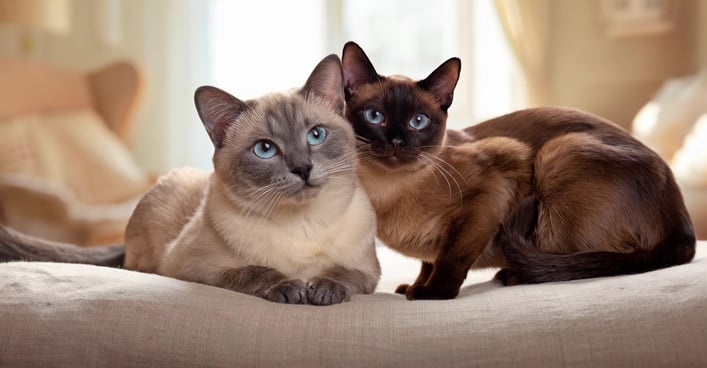
Tonkinese vs Burmese: A Complete 2026 Breed Comparison Guide
Choosing between a Tonkinese and Burmese? Compare their origins, personality, health, and care needs to find your perfect affectionate feline companion.
Share this page
Tonkinese vs Burmese: A Complete 2026 Breed Comparison Guide
The Tonkinese and Burmese share Siamese ancestry and similar affectionate personalities, but differ in appearance, energy, and origin. Both breeds offer devoted, people-oriented companionship with moderate care requirements.
Breed Origins and History
Tonkinese Origins
Modern Development:
Developed in Canada and the United States during the 1960s.
Named after the Tonkin region of Indochina.
Created by intentionally crossing Siamese and Burmese cats.
Goal: To produce a cat with intermediate traits between the two parent breeds.
Recognized by the Cat Fanciers' Association (CFA) in 1984.
Historical Controversy:
Natural Tonkinese-type cats are believed to have existed in Southeast Asia for centuries.
Some claim the breed occurred naturally before planned North American breeding programs.
Regardless, it was officially established as a distinct breed in North America.
Burmese Origins
Ancient Roots:
Tags
tonkinese catburmese catcat breed comparisonaffectionate cat breedsfamily catscat care guide
Originated in Burma (modern-day Myanmar) and Thailand.
Revered as sacred temple cats in Burma.
The foundation cat, Wong Mau, was imported to the United States in 1930.
Dr. Joseph Thompson established the formal breeding program.
Recognized by the CFA in 1936.
Breed Development:
Wong Mau was a walnut brown, Siamese-type cat.
She was bred to a Siamese, and her offspring were interbred to establish the distinct Burmese breed.
Famously described as a "brick wrapped in silk" due to their substantial, muscular build.
Physical Characteristics Comparison
Size and Build
Feature
Tonkinese
Burmese
Male Weight
8-12 lbs (3.6-5.4 kg)
Female Weight
6-8 lbs (2.7-3.6 kg)
6-10 lbs (2.7-4.5 kg)
Body Type
Moderate, muscular, athletic
Medium, compact, and surprisingly substantial
Bone Structure
Medium
Medium, solid, and dense
Overall Impression
Balanced and athletic
Stocky and deceptively heavy for their size
The "Brick" Factor: Burmese cats are famous for being much heavier than they appear—a compact package of solid muscle.
Head and Face
Feature
Tonkinese
Burmese
Head Shape
Modified wedge
Rounded and broad
Profile
Slight stop or curve
Visible nose break
Eyes
Almond-shaped, slightly slanted
Large, round, and set wide apart
Eye Color
Aqua (signature), blue, or green
Gold to yellow
Ears
Medium, wide-set
Medium, wide-set, slightly rounded tips
Muzzle
Medium width
Short and broad
Expression
Alert, curious, and engaging
Sweet, innocent, and open
Key Difference - Eye Color: The Tonkinese's aqua eyes are unique to the breed—a distinctive turquoise that is neither Siamese blue nor Burmese gold.
Coat and Color
Feature
Tonkinese
Burmese
Coat Texture
Soft, silky, close-lying
Satin-like, short, and glossy
Undercoat
Minimal
Minimal
Feel
Mink-like
Fine and sleek
Shedding
Minimal
Minimal
Grooming
Weekly brushing
Weekly brushing
Color Patterns:
Tonkinese:
Natural (medium brown)
Champagne (warm beige)
Blue (soft blue-gray)
Platinum (pale gray)
Each color comes in three distinct coat patterns:
Point: Like the Siamese, with darker points on the face, ears, paws, and tail.
Mink: The Tonkinese signature pattern with subtle contrast between body and points.
Solid: Like the Burmese, with minimal contrast and even color.
Burmese:
Sable: Rich, dark brown (the original and most common color).
Champagne (warm beige)
Blue (medium blue-gray)
Platinum (pale silvery gray)
Note: Chocolate and Lilac are accepted in some international associations but not by the CFA.
Temperament and Personality
Tonkinese Personality
Core Traits:
Highly social and affectionate.
Intelligent and highly trainable.
Moderately to highly active.
Deeply people-oriented.
Excellent with children and other pets.
Moderately vocal with a softer voice than the Siamese.
Behavioral Characteristics:
Tend to follow their owners from room to room.
Often enjoy playing fetch and retrieving toys.
Prefer high perches for observation.
Thrive on interactive play sessions.
May "help" with household tasks.
Can learn tricks and respond well to clicker training.
Balance between being playful lap cats and active companions.
Summary:
Activity Level: Moderate to High
Vocalization: Moderate
Independence: Low
Intelligence: Very High
Burmese Personality
Core Traits:
Exhibit dog-like devotion to their families.
Extremely people-oriented and dependent.
Playful and kitten-like well into old age.
Good-natured with everyone, including strangers.
Trusting and must be kept indoors.
Possess a soft, quiet voice.
Behavioral Characteristics:
Famous for following owners constantly.
Love games of fetch.
Enjoy being held, carried, and are supreme lap cats.
Get along wonderfully with dogs and other pets.
Maintain a playful, youthful demeanor for life.
Their trusting nature necessitates an indoor-only lifestyle.
Summary:
Activity Level: Moderate
Vocalization: Quiet
Independence: Very Low
Intelligence: High
Temperament Comparison Summary
Trait
Tonkinese
Burmese
Affection Level
Very High
Very High
Playfulness
High
High
Independence
Low
Very Low
Good with Children
Excellent
Excellent
Good with Other Pets
Very Good
Excellent
Vocalization
Moderate
Quiet
Energy Level
Moderate-High
Moderate
Trainability
Very High
High
Lap Cat Tendency
Moderate
Very High
Health Comparison
Tonkinese Health
Generally Healthy: Often benefit from the hybrid vigor of crossing two established breeds.
Potential Concerns:
Crossed eyes and kinked tail: Inherited from Siamese ancestry; typically cosmetic only.
Gingivitis: Regular dental care is important.
Amyloidosis: Rare but possible; a disease affecting organ function.
Overall Health: Excellent
Average Lifespan: 15-18 years
Burmese Health
Breed-Specific Concerns:
1. Head Defect (Burmese Craniofacial Defect):
A genetic condition affecting skull development.
Kittens with the severe form do not survive.
A DNA test is available; responsible breeders screen for it.
2. Hypokalemia (Burmese Hypokalaemia):
Causes low blood potassium levels, leading to muscle weakness.
A genetic test is available.
Can be managed with potassium supplements.
3. Other Considerations:
Flat-Chested Kitten Syndrome: Affects chest development; most kittens outgrow it with care.
Diabetes Mellitus: Higher incidence than average; weight management is crucial.
Gangliosidosis: A rare genetic storage disease; DNA test available.
Overall Health: Good, with responsible breeding and screening.
Average Lifespan: 16-18 years (with excellent care)
Health Testing Comparison
Test
Tonkinese
Burmese
Head Defect DNA Test
Not typically needed
Essential for breeding cats
Hypokalemia DNA Test
Not typically needed
Recommended
Gangliosidosis DNA Test
Not typically needed
Recommended
Regular Blood Work
Annual check-up
Annual check-up, especially monitoring for diabetes
Estimated Annual Health Costs:
Tonkinese: $200 - $350
Burmese: $250 - $450 (potentially higher due to breed-specific monitoring)
Care Requirements
Grooming Needs
Both breeds have similar, low-maintenance coats:
Weekly Routine:
Use a soft bristle brush or rubber curry comb.
Both shed minimally.
Bathing is rarely needed.
Trim nails every 2-3 weeks.
Clean ears monthly.
Grooming Costs:
DIY supplies: $30 - $60 per year.
Professional grooming is rarely necessary.
Exercise and Activity
Tonkinese:
Generally higher energy than Burmese.
Enjoy more climbing, jumping, and acrobatic play.
Interactive play with wand toys is essential.
Appreciate puzzle toys and food dispensers.
Retain playfulness into old age.
Burmese:
Have moderate exercise needs.
Love games of fetch and retrieve.
Value lap time and cuddling as much as play.
Exhibit "helping" behavior and enjoy being involved.
Maintain a kitten-like playfulness throughout life.
Recommended Activity Equipment (for both):
Sturdy cat trees: $80 - $200
Interactive toys: $30 - $80
Fetch toys: $10 - $20
Nutrition
Weight Management is Key for Both:
Tonkinese:
Have an active metabolism but still require portion monitoring.
Interactive feeding toys can help manage intake.
Burmese:
Their stocky build can mask weight gain.
Strict portion control is essential.
Prone to diabetes if overweight, making weight management critical.
High estimates account for potential chronic health issues, premium insurance, and higher-end care.
Choosing Between the Breeds
Choose a Tonkinese If You:
Desire their signature aqua eye color.
Prefer a slightly more active and playful companion.
Want a highly trainable and intelligent cat that learns tricks.
Like the intermediate appearance between a Siamese and a Burmese.
Don't mind moderate, conversational vocalization.
Enjoy daily interactive play sessions.
Choose a Burmese If You:
Want the ultimate, devoted lap cat.
Prefer a quieter, less vocal companion.
Love the "eternal kitten" personality.
Appreciate a stocky, cuddly, and deceptively heavy cat.
Seek a soft-spoken, dog-like devoted shadow.
Are home often and can provide constant companionship.
Key Similarities Between Breeds
Both the Tonkinese and Burmese share these wonderful traits:
Extreme people-orientation and need for companionship.
A "don't leave me alone" personality; not suited for long solitude.
Low-maintenance, short coats with minimal grooming.
Playful, engaging natures that last a lifetime.
Generally excellent with children and other family pets.
Must be indoor-only cats due to their trusting natures.
Potential for long lifespans (15+ years) with proper care.
Affectionate, social temperaments that bond deeply with their families.
Conclusion
The Tonkinese and Burmese offer profound devotion with nuanced differences in energy and aesthetics. The Tonkinese provides a vibrant, slightly more active companion with unique aqua eyes and a trainable mind. The Burmese delivers the epitome of lap cat devotion with a quieter, more settled, and perpetually youthful nature.
Both breeds demand significant attention and companionship—they are not ideal for owners seeking an independent, aloof pet. However, for individuals, couples, or families prepared to offer love, interaction, and a central place in the home, either breed will reward that commitment with years of unwavering, affectionate companionship.
Your final choice may come down to aesthetic preference (like eye color), subtle energy level differences, or local breeder availability. Whichever you choose, you are welcoming a loving, social, and remarkable feline family member.
choosing a cat
indoor cats
Cat's Doctor
Get AI-powered advice about your cat's health and care. Enter your cat's information and start a conversation with our veterinary assistant.
Get expert advice about cat care, behavior, nutrition, grooming, and training. Ask our AI cat care expert anything about your cat and receive professional guidance.