Sphynx vs Devon Rex: A Complete Guide to Hairless and Low-Shedding Cats (2026)
Choosing between a Sphynx and a Devon Rex? Compare their grooming needs, personalities, health, and costs to find the perfect low-shedding feline companion for your lifestyle.
Share this page
Sphynx vs Devon Rex: A Complete Guide to Hairless and Low-Shedding Cats (2026)
Considering a unique feline companion? The Sphynx and Devon Rex are two of the most distinctive low-shedding cat breeds, offering captivating personalities for allergy sufferers or those seeking an extraordinary pet. While both minimize shedding, they present dramatically different care requirements, temperaments, and aesthetics. This comprehensive guide provides the insights you need to make an informed decision.
The Sphynx breed originated from a natural genetic mutation in Toronto, Canada, in 1966. A domestic shorthair gave birth to a hairless kitten named Prune, who became the foundation for selective breeding. Contrary to the name's Egyptian implication, the breed is entirely North American.
Early breeding programs faced genetic diversity challenges. Breeders carefully outcrossed with domestic shorthairs to strengthen the gene pool while preserving the hairless trait. The breed achieved championship status in major cat registries in the early 2000s.
Devon Rex History
The Devon Rex emerged in Devon, England, in 1960 with the birth of a unique curly-coated kitten named Kirlee. This spontaneous mutation created a cat with large ears, a pixie-like face, and a distinctive wavy coat. Initially confused with the Cornish Rex, genetic testing confirmed it was a separate mutation.
The breed gained recognition in the UK during the 1960s and in the United States by the 1970s. Kirlee's unique genetics established an entirely new breed known for its elfin appearance and playful spirit.
Physical Appearance
Sphynx Appearance
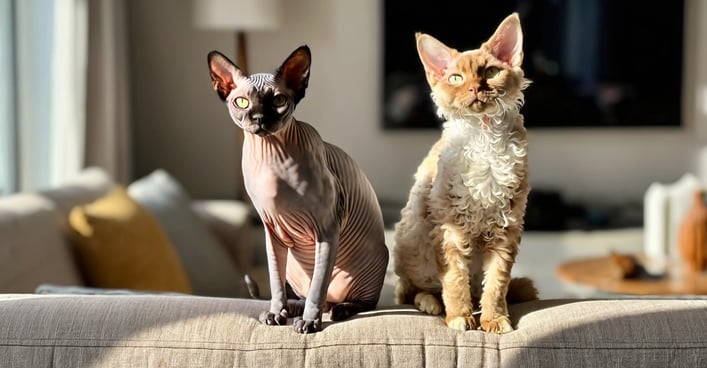
Sphynx cats are unmistakable:
Skin: Wrinkled, warm to the touch with a suede-like texture.
Body: Medium, muscular build with a characteristic rounded abdomen.
Ears: Prominently large, bat-like ears.
Eyes: Lemon-shaped, wide-set, and highly expressive.
Whiskers: Typically absent or very short and brittle.
Build: Surprisingly muscular and sturdy beneath their hairless skin.
While appearing bald, Sphynx are covered in a fine layer of peach fuzz, giving them a unique, warm feel.
Devon Rex Appearance
Devon Rex cats possess an impish, otherworldly charm:
Coat: Short, soft, and distinctly wavy or curly across the body.
Body: Slender, athletic, and medium-sized with a lightweight frame.
Ears: Exceptionally large, low-set on the head, contributing to their elfin look.
Eyes: Large, oval, and wide-set, full of expression.
Face: Short muzzle with prominent cheekbones.
Build: Delicate in appearance but surprisingly strong and agile.
The Devon's coat can vary from loose waves to tight ringlets, often described as "marcel waves."
Coat and Grooming
Sphynx Grooming Requirements
Paradoxically, the hairless Sphynx requires significant grooming commitment:
Bathing: Weekly baths are non-negotiable to remove oily sebum buildup.
Ear Cleaning: Clean large ears weekly to prevent wax accumulation.
Nail Care: Clean nails regularly to remove waxy debris.
Skin Care: May require pet-safe moisturizers to prevent dryness.
Sun Protection: Strictly indoor cats due to high sunburn risk.
Climate Control: Need consistently warm environments; sweaters are often necessary in cooler climates.
Without fur to absorb natural oils, their skin requires diligent maintenance to stay clean and healthy.
Devon Rex Grooming Requirements
The Devon Rex is notably low-maintenance:
Brushing: Gentle, weekly brushing—often using just your fingers—to maintain coat health.
Bathing: Rarely required unless the cat gets particularly dirty.
Ear Cleaning: Monthly checks and cleaning are usually sufficient.
Coat Sensitivity: Their delicate curls can be damaged by harsh brushing.
Time Commitment: Approximately 15 minutes of gentle care per week.
Their minimal shedding and easy-care coat make them an ideal choice for owners seeking a low-grooming breed.
Personality and Temperament
Sphynx Personality
Sphynx cats are the ultimate people-loving extroverts:
Affectionate: Crave constant physical contact and lap time.
Heat-Seeking: Perpetually in search of warm spots and human warmth.
Entertaining: Playful, acrobatic, and often described as clownish.
Social: Prone to loneliness; thrive with constant companionship.
Vocal: Communicative and chatty with their owners.
Dog-like Traits: Often follow owners from room to room, displaying loyal behavior.
They are among the most human-oriented cat breeds and do not fare well with long periods of solitude.
Devon Rex Personality
Devons are best described as eternally playful imps:
Playful: Retain a kitten-like exuberance throughout their lives.
Intelligent: Quick learners and clever problem-solvers.
Affectionate: Form strong bonds but are generally more independent than the Sphynx.
Mischievous: Incredibly curious and often "into everything."
Loyal: Develop deep attachments to their family members.
Athletic: Love to climb and will seek out the highest vantage points.
They offer a delightful blend of intelligence, loyalty, and endless playful energy.
Health Considerations
Sphynx Health
They have a shorter average lifespan with several breed-specific concerns:
Hypertrophic Cardiomyopathy (HCM): A prevalent form of heart disease. Regular cardiac screening is advised.
Skin Conditions: Prone to infections, sun damage, and issues related to oil buildup.
Temperature Regulation: Poor tolerance for cold due to lack of insulation.
Generally robust but with some hereditary conditions to note:
Patellar Luxation: A condition where the kneecap dislocates.
Hypertrophic Cardiomyopathy (HCM): Also a concern; screening is recommended.
Skin Conditions: Some lines may be prone to conditions like Malassezia dermatitis.
Hereditary Myopathy: A rare muscular disorder in certain bloodlines.
Average Lifespan: 9 to 15 years.
Proactive veterinary care and responsible breeding are crucial for both breeds.
Allergen Considerations
Are They Hypoallergenic?
Important Note: No cat breed is 100% hypoallergenic. Allergies are primarily triggered by the Fel d 1 protein found in saliva and skin oils, not just fur.
Sphynx:
Produce Fel d 1 protein in their skin oils.
Weekly bathing can significantly reduce surface allergens.
Some allergy sufferers react less due to the lack of shedding fur.
Others may react more to direct skin contact.
Devon Rex:
Often produce lower levels of Fel d 1 than many breeds.
Their minimal shedding reduces the spread of dander.
Many allergy sufferers report better tolerance with Devon Rex cats.
Individual reactions vary dramatically.
Critical Advice: If you have allergies, spend extended time with both breeds before making a commitment.
Exercise and Activity Needs
Sphynx Activity Level
Highly energetic and require engagement:
Daily Play: Need at least 30 minutes of active play daily.
Warmth: Their activity is often centered around seeking heat sources.
Climbing: Are quite athletic and enjoy cat trees and perches.
Mental Stimulation: Benefit greatly from puzzle toys and interactive games.
Devon Rex Activity Level
Exceptionally high energy and intelligence:
Daily Play: Require extended, interactive play sessions every day.
Vertical Space: Cat trees, shelves, and high perches are essential.
Fetch: Many Devons enjoy and will readily play fetch.
Mental Challenges: Thrive with puzzle feeders, training, and learning tricks.
Both breeds are active and require dedicated owners who can provide ample physical and mental enrichment.
Costs vary widely by location, individual pet needs, and insurance coverage.
Ideal Living Environment
Best Home for a Sphynx
Indoor-only living is mandatory for safety and health.
Warm homes or owners willing to provide sweaters and heated beds.
Households where someone is home most of the day.
Owners committed to a rigorous weekly grooming routine.
Multi-pet homes or those willing to get a companion animal.
Best Home for a Devon Rex
Indoor living is strongly preferred for safety.
Homes with ample vertical space (cat trees, wall shelves).
Active families or individuals who can provide daily interactive play.
Households with other friendly pets for social interaction.
Owners seeking a highly intelligent and playful companion.
Which Breed Is Right for You?
Choose a Sphynx If You:
Desire an exceptionally affectionate, "velcro" cat that demands cuddles.
Are fully prepared for the commitment of weekly bathing and skincare.
Can maintain a consistently warm indoor environment.
Spend a lot of time at home and can provide near-constant companionship.
Appreciate a unique, hairless aesthetic and don't mind the associated care.
Choose a Devon Rex If You:
Want a playful, clever, and mischievous companion with a kitten-like spirit.
Prefer a low-maintenance grooming routine.
Have space for cat trees and high perches for climbing.
Are drawn to an unusual, elfin appearance with a soft, wavy coat.
Can commit to daily interactive play and mental stimulation.
Conclusion
The Sphynx and Devon Rex each offer a captivating alternative to traditional coated cats. The Sphynx delivers unparalleled affection and theatrical personality in a unique hairless package, demanding significant grooming dedication. The Devon Rex provides a brilliant, playful spirit wrapped in low-shedding curls, requiring less maintenance but equal engagement.
Your decision should hinge on these key factors:
Grooming Commitment: Are you ready for weekly baths (Sphynx) or prefer minimal care (Devon)?
Interaction Needs: Do you want a constant shadow (Sphynx) or a playful, slightly more independent friend (Devon)?
Aesthetic Preference: The striking hairless look versus the soft, curly coat.
Budget: The Sphynx typically involves higher acquisition and ongoing care costs.
Whichever breed you choose, you will be rewarded with a deeply loyal, entertaining, and utterly distinctive companion that defies the ordinary feline stereotype.
Get expert advice about cat care, behavior, nutrition, grooming, and training. Ask our AI cat care expert anything about your cat and receive professional guidance.