Sphynx vs Devon Rex: The Ultimate Guide to Hairless and Curly-Coated Cats (2026)
Choosing between a Sphynx and a Devon Rex? Our complete 2026 guide compares their unique care, personalities, and costs to help you find your perfect feline match.
Share this page
Sphynx vs Devon Rex: The Ultimate Guide to Hairless and Curly-Coated Cats (2026)
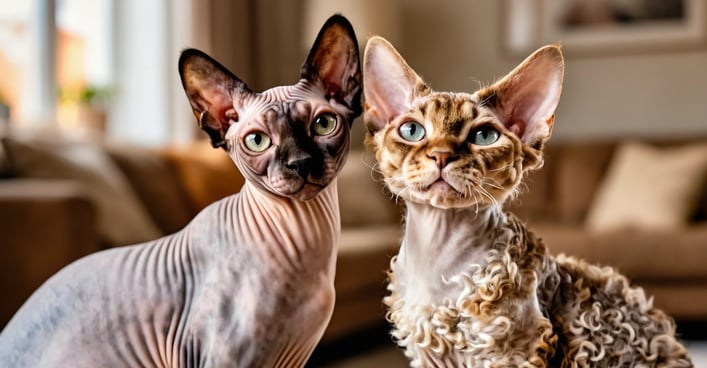
The Sphynx and Devon Rex are two of the most distinctive cat breeds, celebrated for their unconventional looks and charismatic personalities. While one is famously hairless and the other sports a soft, wavy coat, both offer unparalleled companionship with specific care needs. This comprehensive 2026 guide will help you decide which extraordinary feline is right for your home.
Breed Origins and History
Sphynx Origins
A Natural Mutation:
The breed originated in 1966 in Toronto, Canada with a hairless kitten named Prune.
Born to a domestic shorthair, Prune was bred back to his mother, producing more hairless offspring.
Named for its resemblance to the legendary Egyptian Sphinx.
Breed Development:
Early breeding faced challenges, including health issues in foundation cats.
Breeders outcrossed with American Shorthairs to improve genetic diversity.
Separate Canadian and European bloodlines were developed.
Achieved full recognition by the Cat Fanciers' Association (CFA) in 2002.
Tags
sphynx catdevon rexhairless catcurly coated catcat breeds comparisoncat care guide
Key Genetics:
The hairless trait is caused by a recessive gene (both parents must carry it).
They are not truly hairless but covered in a fine, suede-like "peach fuzz."
The degree of hairlessness can vary within the breed.
Devon Rex Origins
A Curly Discovery:
The breed began in 1960 in Devon, England, with a curly-coated barn cat named Kirlee.
Initially thought to be related to the Cornish Rex, genetic testing proved it was a separate, unique mutation.
Breed Development:
Early breeding attempts with Cornish Rex produced straight-coated kittens, confirming the different gene.
Breeders carefully preserved the breed's unique elfin characteristics.
The Devon Rex gained CFA recognition in 1979.
Key Genetics:
The curly coat is also a recessive gene, distinct from the Cornish Rex.
It produces a soft, wavy coat with curled or often absent whiskers.
Physical Characteristics: A Side-by-Side Look
Size and Build
Feature
Sphynx
Devon Rex
Male Weight
8-12 lbs (3.6-5.4 kg)
6-9 lbs (2.7-4 kg)
Female Weight
6-9 lbs (2.7-4 kg)
5-7 lbs (2.2-3.2 kg)
Body Type
Medium, muscular, barrel-chested
Slender, athletic, delicate
Bone Structure
Medium, substantial
Fine, light
Overall Impression
Striking, powerful, and warm to the touch
Whimsical, elfin, and graceful
Key Difference: The Sphynx is a more substantial, muscular cat, while the Devon Rex is notably smaller and more delicate.
Head and Face
Feature
Sphynx
Devon Rex
Head Shape
Modified wedge, slightly rounded
Short, broad wedge
Profile
Slight curve
A definite stop or break
Cheeks
Prominent
Full
Ears
Very large, wide-set
Very large, low-set with a wide base
Eyes
Large, lemon-shaped, any color
Large, oval, any color
Expression
Inquisitive and intelligent
Impish and mischievous
Whiskers
Sparse, short, or completely absent
Short, tightly curled, or absent
Shared Trait: Both breeds are known for their strikingly large, expressive ears.
Coat and Skin Characteristics
Feature
Sphynx
Devon Rex
Coat Type
Hairless to fine peach fuzz
Short, soft, wavy, and curly
Texture
Chamois or suede-like
Silky, fine, often compared to lamb's wool
Coverage
Sparse hair on extremities; visible skin
Full body coverage with possible bare patches
Shedding
None to minimal
Minimal
Allergen Level
Lower (but not hypoallergenic)
Lower than average, but not allergen-free
Grooming Needs
High maintenance (skin care)
Low maintenance
Sphynx Skin Details:
Covered in fine down that feels like peach fuzz.
Prone to visible skin wrinkles, especially on the body.
Produces body oils that require regular cleaning.
Has a higher metabolism and body temperature, seeking warmth.
Devon Rex Coat Details:
Features a distinctive "Marcel wave" pattern across the body.
The coat lacks a full guard-hair layer, making it very soft.
Can have naturally occurring bald patches, which is normal for the breed.
Temperament and Personality
Sphynx Personality
Core Traits:
Extremely people-oriented with dog-like devotion.
Highly energetic, intelligent, and demanding of attention.
Clownish, entertaining, and famously heat-seeking.
Behavioral Characteristics:
Known to follow owners from room to room.
Loves to sleep under covers and seek out high, warm perches.
Very talkative with a wide range of vocalizations.
Excellent with children, other cats, and cat-friendly dogs.
Personality Summary:
Activity Level: Very High
Vocalization: Talkative
Independence: Low
Intelligence: Very High
Devon Rex Personality
Core Traits:
Playful, mischievous, and retains kitten-like behavior for life.
People-oriented but generally less demanding than the Sphynx.
Highly intelligent, trainable, and often food-motivated.
Behavioral Characteristics:
Exhibits "monkey-like" agility, loving high places.
Can learn tricks, play fetch, and often "help" with human activities.
Social and typically excellent with children and other pets.
Personality Summary:
Activity Level: Very High
Vocalization: Quiet to Moderate
Independence: Moderate
Intelligence: Very High
Temperament Comparison at a Glance
Trait
Sphynx
Devon Rex
Affection Level
Very High
High
Playfulness
High
Very High
Attention Demands
Very High
Moderate
Compatibility with Children
Very Good
Excellent
Compatibility with Other Pets
Good
Very Good
Trainability
High
Very High
Special Care Requirements
Sphynx Skin and Health Care
Weekly & Daily Regimen:
Essential Weekly Bathing: Removes oil buildup with gentle, hypoallergenic shampoo. Thorough drying is crucial as they chill easily.
Daily Wiping: Use a warm, damp cloth to remove oils from skin folds.
Ear Cleaning: Large ears accumulate wax; clean 2-3 times weekly.
Nail Care: Trim weekly and clean the oily residue from nail beds.
Environmental Needs:
Indoor-only lifestyle is mandatory.
Requires a warm environment (75-80°F / 24-27°C).
Heated beds and cat clothing are highly recommended in cooler climates.
Use pet-safe sunscreen if they have any sun exposure.
Estimated Annual Care Costs: $145 - $330 for specialized shampoos, moisturizers, ear cleaners, and heated bedding.
Devon Rex Coat and Health Care
Minimal Grooming Needs:
Avoid brushing as it can damage the delicate coat. Hand-grooming with a damp cloth is sufficient.
Occasional baths may be needed if the coat becomes greasy (they have a higher metabolism).
Ear Care: Check and clean their large ears weekly to prevent wax buildup.
Environmental Needs:
More tolerant of standard room temperatures than the Sphynx.
Still appreciates warm spots and should be kept indoors.
Estimated Annual Care Costs: $40 - $60 for basic ear cleaners and occasional grooming supplies.
Health Comparison and Lifespan
Sphynx Health Overview
Primary Breed Concerns:
Hypertrophic Cardiomyopathy (HCM): A prevalent heart condition. Annual echocardiogram screening is essential.
Skin Conditions: Prone to yeast infections, sunburn, and oil-related issues.
Hereditary Myopathy: A rare genetic muscle disorder; DNA testing is available.
Average Lifespan: 12 - 15 years.
Devon Rex Health Overview
Primary Breed Concerns:
Hypertrophic Cardiomyopathy (HCM): Also present in the breed; annual screening is recommended.
Patellar Luxation: Dislocation of the kneecap, which can cause lameness.
Devon Rex Myopathy: A hereditary condition causing muscle spasticity; DNA testing is available.
Skin & Dental: Can develop greasy coat issues (Malassezia) and has a higher propensity for dental disease.
Average Lifespan: 9 - 15 years.
Shared Recommendation: For both breeds, purchasing from a reputable breeder who conducts annual HCM screenings on their breeding cats is the best way to ensure a healthy kitten.
*Sphynx initial costs are higher due to the need for heated beds, clothing, and specialized grooming kits.
Annual Recurring Costs
Expense
Sphynx
Devon Rex
High-Quality Food
$720 - $1,200
$600 - $960
Litter
$200 - $400
$200 - $400
Routine Veterinary Care
$400 - $700
$400 - $700
Pet Insurance
$400 - $600
$300 - $500
Special Care Supplies
$145 - $330
$40 - $60
Total Annual Cost
~$1,965 - $3,430
~$1,540 - $2,620
How to Choose: Which Breed Is Right for You?
Choose a Sphynx If You Want:
An intensely affectionate, "velcro" cat that acts like a dog.
A unique, conversation-starting appearance.
To commit to a weekly bathing and skincare routine.
To maintain a consistently warm home environment.
A high-energy companion that demands your attention.
Important Note: They are not hypoallergenic, as allergens are in saliva and skin oils.
Choose a Devon Rex If You Want:
A playful, mischievous, and elfin companion.
A uniquely coated cat with very low-maintenance grooming.
A highly intelligent cat that can learn tricks and stays kitten-like.
A people-oriented cat that is slightly more independent than a Sphynx.
High energy without the extreme temperature requirements.
Key Similarities Between Breeds
Despite their different looks, Sphynx and Devon Rex cats share many traits:
Striking, unconventional appearances with large ears.
High intelligence, energy, and trainability.
People-oriented, social, and affectionate personalities.
Indoor-only lifestyle requirements for safety.
Potential for hereditary HCM, making screening vital.
Generally good compatibility with families and other pets.
Final Verdict
The Sphynx and Devon Rex are both extraordinary breeds that defy the standard "cat" mold. Your decision ultimately hinges on lifestyle and commitment level.
The Sphynx is for the dedicated owner ready for a high-maintenance but incredibly rewarding relationship. You'll gain a supremely affectionate, hairless companion in exchange for a rigorous care regimen.
The Devon Rex offers a similar level of playful charm and intelligence in a package that requires significantly less daily upkeep. It's the ideal choice for someone who wants a unique, low-shedding cat without the intensive grooming.
Whichever you choose, ensure you source your kitten from a responsible, health-testing breeder. Both breeds promise to fill your home with unparalleled personality, love, and a touch of the extraordinary.
hypoallergenic cats
unique cat breeds
Cat's Doctor
Get AI-powered advice about your cat's health and care. Enter your cat's information and start a conversation with our veterinary assistant.
Get expert advice about cat care, behavior, nutrition, grooming, and training. Ask our AI cat care expert anything about your cat and receive professional guidance.