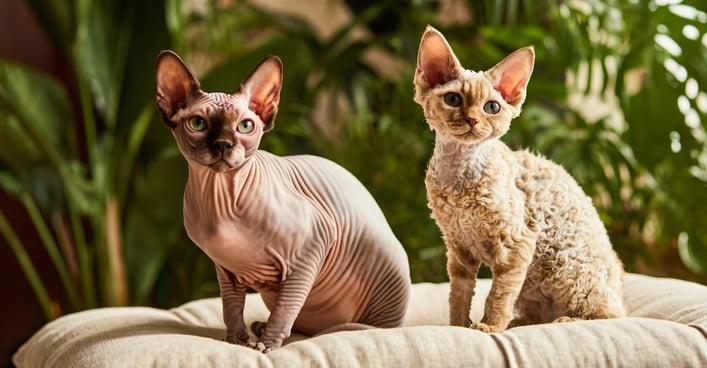
Sphynx vs Devon Rex: A Complete Guide to Hairless and Curly-Coated Cats
Discover the key differences between the unique Sphynx and Devon Rex cat breeds. Compare their personalities, care needs, and costs to find your perfect feline match.
Share this page
Sphynx vs Devon Rex: A Complete Guide to Hairless and Curly-Coated Cats
By Emily Rodriguez, Certified Animal Behaviorist | Published: January 15, 2026 | Reading Time: 12 minutes
Introduction
The Sphynx and Devon Rex are two of the most visually distinctive and charismatic domestic cat breeds. One is renowned for its hairless appearance, while the other captivates with a pixie-like face and a coat of soft, rippling curls. Both breeds challenge traditional feline aesthetics and have cultivated passionate, devoted followings. This comprehensive guide delves into their histories, temperaments, and unique care requirements to help prospective owners determine which extraordinary companion best suits their lifestyle.
Sphynx vs Devon Rex: A Complete Guide to Hairless and Curly-Coated Cats - Articles
Founder:
Development: Selective breeding from natural genetic mutations
The Sphynx breed originated from a spontaneous genetic mutation. In 1966, a domestic shorthair in Toronto gave birth to a hairless male kitten named Prune. Breeders recognized the potential of this recessive gene and, through careful outcrossing and selection, developed the breed we know today. It's important to note that most Sphynx cats are not completely hairless; they typically possess a fine, suede-like down.
Devon Rex Origins
English Discovery:
Origin: Devon, England
Discovery: 1960
Founder: Kirlee (a stray cat with a unique curly coat)
Development: A dedicated breeding program established the breed standard.
The Devon Rex began with Kirlee, a stray cat discovered in Devon, England, who possessed an unusual curly coat and large, bat-like ears. Genetic testing later confirmed that the Devon Rex's curl is caused by a different, recessive gene than that of the Cornish Rex (found in neighboring Cornwall). Selective breeding preserved and refined these distinctive traits.
Physical Characteristics
Coat & Skin
Sphynx:
Feature
Description
Coat
Fine downy fuzz or completely hairless
Texture
Warm, suede-like to the touch
Skin Oils
Produce significant oils, requiring regular cleaning
Wrinkles
Prominent, especially on the face, neck, and shoulders
Colors/Patterns
All possible, visible as skin pigmentation
Devon Rex:
Feature
Description
Coat
Short, soft, and distinctly wavy or curly
Texture
Exceptionally soft and velvety
Wave Pattern
Looser, more rippled than the tight waves of a Cornish Rex
Guard Hairs
Often sparse or absent, contributing to the soft feel
Colors/Patterns
All colors and patterns are accepted
Size & Build
Feature
Sphynx
Devon Rex
Male Weight
8-12 lbs (3.6-5.4 kg)
6-9 lbs (2.7-4 kg)
Female Weight
6-9 lbs (2.7-4 kg)
5-7 lbs (2.3-3.2 kg)
Body Type
Medium, surprisingly muscular and sturdy
Slender, fine-boned, and athletic
Distinguishing Trait
Characteristic pot-bellied appearance
Elegant, pixie-like build with a tucked-up abdomen
Facial Features
Sphynx:
Eyes: Large, lemon-shaped
Face: Pronounced wrinkling, prominent cheekbones
Ears: Very large, wide at the base
Whiskers: Often sparse, broken, or completely absent
Devon Rex:
Eyes: Large, wide-set, and expressive
Face: Short muzzle, high cheekbones, giving a "pixie" look
Sphynx cats are legendary for their devotion. They are often called "Velcro cats" for their desire to be in constant physical contact with their owners. Expect a playful, energetic companion who follows you from room to room, sleeps under the covers, and seeks out warm laps and sunny spots.
Affection Level: Extreme
Activity Level: High (7/10)
Best For: Families, singles, and seniors who are home often and crave a constant companion.
The Devon Rex retains a kitten-like curiosity and playfulness throughout its life. Highly intelligent and trainable, they enjoy learning tricks, playing fetch, and "helping" with household tasks. They are active, agile, and can be mischievously inventive when bored.
Affection Level: High
Activity Level: Very High (8/10)
Best For: Active households that can provide ample interactive play and mental stimulation.
Temperament Comparison
Trait
Sphynx
Devon Rex
More Pronounced In
Affection
Extreme
High
Sphynx
Energy
High
Very High
Devon Rex
Intelligence
High
Very High
Devon Rex
Playfulness
High
Very High
Devon Rex
Sociability
Very High
High
Sphynx
Clownish Antics
High
Moderate
Sphynx
Special Care Requirements
Sphynx Skin Care (High Maintenance)
Weekly Routine is Essential:
Bathing: Weekly to bi-weekly with a gentle, pH-balanced cat shampoo to remove oil buildup.
Ear Cleaning: Weekly cleaning to prevent wax and oil accumulation in their large ears.
Nail Care: Weekly cleaning of the nail beds where oil collects.
Environmental Needs:
Need
Solution
Approximate Cost
Warmth
Heated cat beds, sweaters, maintaining home temperature ~75°F (24°C)
$30 - $150
Sun Protection
Limit direct sun exposure; use pet-safe sunscreen if needed
$15 - $30
Bathing Supplies
Special shampoo, soft towels
$20 - $50 annually
Devon Rex Coat Care (Low Maintenance)
Minimal Grooming Required:
Brushing: A weekly gentle brushing with a soft brush or grooming with your hands is sufficient. Avoid over-brushing, which can damage the delicate curls.
Bathing: Only occasionally needed (every few months) if their coat becomes greasy.
Ear Cleaning: Weekly checks and cleaning due to their large ear size.
Environmental Needs:
Standard cat comforts are adequate. They appreciate warm beds but don't have the same critical need for external heat sources as the Sphynx.
Provide plenty of vertical space (cat trees) and interactive toys to channel their high energy.
Health Considerations
Sphynx Health Issues
Common Concerns:
Hypertrophic Cardiomyopathy (HCM): A form of heart disease. Regular cardiac screening is recommended.
Skin Conditions: Prone to yeast or bacterial infections due to oil buildup; sunburn is also a risk.
Dental Issues: Periodontal disease can be common; establish a dental care routine early.
Devon Rex Health Issues
Common Concerns:
Hypertrophic Cardiomyopathy (HCM): As with Sphynx, regular cardiac screening is advised.
Patellar Luxation: A condition where the kneecap dislocates.
Hereditary Myopathy: A rare genetic condition causing muscle weakness (most lines are now clear).
Preventive Care for Both: Regular veterinary check-ups, a high-quality diet, and maintaining a healthy weight are crucial.
Cost of Ownership
Initial & Annual Costs (Estimates)
Expense
Sphynx
Devon Rex
Purchase Price
$1,800 - $3,500+
$1,000 - $2,000+
Initial Setup (Supplies, Vet)
$500 - $800
$400 - $600
Annual Food
$500 - $700
$400 - $600
Annual Veterinary Care
$600 - $900
$400 - $700
Annual Grooming/Supplies
$150 - $300
$20 - $50
Pet Insurance
$500 - $700/year
$400 - $600/year
Estimated Annual Total
$1,750 - $2,600
$1,220 - $1,950
Lifetime Cost Estimate (14 years):
Sphynx: $27,000 - $40,000+
Devon Rex: $18,000 - $28,000+
Ideal Living Environment
Best Home for a Sphynx
✓ Indoor-only living is non-negotiable.
✓ A consistently warm home with people present often.
✓ Owners committed to a weekly grooming routine.
✓ Households without strong perfumes or harsh chemicals.
✓ Ideal for those with mild cat allergies (though no breed is 100% hypoallergenic).
Best Home for a Devon Rex
✓ Active households that enjoy interactive play.
✓ Owners who appreciate intelligence and can provide mental stimulation (puzzle toys, training).
✓ Homes with vertical space (cat trees, shelves).
✓ Families or individuals who can tolerate and enjoy a mischievous, curious companion.
Pros and Cons Summary
Sphynx
Pros:
Exceptionally affectionate and social.
No fur shedding on furniture.
Often better tolerated by some allergy sufferers.
Entertaining, clown-like personality.
Cons:
High-maintenance grooming requirements.
Higher purchase price and ongoing care costs.
Sensitive to temperature and sun.
Prone to specific health issues (HCM, skin).
Devon Rex
Pros:
Playful, intelligent, and highly interactive.
Very low-shedding and minimal grooming.
Unique, charming "pixie" appearance.
Generally robust health.
Cons:
Very high energy can be demanding.
Can be mischievous and get into everything.
Still produces allergens (not hypoallergenic).
Requires lots of mental and physical stimulation.
Final Verdict: Which Cat is Right for You?
Choose a Sphynx if:
You desire an extremely affectionate, lap-centric cat.
You can dedicate time to weekly bathing and skincare.
You are prepared to maintain a warm home environment.
You want a unique companion and don't mind the oily skin texture.
Choose a Devon Rex if:
You want a playful, entertaining, and highly intelligent partner.
You prefer a low-maintenance grooming routine but love a unique look.
You can provide ample playtime, training, and vertical space.
You enjoy an active, sometimes mischievous, feline personality.
Frequently Asked Questions (2026)
Q: Are Sphynx cats hypoallergenic?A: No cat breed is 100% hypoallergenic. The primary allergen (Fel d1) is in saliva and skin oils. While Sphynx cats lack fur to shed the allergen, they still produce it. Some allergy sufferers tolerate them better, but individual reactions vary widely.
Q: Do Devon Rex cats shed?A: Yes, but minimally. Their short, curly coat sheds far less than that of a typical domestic shorthair. You will likely notice less hair on furniture and clothing.
Q: Can Sphynx cats go outside?A: Absolutely not. They are highly vulnerable to sunburn, frostbite, and skin injuries. They must be indoor-only cats.
Q: Are these breeds good for first-time cat owners?A: Generally, no. The Sphynx's specialized care and the Devon Rex's high energy and intelligence are better suited to experienced cat owners who understand feline needs deeply.
Q: Why do Sphynx cats feel so warm?A: With little to no fur to insulate them, their body heat is directly transferred to your touch. Their normal body temperature is also slightly higher than that of furry cats.
Disclaimer: Both the Sphynx and Devon Rex are wonderful but demanding breeds with unique needs. Thorough research and preparation are essential before welcoming one into your home. Always seek a reputable breeder who performs health screenings.
Get expert advice about cat care, behavior, nutrition, grooming, and training. Ask our AI cat care expert anything about your cat and receive professional guidance.