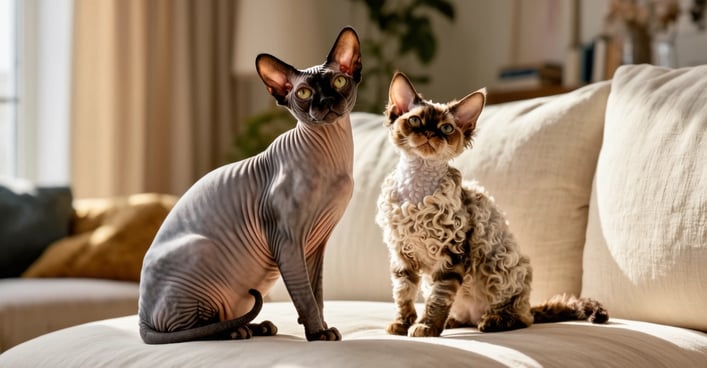
Sphynx vs Devon Rex Cat: A Complete 2026 Comparison Guide
Discover the key differences between the hairless Sphynx and the wavy-coated Devon Rex. Learn which unique, affectionate breed best fits your lifestyle and care commitment.
Share this page
Sphynx vs Devon Rex Cat: A Complete 2026 Comparison Guide
By Dr. Michael Torres, DVM | Updated: 2026 | Reading Time: 14 minutes
Introduction
The Sphynx and Devon Rex are two of the most distinctive and charismatic cat breeds, celebrated for their unconventional looks and magnetic personalities. While both are exceptionally people-oriented and playful, they present vastly different care requirements, health profiles, and physical traits.
This definitive guide provides a detailed, side-by-side comparison to help prospective owners understand the unique joys and responsibilities of each breed, empowering you to make the perfect choice for your home.
Development: Selective breeding programs from the 1970s onward
Recognition: Major cat associations in the 1980s-1990s
Development Story:
The Sphynx breed originated from a spontaneous genetic mutation in Toronto, resulting in a hairless kitten named Prune. Breeders carefully developed the line by outcrossing with normal-coated cats and selectively breeding for the hairless trait. The breed's name is a nod to the ancient Egyptian sphinx, reflecting its striking and statuesque appearance.
Initial Challenges:
Early breeding faced ethical and health-related controversy, but dedicated, responsible breeding programs have since established healthier, more robust bloodlines.
Devon Rex Origins
English Discovery:
Origin: Devon, England (1960)
Foundation Cat: Kirlee, a curly-coated barn kitten
Development: Breed established throughout the 1960s
Recognition: Gained recognition in the 1960s-1970s
Discovery Story:
In Buckfastleigh, Devon, a woman discovered a uniquely curly-coated kitten in a litter of barn cats. Named Kirlee, this kitten became the progenitor of the Devon Rex breed. Initially thought to be related to the Cornish Rex, genetic testing later confirmed the Devon Rex carries a distinct, separate rex mutation.
Physical Characteristics Comparison
Coat Characteristics
Sphynx Coat:
Coverage: Appears hairless; may have a fine peach-fuzz down.
Texture: Often compared to warm chamois or suede leather.
Pattern/Color: All patterns and colors are visible through the skin pigmentation.
Grooming:Weekly bathing is essential to remove oily buildup.
Consideration: Skin produces oils that would be absorbed by fur.
Devon Rex Coat:
Length: Very short, soft, and wavy.
Texture: Described as rippled, crushed velvet, or curly.
Coverage: Full body, though it can be sparse on the chest and belly.
Grooming: Minimal; occasional bathing may be needed if skin becomes oily.
Genetic Trait: Caused by a specific "rex" mutation affecting hair structure.
Size and Build
Feature
Sphynx
Devon Rex
Key Difference
Male Weight
8-12 lbs (3.6-5.4 kg)
6-9 lbs (2.7-4 kg)
Sphynx is notably larger
Female Weight
6-9 lbs (2.7-4 kg)
5-7 lbs (2.2-3.2 kg)
Sphynx is notably larger
Body Type
Medium, muscular, and barrel-chested
Slender, athletic, and whippet-like
Sphynx is stockier; Devon is lithe
Bone Structure
Medium
Fine and delicate
Devon Rex has a more fragile appearance
Overall Build
Substantial and solid
Pixie-like and graceful
Distinctly different body conformations
Head and Facial Features
Sphynx:
Modified wedge-shaped head.
Prominent cheekbones and a strong chin.
Large, lemon-shaped eyes.
Very large, wide-set ears.
Characteristic wrinkled skin, especially in kittens.
Whiskers are sparse, brittle, or entirely absent.
Devon Rex:
Short, modified wedge head with a pronounced "break" at the whisker pads.
High cheekbones creating an "elfin" or "pixie" look.
Large, oval-shaped eyes.
Exceptionally large, low-set ears.
Short, curly, often broken whiskers.
Distinctive Features
Sphynx Unique Traits:
Completely hairless appearance.
Warm, soft skin to the touch.
Visible skin wrinkles and patterns.
Often has a noticeable "pot belly."
Devon Rex Unique Traits:
Unmistakable "pixie" face with large eyes and ears.
A soft, wavy coat.
A slender, athletic body reminiscent of a whippet.
An expressive, mischievous demeanor.
Temperament Comparison
Personality Traits at a Glance
Trait
Sphynx
Devon Rex
Activity Level
High
Very High / Energetic
Playfulness
High, clownish
Extremely High, acrobatic
Intelligence
High, curious
Very High, inventive
Affection Level
Extremely High, "Velcro" cats
Extremely High, social butterflies
Vocalization
Moderate, communicative
Moderate to High, conversational
Social Needs
Very High, hates solitude
Very High, thrives on interaction
Shared Characteristics
People-Oriented Nature:
Both breeds form intense bonds with their owners.
They are known as "shadow" or "Velcro" cats, following you from room to room.
They demand attention and participation in household activities.
Not suitable for owners who are away from home for long periods.
Playful & Intelligent:
Both retain a kitten-like playfulness well into adulthood.
Highly intelligent and benefit from puzzle toys and interactive games.
Can be trained to perform tricks and walk on a harness.
Their mischievous nature requires mental stimulation to prevent boredom.
Behavioral Differences
Sphynx:
Often described as clownish, seeking to entertain.
Pronounced heat-seeking behavior; will find sunny spots or snuggle under blankets.
Can be slightly more relaxed and cuddly than the Devon Rex.
Known for being bed-hoggers who love to sleep with their owners.
Devon Rex:
Incredibly athletic, agile, and often described as a "monkey in a cat suit."
Exhibits higher, more constant energy levels.
Tends to be more mischievous and may get into cabinets or high places.
Often more vocal and conversational with a variety of chirps and trills.
Health Comparison
Sphynx Health Concerns
Common Issues:
Hypertrophic Cardiomyopathy (HCM): A form of heart disease; regular screening is crucial.
Skin Conditions: Prone to yeast/bacterial infections, sunburn, and feline acne.
Temperature Sensitivity: Cannot regulate body heat effectively; risk of hypothermia and heatstroke.
Ear Infections: Lack of ear hair leads to wax buildup.
Typical Lifespan: 8-14 years
Devon Rex Health Concerns
Common Issues:
Hypertrophic Cardiomyopathy (HCM): Also a significant concern; regular screening advised.
Patellar Luxation: Kneecap dislocation, a common orthopedic issue.
Hereditary Myopathy: A genetic muscle weakness disorder; a DNA test is available.
Skin Issues: Susceptible to Malassezia (yeast) dermatitis due to oily skin.
Dental Issues: Can be prone to early gingivitis and tooth loss.
Typical Lifespan: 9-15 years
Recommended Health Testing
Test
Sphynx Priority
Devon Rex Priority
HCM Ultrasound Screening
Essential
Essential
HCM DNA Test
Recommended
Recommended
Patella Evaluation
Not typically needed
Recommended
Myopathy DNA Test
Not applicable
Essential
Regular Dermatological Exams
Essential
Recommended
Frequent Dental Check-ups
Essential
Essential
Care Requirements Comparison
Grooming Regimen
Critical Difference in Maintenance:
Aspect
Sphynx
Devon Rex
Bathing
Weekly with cat-safe shampoo
Monthly or as needed (when coat feels oily)
Ear Cleaning
Weekly to remove wax buildup
Monthly, or as needed
Nail Care
Weekly cleaning of nail beds (oil accumulates)
Regular trimming as needed
Skin Care
May require moisturizing; sunblock if exposed
Generally low-maintenance
Sun Protection
Essential – indoor-only cats
Recommended; can sunburn but less vulnerable
Sphynx-Specific Notes:
The weekly bath is non-negotiable to prevent oily residue on skin, furniture, and bedding. Many owners find their Sphynx enjoys wearing sweaters for warmth and to protect their skin.
Temperature & Environment
Sphynx:
Must be indoor-only cats.
Ideal ambient temperature is 70-80°F (21-27°C).
Will actively seek heat sources (radiators, sun patches, laps).
May require cat-safe heating pads or clothing in cooler climates.
Devon Rex:
Strongly recommended as indoor-only for safety.
More tolerant of normal household temperature fluctuations.
Still appreciates warmth and cozy spots but is less vulnerable than the Sphynx.
Exercise & Enrichment
Both Breeds Require:
Daily, dedicated play sessions (at least 30-60 minutes).
Interactive toys like wand teasers, puzzle feeders, and laser pointers.
Ample vertical space: cat trees, shelves, and perches.
Companionship—consider a feline friend if you work long hours.
Energy Nuances:
Sphynx: Energetic and playful but may have bursts followed by cozy naps.
Devon Rex: Seemingly boundless, acrobatic energy; needs more constant stimulation and space to run and climb.
Cost Comparison
Initial Acquisition Cost
Source
Sphynx
Devon Rex
Reputable Breeder (Pet Quality)
$1,800 - $3,500
$1,000 - $2,000
Reputable Breeder (Show Quality)
$3,500 - $6,000+
$2,000 - $3,500
Rescue/Shelter
Very Rare
Rare
Note: Sphynx cats are typically more expensive due to specialized breeding and higher care demands for queens and kittens.
Estimated Annual Care Costs
Expense Category
Sphynx (Estimated)
Devon Rex (Estimated)
High-Quality Food
$600 - $900
$500 - $700
Routine Veterinary Care
$600 - $1,200
$500 - $900
Grooming Supplies
$200 - $400
$100 - $200
Heating/Clothing
$100 - $300
$0 - $50
Toys & Enrichment
$150 - $300
$200 - $400
Pet Insurance
$300 - $600
$250 - $500
Total Annual Range
$1,950 - $3,700
$1,550 - $2,750
Living Environment Suitability
Ideal Home for a Sphynx
Essential Requirements:
A consistently warm, draft-free, indoor-only environment.
An owner committed to a strict weekly grooming routine.
Someone home frequently, or a feline companion to prevent loneliness.
A household that doesn't mind a cat that may leave oily marks on light fabrics.
Thrives In:
Active families or individuals who want a constant companion.
Multi-pet households (with proper introductions).
Homes where the cat can be involved in daily activities.
Ideal Home for a Devon Rex
Essential Requirements:
An active owner committed to multiple daily play sessions.
A home with ample vertical and horizontal space for climbing and running.
Plenty of interactive toys and puzzles to challenge their intelligence.
An owner who enjoys a highly involved, "in-your-lap" type of cat.
Challenging Situations:
Sedentary households or owners with very long work hours.
Homes with valuable, fragile items on shelves (they will climb everywhere).
Environments without dedicated time for engagement and play.
Breed-Specific Considerations
Sphynx Considerations
High-Maintenance Reality:
The weekly bath is a significant, non-negotiable time commitment.
Their high metabolism often requires more food.
You must be vigilant about skin health, ear cleaning, and dental care.
Not ideal for neat freaks or those with severe allergies (they still produce dander).
Emotional Needs:
Prone to separation anxiety; they are not independent cats.
They will demand to be the center of your attention.
Devon Rex Considerations
Energy Management is Key:
Their boundless energy can be exhausting; they need an outlet.
Without sufficient stimulation, they may become destructive or mischievous.
They often do best with another playful pet as a companion.
Grooming Paradox:
While their coat is low-shedding and easy, their skin can be prone to oiliness and yeast issues, sometimes requiring medicated baths or dietary adjustments.
Which Breed Is Right for You?
Choose a Sphynx If You:
Can faithfully commit to a weekly bathing and grooming routine.
Can maintain a warm home environment year-round.
Desire an extremely affectionate, lap-loving "Velcro" companion.
Don't mind higher maintenance and associated costs.
Are captivated by their unique, hairless appearance and warm touch.
Are prepared for potential health monitoring, especially for HCM.
Choose a Devon Rex If You:
Want a highly active, entertaining, and acrobatic companion.
Can provide multiple daily play sessions and constant mental stimulation.
Love their unique "elfin" appearance and soft, wavy coat.
Want a highly affectionate cat with less intensive grooming than a Sphynx.
Enjoy a talkative, mischievous cat with a big personality.
Have a home with plenty of space for climbing and exploration.
Conclusion
Both the Sphynx and Devon Rex offer unparalleled companionship, immense affection, and endless entertainment. Your decision hinges on your lifestyle and the type of care commitment you can provide.
The Sphynx demands more hands-on grooming and environmental management but offers a uniquely cuddly and warm presence. The Devon Rex requires less routine grooming but more active engagement to channel its boundless energy.
Whichever breed you choose, you will be welcoming an intelligent, social, and deeply loving member into your family. Both will reward your dedication with a lifetime of loyalty, laughter, and unforgettable moments.
Related Articles:
Sphynx Cat Care: The Complete Guide for 2026
Devon Rex Care: Meeting the Needs of Your Elfin Companion
Hairless Cat Care: Special Considerations for Sphynx and Other Breeds
Best Cat Breeds for Active Households: A 2026 Guide
Get expert advice about cat care, behavior, nutrition, grooming, and training. Ask our AI cat care expert anything about your cat and receive professional guidance.