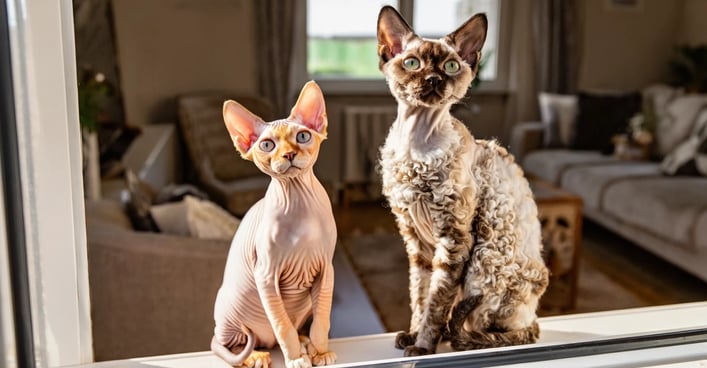
Sphynx vs Devon Rex Cat: The Ultimate 2026 Breed Comparison Guide
Deciding between a Sphynx and a Devon Rex? Our complete guide compares their personalities, care needs, health, and costs to help you choose your perfect feline companion.
Share this page
Sphynx vs Devon Rex Cat: The Ultimate 2026 Breed Comparison Guide
Sphynx and Devon Rex cats are two of the most distinctive and captivating domestic cat breeds. They appeal to owners seeking a feline companion that stands out from the crowd—whether it's the hairless, elegant Sphynx or the pixie-like, wavy-coated Devon Rex. This comprehensive guide explores their similarities and key differences to help you decide which extraordinary breed best suits your lifestyle.
Historical Origins
Sphynx Origins
Accidental Discovery:
Origin: Toronto, Canada (1966)
Foundation: A natural genetic mutation
Development: A dedicated breeding program to establish the breed
Recognition: Gained recognition throughout the 1970s and 1980s
Development Story:
The Sphynx breed began with a naturally hairless kitten named Prune, born to a domestic shorthair in Toronto. Breeders carefully crossed hairless cats with breeds like the Devon Rex to ensure genetic diversity and health. The result is a robust, affectionate breed celebrated for its wrinkled skin and warm personality.
Sphynx vs Devon Rex Cat: The Ultimate 2026 Breed Comparison Guide - Articles
Devon Rex Origins
The English Pixie:
Origin: Devon, England (1960)
Foundation: A natural mutation in a feral cat
Recognition: Officially recognized from 1967 onward
Development Story:
The Devon Rex originated from a curly-coated kitten named Kirlee, discovered in a litter of feral cats. Unlike the similar-looking Cornish Rex, the Devon Rex gene is recessive, producing a uniquely soft, wavy coat. The breed was developed through strategic outcrossing to maintain genetic health and its characteristic "elfin" charm.
Physical Characteristics Comparison
Coat: The Most Obvious Difference
Sphynx Coat:
Coverage: Hairless or covered in a fine peach fuzz
Texture: Warm, soft skin often compared to a suede or peach
Wrinkles: Prominent, especially on the head, neck, and body
Shedding: Minimal to none
Colors: All colors and patterns are visible in the skin pigmentation
Feel: Warm to the touch due to lack of insulating fur
Devon Rex Coat:
Coverage: Short, wavy fur over the entire body
Texture: Exceptionally soft with defined ripples or waves
Density: A thin undercoat; guard hairs are often missing
Shedding: Minimal
Colors: All colors and patterns are possible
Feel: A unique, plush velvety texture
Grooming Comparison:
Aspect
Sphynx
Devon Rex
Brushing
Not needed
Weekly with a soft brush
Bathing
Weekly (essential)
Rarely needed
Skin Care
Weekly cleansing
Minimal
Ear Cleaning
Weekly
Weekly
Nail Cleaning
Weekly (during bath)
As needed
Body Type
Sphynx Build:
Medium-sized, muscular, and athletic
Barrel-shaped chest and a firm, medium-boned structure
A rounded "pot belly" is normal and not a sign of obesity
Adult Weight: 6-12 pounds
Devon Rex Build:
Small to medium-sized with a fine-boned, slender frame
Broad chest, long slender legs, and characteristically high hindquarters
Adult Weight: 5-10 pounds
Size Comparison:
Feature
Sphynx
Devon Rex
Body Type
Muscular and substantial
Delicate and fine-boned
Weight Range
6-12 lbs
5-10 lbs
Bone Structure
Medium, sturdy
Fine, light
Overall Feel
Warm, surprisingly heavy for size
Light and delicate
Head and Facial Features
Sphynx:
Modified wedge-shaped head
Prominent cheekbones and large, lemon-shaped eyes
Any eye color is acceptable
Large, wide-set ears and wrinkled skin on the head
Devon Rex:
Short, broad wedge-shaped head
High cheekbones and large, oval eyes
Any eye color is acceptable
Very large, low-set ears and a short muzzle with a strong chin
Famous for its "pixie" or "elfin" expression
Distinctive Features:
Feature
Sphynx
Devon Rex
Ears
Large and wide-set
Enormous and low-set
Whiskers
Often sparse or absent
Often crinkled or short
Expression
Sweet, open, and inquisitive
Mischievous, intelligent, and elfin
Skin/Coat
Wrinkled and warm to the touch
Wavy and velvety soft
Temperament Comparison
Personality Overview
Trait
Sphynx
Devon Rex
Activity Level
High
Very High
Affection
Very High
High
Clownish Behavior
Moderate
Very High
Intelligence
High
Very High
Social Needs
Very High
High
Vocalization
Moderate
Moderate
Playfulness
High
Very High
Sphynx Personality: The "Velcro" Cat
Heat-seeking: Constantly seeks warm spots and human laps.
Extremely Affectionate: Deeply people-oriented and forms strong bonds.
Social Butterfly: Thrives on companionship; dislikes being alone.
Intelligent & Playful: Shows problem-solving abilities and enjoys interactive games.
Behavioral Traits: Known to follow owners everywhere, greet them at the door, and "help" with tasks. They are generally excellent with children and other pets.
Devon Rex Personality: The "Pixie Clown"
Perpetually Playful: Retains a kitten-like energy and curiosity throughout its life.
Athletic Acrobat: An excellent jumper and climber who loves high places.
Clever & Mischievous: Highly intelligent, known for learning tricks, opening doors, and even stealing food.
Affectionate but Independent: Enjoys human company but is often more self-sufficient than the Sphynx.
Behavioral Traits: Highly entertaining, loves puzzle toys, and can amuse themselves but still craves interaction.
Care Requirements Comparison
Sphynx-Specific Care
Weekly Bathing:
Why: Their skin produces oils that aren't absorbed by fur.
How: Use warm water and a gentle, hypoallergenic cat shampoo.
Tip: Start bathing routines when they are kittens to create a positive experience.
Weekly Ear & Nail Cleaning:
Ears: Lack of ear hair leads to wax buildup; clean weekly with a vet-approved solution.
Nails: Oils accumulate around the nail beds; clean during the weekly bath.
Temperature Management:
Essential: Must be indoor-only cats.
Needs: Heated beds, sweaters in cooler months, and a home temperature of at least 70°F (21°C).
Caution: They are prone to sunburn and must be protected from direct sunlight.
Devon Rex-Specific Care
Coat Care:
Brushing: A gentle weekly brushing with a soft brush is sufficient.
Bathing: Rarely required; over-bathing can dry out their skin.
General Maintenance:
Lower maintenance than the Sphynx.
Requires standard ear cleaning and nail trimming.
Needs mental stimulation via puzzle toys and secure food storage (they are clever thieves!).
Environmental Needs for Both Breeds
Both Breeds Require:
A strictly indoor lifestyle for safety.
A warm, comfortable home environment.
Plenty of interactive playtime and mental stimulation.
Consistent companionship; they are not suited for absentee owners.
Breed-Specific Needs:
Sphynx
Devon Rex
Higher ambient temperature
Tall cat trees and vertical space
Multiple heated beds
Interactive puzzle toys
Sunscreen for outdoor exposure (if on a harness)
Secure cabinets for food
Health Comparison
Sphynx Health Concerns
Common Issues:
Hypertrophic Cardiomyopathy (HCM): A form of heart disease. Annual screening is recommended.
Skin Conditions: Prone to sunburn, acne, and fungal infections without proper care.
Temperature Regulation: Cannot tolerate cold environments.
Dental Disease: May have a higher incidence; regular dental care is crucial.
Average Lifespan: 12-16 years
Devon Rex Health Concerns
Common Issues:
Patellar Luxation: A condition where the kneecap dislocates.
Hereditary Myopathy (Spasticity): A genetic muscle disorder. DNA testing is available.
Skin & Coat Issues: Can develop a greasy coat if not groomed regularly.
Ear Infections: Their large ears can be prone to buildup and infection.
Average Lifespan: 10-15 years
Estimated Annual Veterinary Costs
Expense
Sphynx
Devon Rex
Annual Checkups
$200 - $400
$200 - $400
Cardiac Screening (HCM)
$300 - $500
Not typically routine
Genetic/DNA Testing
$100 - $200
$100 - $200 (for Myopathy)
Skin Care Products
$200 - $400/year
Minimal
Estimated Annual Total
$500 - $1,100+
$300 - $600+
Living Environment Suitability
Ideal Home for a Sphynx
Warm climates or homes with consistent heating.
Owners who are home frequently or can provide a feline companion.
Individuals seeking an extremely affectionate, "shadow" cat.
Owners willing and able to commit to a weekly grooming routine.
Ideal Home for a Devon Rex
Active households that enjoy interactive play.
Homes with ample vertical space (cat trees, shelves).
Owners who appreciate a clever, entertaining, and mischievous personality.
Those wanting a unique-looking cat with lower grooming needs than a Sphynx.
Cost of Ownership Comparison
Initial Acquisition Cost (2026)
Source
Sphynx
Devon Rex
Pet Quality
$1,500 - $3,500
$1,000 - $2,500
Show Quality
$3,000 - $6,000+
$2,000 - $4,000
Adoption
Very Rare
Rare
Estimated Annual Care Costs
Expense
Sphynx
Devon Rex
High-Quality Food
$600 - $900
$500 - $800
Litter
$150 - $250
$150 - $250
Veterinary Care
$500 - $1,100
$300 - $600
Grooming Supplies
$200 - $400
$50 - $100
Extra Heating/Clothing
$100 - $300
Minimal
Total Annual Estimate
$1,600 - $3,100
$1,000 - $1,800
Which Breed Is Right for You?
Choose a Sphynx If You:
Desire an extremely affectionate, "Velcro" companion.
Don't mind a weekly bathing and grooming commitment.
Can provide a consistently warm indoor environment.
Are home often and want a shadow-like companion.
Appreciate a unique, exotic appearance and warm cuddles.
Choose a Devon Rex If You:
Want a highly active, playful, and entertaining clown.
Have space for cat trees and high perches.
Enjoy a clever, sometimes mischievous personality.
Want a distinctive look without the high-maintenance grooming of a hairless cat.
Can provide plenty of mental stimulation and interactive play.
Both Breeds Are a Great Fit If You:
Are committed to an indoor-only lifestyle.
Can provide a loving home for 10-16 years.
Value intelligence, interaction, and a unique feline friend.
Have time for daily play and companionship.
Conclusion
Choosing between a Sphynx and a Devon Rex is a decision between two uniquely wonderful companions. The Sphynx offers unparalleled warmth and affection but requires a significant grooming commitment. The Devon Rex provides endless entertainment and pixie-like charm with relatively lower maintenance.
Both breeds demand dedicated owners who can meet their specific needs for warmth, interaction, and indoor safety. Your final choice will likely hinge on your tolerance for grooming (higher for Sphynx) and your preference for activity level (higher for Devon Rex). Whichever you choose, you'll be welcoming an intelligent, loving, and truly extraordinary cat into your life.
Related Articles:
The Complete Guide to Sphynx Cat Care in 2026
Devon Rex Cats: Personality, Care, and Health Guide
A Beginner's Guide to Hairless Cat Care
Top 10 Most Unique Cat Breeds for Adventurous Owners
Get expert advice about cat care, behavior, nutrition, grooming, and training. Ask our AI cat care expert anything about your cat and receive professional guidance.