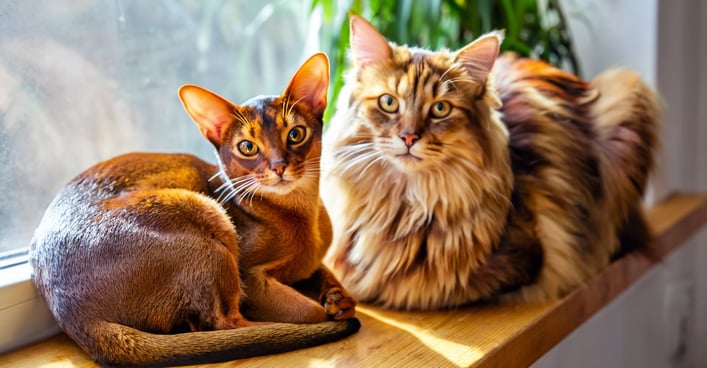
Somali vs Abyssinian: The Complete 2026 Breed Comparison Guide
Discover the key differences between the sleek Abyssinian and the long-haired Somali. Compare personality, grooming needs, costs, and find your perfect ticked-tabby companion.
Share this page
Somali vs Abyssinian: The Complete 2026 Breed Comparison Guide
Two stunning breeds share the captivating ticked tabby coat but offer distinct experiences: the short-coated, energetic Abyssinian and the long-haired, affectionate Somali. While they descend from the same genetic lineage, centuries of development have shaped them into unique companions. This definitive guide breaks down their origins, personalities, care needs, and costs to help you make the perfect choice for your home.
Origins and History
Abyssinian Origins
The Abyssinian is one of the oldest known cat breeds, though its true origins are a historical puzzle. Contrary to its name suggesting Ethiopian roots, modern genetic research points to a Southeast Asian or coastal Indian Ocean ancestry.
Key Historical Facts:
First exhibited at London's Crystal Palace in 1871.
Named after Abyssinia (modern-day Ethiopia).
"Zula" is the first documented Abyssinian cat.
Genetically linked to cats found in Singapore and coastal regions.
Prized for its natural, wild-looking ticked tabby pattern.
Somali Origins
The Somali is essentially the long-haired expression of the Abyssinian, resulting from a recessive gene carried within Abyssinian bloodlines for generations.
Long-haired kittens appeared sporadically in Abyssinian litters for decades.
Initially dismissed as undesirable by breeders.
1960s-1970s: Dedicated breeders began developing the Somali as a separate breed.
Named after Somalia, reflecting its geographical link to Abyssinia (Ethiopia).
1979: Granted championship status by the Cat Fanciers' Association (CFA).
Genetic Relationship:
Somalis can produce short-haired Abyssinian offspring.
Abyssinians can be carriers of the long-hair gene.
Breeding two carriers yields Somali kittens.
They share the same foundational stock but express different coat lengths.
Physical Appearance Comparison
Size and Build
Feature
Abyssinian
Somali
Weight (Male)
8-12 pounds
8-12 pounds
Weight (Female)
6-9 pounds
6-9 pounds
Body Type
Lithe, muscular, athletic
Lithe, muscular, athletic
Bone Structure
Fine but remarkably strong
Fine but remarkably strong
Overall Build
Balanced, graceful, and agile
Balanced, graceful, and agile
Coat Characteristics: The Defining Difference
Aspect
Abyssinian
Somali
Length
Short to medium
Medium to long
Texture
Soft, silky, and close-lying
Exceptionally soft, silky, and fine
Undercoat
Minimal
Moderate
Fullness
Sleek and elegant
Full, flowing, and luxurious
Maintenance Level
Low
Moderate to High
The Ticked Tabby Pattern (Shared Trait):
Each hair is banded (ticked) with multiple colors.
Creates a warm, "agouti" or wild appearance.
No distinct stripes, spots, or markings on the body.
Color is typically darker along the spine ("spinal line").
The coat has a characteristic warm, glowing radiance.
Accepted Colors (Both Breeds):
Ruddy (Usual): Warm brown or burnt sienna ticking.
Sorrel (Cinnamon): Rich chocolate or copper ticking.
Blue: Soft blue-gray ticking over a warm beige base.
Fawn: Delicate warm rose-beige ticking.
Head, Face, and Tail
Shared Facial Features:
Modified wedge-shaped head.
Large, alert, and expressive ears.
Almond-shaped eyes in shades of gold, green, or hazel.
Faint "M" marking on the forehead.
An alert, intelligent, and curious expression.
Somali Distinctions:
Fuller ruff around the neck.
Lynx-like feathering on the ears.
Distinct "breeches" (long fur) on the hind legs.
A magnificent, full, and plumed "fox-like" tail.
Tail Feature
Abyssinian
Somali
Length
Medium to long
Long and flowing
Appearance
Tapered, fairly slender
Full, bushy, and plumed
Fur
Short hair
Long, luxurious hair
Carriage
Usually carried level or down
Often carried high and proudly
Personality and Temperament
Shared Core Traits
Both breeds are celebrated for their:
High Energy & Athleticism: Agile climbers who love heights.
Intelligence & Curiosity: Problem-solvers who explore everything.
Lifelong Playfulness: Remain kitten-like well into adulthood.
Social Nature: Bond strongly with their human families.
Vocalizations: Communicate with soft chirps, trills, and meows.
Affectionate Demeanor: Enjoy companionship but are not typically "velcro" lap cats.
Breed-Specific Personalities
The Abyssinian Personality:
More Independent: Confident and self-assured.
Intensely Curious: The quintessential "busybody" of the cat world.
Frenetic Energy: Constantly in motion, with lightning-fast reflexes.
Moderately Demanding: Seeks interaction but on their own terms.
Reserved with Strangers: Can be initially aloof with new people.
The Somali Personality:
More People-Oriented: Seeks out human interaction and companionship.
Slightly More Relaxed: Energetic but with a gentler pace than the Aby.
Overtly Affectionate: More likely to enjoy cuddles and lap time.
Gentle Demeanor: Often described as having a "softer" personality.
Social with Guests: Typically more welcoming to visitors.
Temperament Comparison at a Glance
Trait
Abyssinian
Somali
Energy Level
Very High
High
Independence
Moderate-High
Low-Moderate
Affection Level
Moderate
High
Playfulness
Very High
High
Sociability with Family
High
Very High
Lap Cat Tendency
Low
Moderate-High
Vocalization
Low-Moderate (chirps)
Moderate (soft meows)
Grooming and Care Requirements
Abyssinian Grooming (Low Maintenance)
Brushing: Once a week is sufficient.
Shedding: Minimal year-round shedding.
Bathing: Rarely required; they are fastidious self-cleaners.
Nail Trimming: Every 2-3 weeks.
Ear Cleaning: Check and clean monthly.
Matting: Extremely rare due to short coat.
Estimated Monthly Time Investment: ~1 hour
Somali Grooming (Moderate Maintenance)
Brushing: 2-3 times per week to prevent tangles.
Shedding: Moderate, with increased seasonal shedding (spring/fall).
Bathing: Occasionally beneficial (every 2-3 months) to maintain coat health.
Nail Trimming: Every 2-3 weeks.
Ear Cleaning: Check and clean monthly.
Matting: Pay special attention to the ruff, "breeches," and tail.
Estimated Monthly Time Investment: ~2-3 hours
Grooming Task Comparison
Task
Abyssinian
Somali
Weekly Brushing
10-15 minutes
30-45 minutes
Seasonal Shedding Management
Minimal effort
Requires consistent brushing
Bathing Frequency
Rare (only if dirty)
Every 2-3 months for coat health
Mat Prevention
Not a concern
Requires regular attention
Health and Lifespan
Abyssinian Health Profile
Average Lifespan: 12-15 years
Common Health Considerations:
Pyruvate Kinase Deficiency (PKD): A genetic anemia.
Progressive Retinal Atrophy (PRA): A genetic eye disorder.
Renal Amyloidosis: A kidney disease.
Patellar Luxation: Slipping kneecap.
Gingivitis/Tooth Resorption: Dental issues are common.
Somali Health Profile
Average Lifespan: 11-16 years
Common Health Considerations:
Shares the same genetic predispositions as the Abyssinian (PKD, PRA).
Similar risks for dental issues.
Responsible breeders test for these genetic conditions.
Estimated Annual Healthcare Costs*
*Costs are similar due to shared health profiles.
Expense
Abyssinian
Somali
Annual Wellness Exam
$150 - $300
$150 - $300
Core Vaccinations
$80 - $150
$80 - $150
Recommended Genetic Testing
$150 - $250
$150 - $250
Monthly Pet Insurance
$30 - $50
$30 - $50
Estimated Annual Total
$770 - $1,450
$770 - $1,450
Cost of Ownership
Initial Purchase Price (2026 Estimates)
Source
Abyssinian
Somali
Pet Quality
$800 - $1,500
$1,000 - $1,800
Show/Breeder Quality
$1,500 - $2,500
$1,800 - $3,000
Adoption/Rescue
$100 - $300
$100 - $400
Note: Somalis are generally more expensive due to their relative rarity and more demanding coat genetics.
Estimated Monthly Ongoing Costs
Category
Abyssinian
Somali
High-Quality Food
$35 - $60
$35 - $60
Premium Litter
$15 - $25
$15 - $25
Grooming Supplies
$5 - $10
$10 - $15
Pet Insurance
$30 - $50
$30 - $50
Toys & Enrichment
$25 - $45
$25 - $45
Monthly Total
$110 - $190
$115 - $195
Living Environment & Lifestyle Fit
The Ideal Home for an Abyssinian
Space: Requires ample room to run, jump, and explore.
Vertical Space: Non-negotiable. Cat trees, shelves, and high perches are essential.
Attention: Enjoys interaction but is content with independent play.
Companionship: Often thrives with another active cat companion.
Household Activity: Best suited for active individuals or families.
Owner Experience: Ideal for experienced cat owners who understand high-energy breeds.
Children/Pets: Usually good with respectful children and other pets after proper introductions.
The Ideal Home for a Somali
Space: Needs room to play but can be slightly more adaptable than the Aby.
Vertical Space: Important, but their need is slightly less intense.
Attention: Has higher social needs; dislikes being left alone for long periods.
Companionship: A very social cat that craves interaction—human or feline.
Household Activity: Suits active homes but apprecives calm moments too.
Owner Experience: Excellent for dedicated cat lovers willing to provide grooming and companionship.
Children/Pets: Often more patient and gentle with children; good with other pets.
Exercise and Play Needs
Abyssinian Exercise Regimen
Daily Playtime: Minimum 30-45 minutes of vigorous, interactive play.
Activity Type: Loves chasing, jumping, and acrobatic feats.
Mental Stimulation:Essential. Puzzle feeders, training, and rotating toys are a must to prevent boredom.
Play Style: Enjoys a mix of independent and interactive play.
Somali Exercise Regimen
Daily Playtime: 20-30 minutes of engaged play.
Activity Type: Playful and energetic but less intensely frenetic than the Aby.
Mental Stimulation: Important, but their need for social interaction is equally critical.
Play Style: Prefers interactive play with their favorite human.
Pros and Cons Summary
Abyssinian: Pros & Cons
Advantages (✅)
Exceptionally low grooming needs.
Incredibly entertaining, playful, and intelligent.
Beautiful, sleek, wild appearance.
Highly athletic and agile.
Forms strong, loyal bonds with family.
Challenges (❌)
Very high energy demands can be overwhelming.
Prone to boredom, which may lead to mischief.
Can be too independent for owners seeking a cuddly lap cat.
Requires constant mental and physical stimulation.
Shares genetic health concerns that require screening.
Somali: Pros & Cons
Advantages (✅)
Breathtakingly beautiful, long, and flowing coat.
More overtly affectionate and people-oriented.
Playful but with a slightly calmer energy than the Aby.
Magnificent fox-like tail and elegant presence.
Often more adaptable to family life and children.
Challenges (❌)
Requires a significant, regular grooming commitment.
Still a high-energy cat, not a couch potato.
Shares the same genetic health concerns as the Abyssinian.
Generally higher initial purchase price.
Can be demanding of attention and dislike solitude.
Final Decision Guide: Which Cat is Right for You?
Choose an Abyssinian If You Want:
A low-maintenance coat.
An independent, curious, and entertaining companion.
A cat with a wild, exotic look in a sleek package.
To provide a home full of cat trees and climbing shelves.
An extremely active, "always-on-the-go" feline.
An experienced owner who enjoys interactive play.
Choose a Somali If You Want:
A stunning, long-haired cat with a luxurious coat.
A more affectionate and clingy companion.
A playful cat with a slightly gentler, more relaxed energy.
A breed that is more likely to enjoy lap time and cuddles.
To commit to a regular grooming routine.
A beautiful, fox-like appearance with a plumed tail.
Conclusion
The Abyssinian and Somali are two sides of a magnificent coin. They share a deep genetic heritage, intelligence, and captivating ticked coats but cater to different lifestyles.
The Abyssinian is for those who admire wild elegance with minimal grooming and possess the energy to match their cat's boundless vitality.
The Somali is for those who desire flowing beauty paired with a more affectionate, people-oriented personality and are willing to invest in regular grooming.
Your choice ultimately hinges on your grooming tolerance, desired activity level, and the type of bond you seek. Both breeds will fill your home with breathtaking beauty, clever antics, and devoted companionship for years to come. The question is: will you be captivated by the sleek athlete or the affectionate fox?
Get expert advice about cat care, behavior, nutrition, grooming, and training. Ask our AI cat care expert anything about your cat and receive professional guidance.