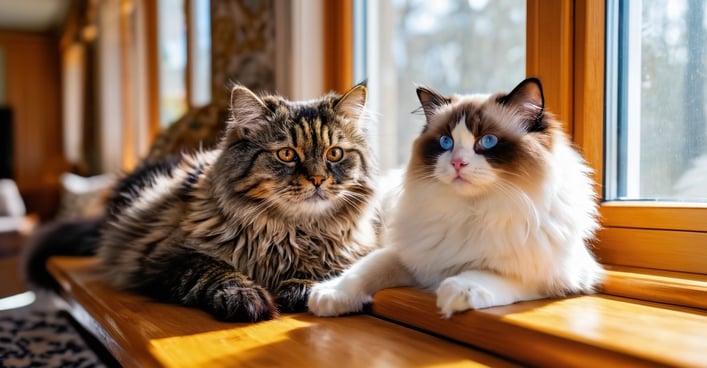
Siberian vs Ragdoll: The 2026 Breed Comparison Guide
Deciding between a Siberian and a Ragdoll? Our complete guide compares temperament, grooming, health, and costs to help you choose the perfect long-haired companion for your lifestyle.
Share this page
Siberian vs Ragdoll: The 2026 Breed Comparison Guide
Choosing between two magnificent long-haired breeds like the Siberian and Ragdoll is a delightful dilemma. Both offer stunning beauty, affectionate natures, and make wonderful family companions. However, their distinct differences in temperament, care requirements, and health are crucial for prospective owners to understand before welcoming one into their home.
Breed Overview
Siberian Cats
Origin and History
The Siberian cat is Russia's national treasure and one of the oldest natural breeds, with a history spanning at least 1,000 years. These cats evolved naturally in Siberia's harsh climate, developing a dense, water-resistant triple coat and a hardy constitution. First appearing in Russian literature in the 13th century, they were prized as skilled rodent hunters in homes, shops, and monasteries.
Siberians remained largely unknown outside Russia until the 1980s, when they began appearing in international cat shows. Major cat associations recognized the breed in the 1990s, and its popularity has grown steadily worldwide.
Coat: Medium to long, triple-layered, water-resistant
Colors: All colors and patterns except pointed colors (in traditional lines)
Eyes: Green, gold, copper, or odd-eyed; blue in colorpoint varieties
Lifespan: 11-18 years
Ragdoll Cats
Origin and History
The Ragdoll is a relatively modern breed developed in the 1960s by Ann Baker in Riverside, California. The foundation cat, Josephine, was a white long-haired domestic with a notably gentle temperament. Baker selectively bred for specific traits: large size, a semi-long coat, pointed coloration, and the breed's signature relaxed nature.
The breed's name derives from their tendency to go completely limp when picked up. Early development was controversial due to Baker's unusual claims, but Ragdolls gained formal recognition in the 1970s and have since become one of the world's most popular cat breeds.
Coat: Semi-long, silky, with a rabbit-like texture
Colors: Colorpoint, mitted, or bicolor patterns in seal, blue, chocolate, lilac, red, or cream
Eyes: Always a vivid blue
Lifespan: 12-17 years
Temperament and Personality Comparison
Siberian Personality
Playful and Energetic
Siberians retain a kitten-like playfulness well into adulthood. They are athletic cats that enjoy climbing, jumping, and interactive play, maintaining the energy of their working-cat heritage.
Intelligent and Inquisitive
Highly intelligent and known for problem-solving, Siberians can learn to open doors and cabinets. They thrive on mental stimulation from puzzle toys and interactive games.
Affectionate but Independent
Siberians form strong family bonds but are not typically "velcro" cats. They prefer to be near you—following from room to room or sleeping at the foot of the bed—showing affection on their own terms.
Excellent Family Cats
Generally patient and tolerant, Siberians get along well with children, other cats, and cat-friendly dogs, making them suitable for active households.
Communicative
They possess a wide vocal range with soft, melodic chirps and trills, using their voice to greet or comment rather than demand.
Ragdoll Personality
Exceptionally Docile and Relaxed
Ragdolls are famous for their calm, placid temperament, often going limp when held—true to their name. This makes them ideal lap cats and cuddle companions.
Dog-Like Devotion
They often follow owners like puppies, greet them at the door, and form intense attachments. Many can be trained to come when called or play fetch.
Gentle and Patient
Exceptionally gentle, they rarely use claws during play. Their patient nature makes them excellent for families with respectful children.
Strictly Indoor Cats
Lacking defensive instincts, Ragdolls should be kept strictly indoors. Their trusting nature makes them vulnerable to outdoor threats.
Quiet Companions
Ragdolls are not particularly vocal, using soft meows or chirps sparingly to communicate.
Temperament Summary
Trait
Siberian
Ragdoll
Energy Level
Moderate to High
Low to Moderate
Playfulness
Very Playful
Moderately Playful
Affection Level
Affectionate (on own terms)
Extremely Affectionate
Lap Cat Tendency
Moderate
Very High
Independence
Moderate
Low
Intelligence
Very High (Problem-Solving)
Moderate (Social/Emotional)
Vocalization
Moderate
Low
Good with Children
Excellent
Excellent
Good with Other Pets
Very Good
Very Good
Grooming and Coat Care
Siberian Coat Care
Triple-Layer Coat
Their coat consists of guard hairs (outer), awn hairs (middle), and a downy undercoat. It's water-resistant and somewhat self-maintaining.
Grooming Routine
Frequency: 2-3 times per week
Tools: Metal comb, slicker brush, undercoat rake
Seasonal Shedding: Heavy "coat blowing" in spring and fall
Bathing: Rarely needed
Key Points: Focus on mat-prone areas (behind ears, armpits, belly). Many with mild allergies tolerate Siberians well due to lower Fel d 1 protein levels.
Ragdoll Coat Care
Semi-Long Silky Coat
They have a semi-long coat with a silky texture and lack a dense undercoat, making it less prone to matting.
Grooming Routine
Frequency: 2-3 times per week
Tools: Steel comb, soft slicker brush
Seasonal Shedding: Moderate, year-round
Bathing: Occasional baths may be needed
Key Points: While less prone to mats, pay attention to behind the ears, under the collar, and hindquarters.
Grooming Comparison
Aspect
Siberian
Ragdoll
Coat Type
Dense triple coat
Semi-long, single coat
Grooming Frequency
2-3x weekly
2-3x weekly
Seasonal Shedding
Heavy (twice yearly)
Moderate (year-round)
Matting Tendency
Moderate
Low
Bathing Needs
Rare
Occasional
Allergen Levels
Lower Fel d 1
Standard
Health and Lifespan
Siberian Health
Overall Health: Generally robust with no major breed-specific genetic diseases, thanks to natural evolution and genetic diversity.
Common Health Considerations:
Hypertrophic Cardiomyopathy (HCM): A risk, as with many breeds. Reputable breeders screen for it.
Kidney Disease: Prone to chronic kidney disease in senior years.
Obesity: Can gain weight if overfed; requires monitored diet and exercise.
Lifespan: 11-18 years.
Ragdoll Health
Overall Health: Generally healthy but with specific breed concerns that require screening.
Common Health Considerations:
HCM: The most significant concern. A genetic mutation has been identified; responsible breeders test for it. Annual cardiac screening is recommended.
Bladder Stones: Some predisposition to calcium oxalate stones.
Feline Infectious Peritonitis (FIP): Some studies suggest increased susceptibility.
Obesity: Their laid-back nature increases risk; portion control and encouraged play are key.
Lifespan: 12-17 years.
Health Comparison
Health Factor
Siberian
Ragdoll
Overall Health
Excellent
Good
HCM Risk
Present
Higher risk (genetic test available)
Genetic Diversity
High
Lower
Common Issues
Obesity
HCM, Bladder Stones
Typical Veterinary Attention
Routine
Moderate (cardiac screening advised)
Exercise and Activity Needs
Siberian Exercise Requirements
Moderate to High Activity Needs. They are athletic and need regular activity.
Recommended: 2-3 interactive play sessions daily (15-20 mins each).
Enrichment: Tall cat trees, puzzle toys, window perches, and supervised outdoor access in enclosed spaces.
Ragdoll Exercise Requirements
Low to Moderate Activity Needs. They enjoy play but are content lounging.
Recommended: 1-2 gentle play sessions daily (10-15 mins each).
Enrichment: Wand toys, puzzle feeders, and vertical spaces to encourage movement and prevent obesity.
Exercise Comparison
Aspect
Siberian
Ragdoll
Activity Level
Moderate to High
Low to Moderate
Daily Play Sessions
2-3
1-2
Session Duration
15-20 minutes
10-15 minutes
Obesity Risk
Moderate
Higher
Indoor/Outdoor
Enjoys supervised outdoor time
Strictly indoor only
Living Environment & Cost
Ideal Living Environment
Siberian: Thrives in homes with space to climb and explore. Adapts to apartments but prefers multiple levels or safe outdoor access (e.g., a catio). Excellent in multi-pet households.
Ragdoll: Well-suited for apartments and smaller homes. Must be kept strictly indoors. Their calm nature fits both single-pet and family homes.
Cost Comparison (2026 Estimates)
Initial Costs
Expense
Siberian
Ragdoll
Kitten (Reputable Breeder)
$1,000 - $2,500
$1,200 - $3,000
Initial Vet & Supplies
~$600 - $1,300
~$600 - $1,300
Total Initial Investment
$1,600 - $3,800
$1,800 - $4,300
Annual Ongoing Costs
Expense
Siberian
Ragdoll
Food, Litter, Routine Vet
$1,050 - $2,100
$1,150 - $2,300
Insurance & Miscellaneous
$500 - $1,000
$500 - $1,000
Total Annual
$1,550 - $3,100
$1,650 - $3,300
Note: Ragdolls may incur higher vet costs due to recommended cardiac screening.
Which Breed Is Right for You?
Choose a Siberian If You Want:
An active, playful, and intelligent companion.
A cat that enjoys interactive play and supervised outdoor time.
An affectionate but independent personality.
A potential better fit for mild cat allergies.
A confident cat for a multi-pet, active household.
Choose a Ragdoll If You Want:
A supremely relaxed, gentle lap cat.
A quiet, devoted shadow that follows you everywhere.
An ideal strictly-indoor apartment companion.
An exceptionally patient cat for families with children.
A less demanding, lower-energy pet.
Conclusion
Both the Siberian and Ragdoll make exceptional companions but cater to different lifestyles. The Siberian is the perfect intelligent, playful partner for active households seeking a cat with independent charm. The Ragdoll is the ultimate gentle, devoted companion for those desiring a relaxed, affectionate shadow.
Your choice should align with your activity level, living space, and the type of feline relationship you desire. Whichever you choose, you'll gain a beautiful, loving companion for years to come.
Disclaimer: Individual cats may vary. Always meet kittens and their parents when possible. Source your cat from reputable breeders who perform required health screenings and prioritize animal welfare.
Get expert advice about cat care, behavior, nutrition, grooming, and training. Ask our AI cat care expert anything about your cat and receive professional guidance.