Siberian vs Norwegian Forest Cat: A Complete Breed Comparison Guide for 2026
Discover the key differences between the majestic Siberian and Norwegian Forest Cat. Learn which large, long-haired northern breed best fits your lifestyle and home.
Share this page
Siberian vs Norwegian Forest Cat: A Complete Breed Comparison Guide for 2026
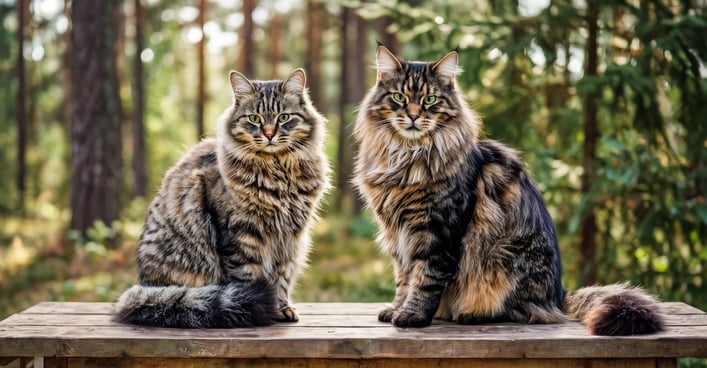
The Siberian and Norwegian Forest Cat are magnificent, large, long-haired breeds forged in harsh northern climates. While they share impressive size, luxurious coats, and gentle temperaments, their distinct origins, appearances, and personalities set them apart. This guide provides a detailed comparison to help you choose your perfect feline companion.
Breed Origins & History
Siberian Cat Origins
An Ancient Russian Treasure:
National Status: Revered as the national cat of Russia.
Historical Depth: A natural breed with over 1,000 years of documented history originating in Siberia.
Modern Introduction: First imported to the United States in the 1990s.
Formal Recognition: Achieved Cat Fanciers' Association (CFA) championship status in 2006.
Cultural Significance:
Featured prominently in Russian fairy tales and folklore.
Valued as working cats, protecting grain stores from rodents.
First written records date back to the 13th century.
Faced near-extinction during the Soviet era before dedicated preservation efforts.
Siberian vs Norwegian Forest Cat: A Complete Breed Comparison Guide for 2026 - Articles
Norwegian Forest Cat Origins
A Legacy of the Vikings:
Natural Heritage: A native, natural breed from the forests of Norway.
Seafaring Companions: Believed to have traveled with Vikings on their ships as mousers.
Conservation Success: Nearly extinct by the mid-20th century, saved by organized breeding programs.
National Symbol: Holds the title of the official cat of Norway.
Formal Recognition: Granted CFA championship status in 1993.
Mythological Roots:
Known traditionally as "Skogkatt," meaning forest cat.
Appears in Norse mythology; the goddess Freyja's chariot was said to be pulled by large cats.
Evolved over centuries to survive the harsh Scandinavian wilderness.
Physical Characteristics: A Side-by-Side Look
Size & Build
Feature
Siberian Cat
Norwegian Forest Cat
Male Weight
15-20 lbs (6.8-9.1 kg)
13-22 lbs (5.9-10 kg)
Female Weight
10-15 lbs (4.5-6.8 kg)
8-15 lbs (3.6-6.8 kg)
Body Type
Substantial, powerful, and barrel-chested
Athletic, muscular, and rectangular
Maturation
Slow to mature, reaching full size at 4-5 years
Slow to mature, reaching full size at 4-5 years
Note: Both breeds are considered large and continue to fill out physically until around age five.
Coat & Grooming
Feature
Siberian Cat
Norwegian Forest Cat
Texture
Medium-long, triple-layered coat
Long, double-layered, water-resistant coat
Undercoat
Dense and woolly
Dense and woolly
Guard Hairs
Water-resistant
Glossy and highly weatherproof
"Pants" (Hindquarters)
Moderate feathering
Very full and dramatic
Ruff (Neck)
Full
Very full and impressive
Tail
Full, fox-like brush
Long, bushy, and carried high
Coat "Glitter"
Often exhibits a natural shine
Often exhibits a natural shine
Grooming Requirements:
Both Breeds: Require weekly brushing to prevent mats and tangles.
Seasonal Shedding: Expect heavy shedding ("coat blow") in spring and a moderate shed in autumn. Daily brushing is recommended during these periods.
Tools: A metal comb and slicker brush are essential for both.
Mat Resistance: Their coats are generally mat-resistant with proper care.
Head & Facial Features
Feature
Siberian Cat
Norwegian Forest Cat
Head Shape
Modified wedge with rounded contours
Distinctly triangular, forming an equilateral shape
Profile
Gentle curve
Straight line from brow to nose tip
Eyes
Almost round; colors range from gold to green
Almond-shaped; all eye colors accepted
Ears
Medium-sized, wide-set, with lynx tips (tufts)
Medium-sized, heavily tufted, following the head's triangle
Overall Expression
Sweet, open, and gentle
Alert, intelligent, and slightly "wild"
Key Distinction: The Norwegian Forest Cat's triangular head and almond eyes create a more feral appearance, while the Siberian's rounder eyes and softer contours give a sweeter expression.
Temperament & Personality
Siberian Cat Personality
Affectionate & Devoted: Known for dog-like loyalty and a strong desire to be near their owners. Often described as "cuddly."
Playful & Energetic: Retains a playful, kitten-like demeanor well into adulthood.
Intelligent & Trainable: Quick learners who can be taught tricks and often enjoy games like fetch.
Family-Friendly: Typically excellent with gentle children and other pets.
Vocalization: Has a quiet, chirping voice.
Unique Traits: Many exhibit a fascination with water and are exceptional jumpers.
Hypoallergenic Note:
Some studies suggest some Siberians may produce lower levels of the Fel d 1 allergen.
They are NOT truly hypoallergenic. Individual reactions vary greatly, and allergy sufferers should spend time with a cat before committing.
Norwegian Forest Cat Personality
Independent Yet Loving: Affectionate on their own terms, enjoying companionship without being overly clingy.
Born Climbers: Their evolution as forest cats gives them an incredible drive to climb. They need vertical space.
Generally Healthy: Also a robust breed with good overall health.
Primary Concerns:
Hypertrophic Cardiomyopathy (HCM): Screening is recommended.
Glycogen Storage Disease Type IV (GSD IV): A rare, inherited metabolic disorder. A genetic test is available, and reputable breeders test to avoid it.
Average Lifespan: 14 to 16 years.
Care & Lifestyle Requirements
Exercise & Enrichment
Siberian Needs:
Ample interactive play sessions.
Toys that engage their intelligence (puzzle feeders, fetch toys).
High perches and cat trees to accommodate their jumping prowess.
Norwegian Forest Cat Needs:
Essential: Multiple tall, sturdy cat trees and shelves to satisfy their climbing instinct.
Play that mimics hunting (wand toys, feather teasers).
Secure outdoor access via a catio is highly beneficial.
Both Breeds Need: Mental stimulation, daily playtime, and a safe environment to explore vertically.
Cost Comparison
Initial Investment (Approximate)
Item
Siberian Cat
Norwegian Forest Cat
Kitten from Reputable Breeder
$1,200 - $2,500
$900 - $1,800
Initial Supplies (carrier, litter box, etc.)
$400 - $600
$400 - $600
Initial Veterinary Care (vaccinations, spay/neuter)
$300 - $600
$300 - $600
Annual Ongoing Costs (Approximate)
Item
Siberian Cat
Norwegian Forest Cat
High-Quality Food
$600 - $900
$600 - $900
Routine Veterinary Care
$300 - $500
$300 - $500
Grooming Supplies & Care
$100 - $200
$100 - $200
Toys & Enrichment
$100 - $200
$100 - $200
Total Annual Estimate
$1,100 - $1,800
$1,100 - $1,800
Note: Costs vary significantly by location and individual pet needs. Pet insurance is a recommended consideration.
Which Breed Is Right For You?
Choose a Siberian Cat If You Want:
A supremely affectionate, "velcro" cat that seeks constant companionship.
A playful, dog-like personality that enjoys interactive games.
A potential (but not guaranteed) better fit for some allergy sufferers.
A cat with a softer, rounder, and sweeter facial expression.
Choose a Norwegian Forest Cat If You Want:
A cat with a majestic, wild appearance and fascinating Viking heritage.
An independent yet loving companion who enjoys affection on their terms.
An athletic cat that will utilize every inch of vertical space in your home.
A natural hunter who enjoys stalking and pouncing games.
Final Verdict
Both the Siberian and Norwegian Forest Cat are exceptional breeds that offer the grandeur of a large cat with the heart of a gentle companion. Your choice ultimately hinges on lifestyle and personality preference.
The Siberian is the quintessential "lovebug"—more consistently cuddly and people-focused.
The Norwegian Forest Cat is the elegant "athlete"—slightly more independent and driven to climb, reflecting its forest origins.
Whichever you choose, be prepared for a significant commitment to grooming, especially during shedding seasons, and the joy of sharing your home with a magnificent, loyal friend for years to come.
Get expert advice about cat care, behavior, nutrition, grooming, and training. Ask our AI cat care expert anything about your cat and receive professional guidance.