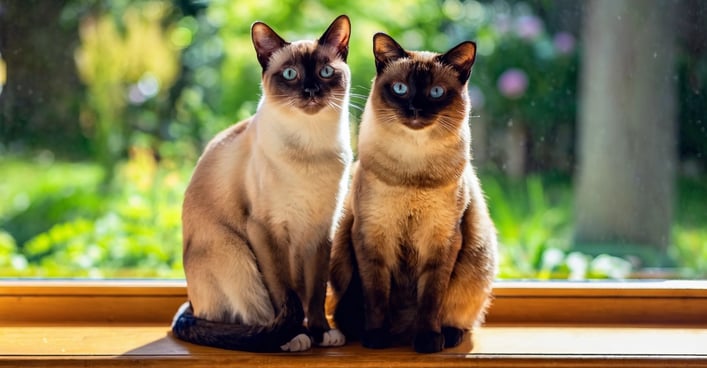
Siamese vs Tonkinese: The Complete 2026 Breed Comparison Guide
Discover the key differences between the elegant Siamese and the balanced Tonkinese. Our guide helps you choose the perfect intelligent, affectionate feline companion for your lifestyle.
Share this page
Siamese vs Tonkinese: The Complete 2026 Breed Comparison Guide
The Siamese and Tonkinese are two captivating, closely related breeds with a shared heritage but distinct personalities. The Tonkinese was developed by crossing the Siamese with the Burmese, creating a wonderful hybrid that blends the best of both worlds. This comprehensive 2026 guide explores their histories, temperaments, and care needs to help you decide which intelligent, affectionate cat is your ideal match.
Historical Origins
Siamese Cat History
Ancient Thai Origins
The Siamese is one of the world's oldest and most iconic cat breeds, originating centuries ago in Thailand (formerly Siam).
Historical Timeline:
1350s: First documented in the Thai manuscript "Tamra Maew" (The Cat-Book Poems).
1878: The first Siamese cat arrives in America as a gift to President Rutherford B. Hayes.
1884: The first breeding pair, Pho and Mia, arrives in England.
1890s: Popularity spreads rapidly across Europe.
Early 1900s: Distinct breed types begin to develop (Traditional vs. Modern).
Siamese vs Tonkinese: The Complete 2026 Breed Comparison Guide - Articles
Historical Significance:
Revered as sacred temple cats in Siam.
Companions to royalty in royal palaces.
Believed to house the souls of deceased royalty.
A naturally occurring breed, not created by human design.
Type Evolution:
Traditional/Applehead: The original, moderate-bodied type.
Classic/Old-Style: A transitional type.
Modern/Wedgehead: The extreme, sleek contemporary type.
Both Traditional and Modern types are actively bred today.
Tonkinese History
Modern American Development
In contrast to the ancient Siamese, the Tonkinese is a deliberately developed mid-20th-century breed.
Historical Timeline:
1930s: The first recorded crosses between Burmese and Siamese cats.
1950s-60s: Canadian breeder Margaret Conroy formalizes the breed development.
1960s: Officially named "Tonkinese" after the Tonkin region of Vietnam.
1970s: Major cat registries begin recognizing the breed.
1984: Achieves championship status with the Cat Fanciers' Association (CFA).
Development Purpose:
To blend the outgoing Siamese personality with the sturdier Burmese body type.
To moderate the extreme appearance of the Modern Siamese.
To create a perfectly "intermediate" or balanced cat.
To preserve beautiful colorpoint patterns.
Name Origin:
Named for the exotic-sounding Tonkin region.
Has no actual historical connection to the area.
Was originally spelled "Tonkanese."
Physical Characteristics
Size and Build
Feature
Siamese
Tonkinese
Weight (Females)
6-10 lbs
6-8 lbs
Weight (Males)
8-12 lbs
8-12 lbs
Body Type
Long, svelte, tubular
Moderate, muscular, and balanced
Bone Structure
Fine and delicate
Medium and solid
Body Length
Long
Medium-long
Height
Medium-tall
Medium
Build Distinctions:
Siamese: Known for extreme elegance, fine bones, and a willowy silhouette.
Tonkinese: The "Goldilocks" build—not too extreme, not too cobby, but just right.
Both are muscular, but the Tonkinese has a more substantial feel.
Coat and Color Patterns
Siamese Coat:
Length: Very short and fine.
Texture: Sleek, glossy, and lies close to the body.
Undercoat: Minimal.
Feel: Satin-like.
Tonkinese Coat:
Length: Short and fine.
Texture: Exceptionally soft, silky, and close-lying.
Undercoat: Minimal.
Feel: Distinctly mink-like (the origin of the breed's "mink" color terminology).
Colorpoint Patterns
Siamese Colors:
Seal Point (dark brown points)
Chocolate Point (milk chocolate)
Blue Point (slate gray)
Lilac Point (pinkish-gray)
Traditional Siamese Additional Colors:
Red Point
Cream Point
Lynx (Tabby) Points
Tortie Points
Tonkinese Patterns:
The breed is defined by three distinct patterns, each linked to eye color:
Pointed (High Contrast)
Similar to a Siamese.
Bright blue eyes.
Light body color with dark points.
Mink (Medium Contrast)
Unique to the Tonkinese.
Striking aqua-colored eyes (the breed's trademark).
Medium body color, darker than the points.
Solid (Low Contrast)
Similar to a Burmese.
Green to yellow-green eyes.
Body and points are very similar in tone.
Tonkinese Colors:
Natural (seal)
Champagne (chocolate)
Blue
Platinum (lilac)
Head and Facial Features
Siamese (Modern Type):
Head: Distinct wedge-shaped, long and triangular.
Profile: Straight, with a long nose.
Ears: Very large, pointed, and wide-set.
Eyes: Almond-shaped, slanted, and vivid blue.
Expression: Alert, intense, and intelligent.
Siamese (Traditional Type):
Head: Rounder, often called "apple-shaped."
Profile: Shows a gentle curve.
Ears: Medium-sized.
Eyes: Rounder, but still blue.
Expression: Sweet, gentle, and open.
Tonkinese:
Head: A modified wedge, slightly rounded.
Profile: Shows a gentle stop, medium length.
Ears: Medium-sized with slightly rounded tips.
Eyes: Almond-shaped but slightly rounded.
Pointed: Blue
Mink: Aqua (signature color)
Solid: Green to yellow-green
Expression: Alert, open, and engaging.
Eye Color Significance
Siamese:
Blue eyes are required in all color varieties.
Deep sapphire blue is preferred.
Eye color is linked to the temperature-sensitive albinism gene that creates their points.
Tonkinese:
Eye color is a direct indicator of the pattern type.
Aqua eyes are unique to the mink pattern and a hallmark of the breed.
Blue eyes indicate a pointed pattern.
Green eyes indicate a solid pattern.
Temperament and Personality
Siamese Personality
Core Characteristics:
Exceptionally intelligent and curious.
Extremely vocal and communicative.
Demanding of attention and interaction.
Highly active and energetic.
Strong-willed and opinionated.
Deeply affectionate and loyal to their family.
Behavior Patterns:
Often follows owners from room to room ("velcro cat").
"Talks" constantly with a loud, distinctive voice.
Demands to be involved in all household activities.
Remains playful and mischievous well into adulthood.
Social Traits:
Forms intense, dog-like bonds with their chosen people.
Can be jealous or possessive if attention is divided.
Thrives on constant companionship and mental stimulation.
Not ideal for owners who are away for long hours.
Tonkinese Personality
Core Characteristics:
Highly intelligent and playful.
Moderately vocal with a softer, melodic voice.
Affectionate but less demanding than the Siamese.
Active, yet adaptable and easygoing.
Social and friendly with almost everyone.
Truly embodies the "best of both worlds" from its Siamese and Burmese parents.
Behavior Patterns:
Enjoys following owners but is less obsessive.
Communicates needs pleasantly but isn't insistent.
Loves interactive play and puzzle toys.
Strikes an excellent balance between activity and cuddle time.
Social Traits:
Typically very friendly with strangers.
Excellent with gentle children and other pets.
Less likely to develop single-person attachment or jealousy.
A great choice for families and first-time cat owners.
Temperament Comparison
Trait
Siamese
Tonkinese
Activity Level
High
Moderate-High
Playfulness
Very High
High
Affection Level
Very High
High
Independence
Low
Moderate
Vocalization
Very High
Moderate
Intelligence
Very High
Very High
Demanding Nature
High
Moderate
Stranger Friendly
Moderate
High
Child Friendly
Moderate
High
Dog Friendly
Moderate
High
Trainability
Very High
Very High
Attention Needs
Constant
Moderate
Health and Longevity
Siamese Health Profile
General Health:
Generally a healthy, long-lived breed.
Some inherited conditions are present, particularly in poorly bred lines.
The modern (wedgehead) type may be prone to more issues than the traditional type.
Common Health Concerns:
Dental Issues: Prone to periodontal disease; regular dental care is essential.
Respiratory Issues (Modern Type): Higher incidence of feline asthma and upper respiratory infections.
Eye Problems: Crossed eyes (strabismus) and nystagmus (involuntary eye movement) are cosmetic, inherited traits. Progressive Retinal Atrophy (PRA) is rare.
Other Concerns: Amyloidosis (protein buildup in organs), certain heart conditions, and psychogenic alopecia (stress-induced over-grooming).
Average Lifespan: 15-20 years
Tonkinese Health Profile
General Health:
Benefits from hybrid vigor, making it a generally robust and healthy breed.
Tends to have fewer severe genetic issues than some purebreds.
Common Health Concerns:
From Siamese Side: Potential for dental issues and asthma (both less common).
From Burmese Side: Risk of hypokalemia (low potassium), for which genetic testing is available.
General Concerns: Like all cats, they require dental health maintenance and can become obese if overfed.
Average Lifespan: 15-18 years
Health Comparison
Factor
Siamese
Tonkinese
Overall Health
Good
Very Good
Genetic Issues
Moderate
Few
Average Lifespan
15-20 years
15-18 years
Veterinary Costs
Moderate
Low-Moderate
Robustness
Moderate
High (hybrid vigor)
Grooming and Care
Grooming Needs
Both breeds are exceptionally low-maintenance when it comes to coat care.
Shared Routine:
Brushing: A weekly brushing with a soft bristle brush or grooming glove is sufficient to remove loose hair and distribute skin oils.
Bathing: Rarely needed due to their short, clean coats.
Shedding: Both are low shedders.
Essential Care (for both breeds):
Dental Care: Daily tooth brushing or dental treats are crucial to prevent periodontal disease.
Nail Trimming: Every 1-2 weeks.
Ear Cleaning: Check and clean weekly with a vet-approved solution.
Living Environment
Ideal Siamese Home
Perfect Match For:
Experienced cat owners or dedicated first-timers.
People who work from home or are home frequently.
Owners who enjoy constant interaction and conversation with their pet.
Households seeking a deeply bonded, "dog-like" feline companion.
Challenges For:
Quiet, sedentary households.
Owners who are away from home for long daily hours.
Those sensitive to noise or wanting a completely peaceful environment.
Hands-off pet owners.
Ideal Tonkinese Home
Perfect Match For:
First-time cat owners.
Families with children and other pets.
Working professionals (especially if the cat has a feline companion).
Owners who want an intelligent, affectionate cat without extreme demands.
Various household types, from apartments to houses.
Challenges For:
Very quiet, inactive homes with little stimulation.
Leaving the cat completely alone for extended periods without any companionship.
Cost Comparison (2026 Estimates)
Initial Acquisition Costs
Source
Siamese
Tonkinese
Reputable Breeder (Pet Quality)
$800 - $1,500
$700 - $1,300
Reputable Breeder (Show Quality)
$1,500 - $3,500
$1,200 - $2,800
Rescue/Adoption
$75 - $300
$75 - $300
Annual Care Costs
Expense
Siamese
Tonkinese
High-Quality Food
$400 - $700
$400 - $700
Litter
$200 - $350
$200 - $350
Routine Veterinary Care
$300 - $500
$250 - $450
Preventatives (Flea/Heartworm)
$150 - $300
$150 - $300
Pet Insurance
$300 - $550
$280 - $500
Toys & Enrichment
$150 - $300
$150 - $300
Total Annual Range
$1,500 - $2,700
$1,430 - $2,600
Training and Intelligence
Both breeds are highly intelligent and trainable. They excel at:
Learning tricks (sit, high-five, fetch).
Walking on a harness and leash.
Solving puzzle feeders and interactive games.
Key Training Difference:
Siamese: Require more consistent mental stimulation to prevent boredom. They are quick learners but may try to outsmart their owners.
Tonkinese: Eager to please and often highly food-motivated, making training sessions very productive and enjoyable. Slightly less prone to boredom-related mischief.
Making Your Decision
Choose a Siamese If:
You desire a deeply bonded, "shadow" cat that follows you everywhere.
You enjoy and are entertained by constant vocal communication.
You have ample time for daily interactive play and engagement.
You appreciate the breed's iconic, elegant appearance.
You are prepared for a strong-willed, demanding, and highly intelligent companion.
Choose a Tonkinese If:
You love the Siamese personality but prefer a more moderate, adaptable version.
You want a communicative cat with a softer, less insistent voice.
You have a family, children, or other pets.
You are a first-time cat owner seeking an easygoing, friendly breed.
You are captivated by their unique aqua eyes and balanced "mink" appearance.
Consider Another Breed If:
You prefer a quiet, independent cat that requires minimal interaction.
You are away from home very frequently without pet care.
You cannot provide daily mental and physical stimulation for an intelligent breed.
Similar Breeds to Consider
If You Like the Siamese:
Oriental Shorthair: Offers the same personality and body type in over 300 color and pattern combinations.
Balinese: Essentially a long-haired Siamese with a silky coat and plumed tail.
Javanese: A related breed with a similar personality and a variety of point colors.
If You Like the Tonkinese:
Burmese: Affectionate, playful, and solid-colored, but with a softer voice and sturdier build.
Snowshoe: A cross between Siamese and American Shorthair, known for white paws and a balanced temperament.
European Burmese: Shares the moderate, muscular build and friendly nature.
Final Verdict
Siamese: 4.6/5 Stars
An extraordinary companion for the right owner. Their legendary intelligence, deep devotion, and conversational nature create a unique bond. However, their intense, vocal, and demanding personality requires a committed owner ready for a lifelong interactive partnership.
Tonkinese: 4.7/5 Stars
Successfully perfects the hybrid ideal. It offers most of the Siamese's appeal—intelligence, affection, and beauty—in a more manageable, easygoing, and adaptable package. Their moderate nature makes them suitable for a wider range of households, earning them a slight edge in overall versatility.
The Bottom Line: Both breeds will reward you with years of loyal, intelligent, and affectionate companionship. Your choice ultimately hinges on your lifestyle and your preference for the Siamese's dramatic intensity versus the Tonkinese's harmonious balance.
Last Updated: 2026 | Both breeds are highly social and thrive with companionship. If you are away from home regularly, seriously consider adopting a pair to keep each other entertained.
Get expert advice about cat care, behavior, nutrition, grooming, and training. Ask our AI cat care expert anything about your cat and receive professional guidance.