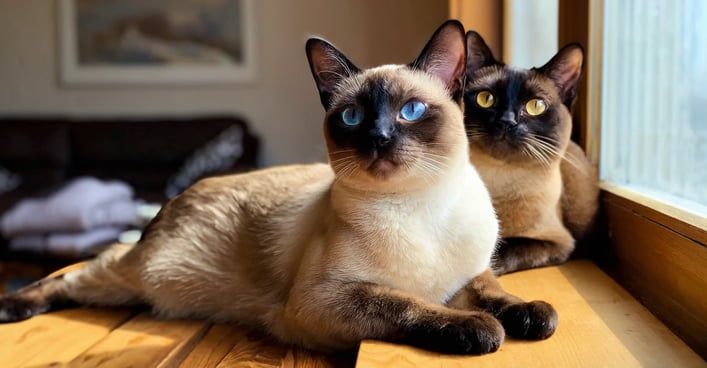
Siamese vs Burmese Cat: A Complete 2026 Comparison Guide
Discover the key differences between Siamese and Burmese cats, from temperament and energy to health and care, to find your perfect feline companion.
Share this page
Siamese vs Burmese Cat: A Complete 2026 Comparison Guide
By Dr. Patricia Williams, Veterinary Behaviorist | Updated: 2026 | Reading Time: 14 minutes
Introduction
Siamese and Burmese cats are two of the most affectionate, people-oriented, and expressive breeds in the feline world. Both originate from Southeast Asia and share a reputation for forming deep, dog-like bonds with their humans. However, they differ significantly in energy, vocalization, and overall demeanor.
This definitive guide compares every aspect of these charming breeds—from history and appearance to health and personality—helping you make an informed decision for your home and lifestyle.
Historical Significance:
The Siamese was revered in Thai culture, kept exclusively by royalty and monks. Ancient manuscripts like the Tamra Maew (Cat-Book Poems) describe them as treasures that brought prosperity and good fortune.
Development:
The breed has diverged into two distinct types: the traditional "Applehead" with moderate, rounded features, and the modern "Wedgehead" with a sleek, angular silhouette. Both share the iconic pointed coloration.
Burmese Origins
Burmese Temple Origins:
Origin: Myanmar (formerly Burma)
Historical Period: Ancient times
Foundation Cat: Wong Mau (1930)
American Development: 1930s to present
Creation Story:
The modern Burmese breed began with a single cat, Wong Mau, a walnut-brown feline brought from Burma to the United States in 1930. Dr. Joseph Thompson bred her with Siamese cats, establishing the genetic foundation for the breed we know today.
European Development:
English breeders developed a slightly different standard, creating the "European Burmese," which has a more varied color palette and a somewhat different head shape.
Physical Characteristics Comparison
Size and Build
Feature
Siamese
Burmese
Larger/More Substantial
Male weight
8-12 lbs
8-12 lbs
Equal
Female weight
5-8 lbs
6-10 lbs
Burmese
Body type
Elegant, svelte, long
Compact, muscular, rounded
Burmese
Bone structure
Fine, refined
Medium, substantial
Burmese
Leg length
Long, slender
Medium, proportional
Equal
Coat and Color
Siamese Coat:
Texture: Very short, fine, and silky.
Pattern: Colorpoint (darker extremities on face, ears, paws, and tail).
Colors: Seal, chocolate, blue, and lilac point are most common.
Shedding: Minimal.
Grooming: A weekly brushing is sufficient.
Burmese Coat:
Texture: Short, fine, with a distinctive satin-like sheen.
Pattern: Solid (no points).
Colors: Sable (rich brown), champagne, blue, and platinum.
Shedding: Minimal.
Grooming: Weekly brushing maintains the glossy finish.
Head and Facial Features
Siamese (Modern Wedgehead):
Extreme wedge-shaped head.
Large, pointed ears.
Slanted, vivid blue almond-shaped eyes.
Long, straight nose.
Strikingly angular appearance.
Siamese (Traditional Applehead):
Rounder, more moderate head shape.
Medium-sized ears.
Rounder blue eyes.
Shorter nose.
Classic, less extreme look.
Burmese:
Distinctly round head with full cheeks.
Medium-sized, rounded ear tips.
Large, expressive gold or yellow eyes.
Short, broad muzzle.
Consistently sweet and open expression.
Temperament and Personality Comparison
Energy Levels
Siamese Energy:
Very high energy. They are constantly on the move.
Require significant daily stimulation and play.
Remain intensely playful well into adulthood.
Known for getting into everything—curiosity is a hallmark.
Burmese Energy:
Moderate to high energy. Playful but more settled.
Enjoy interactive games but are less frantic.
Happy with structured play sessions.
Often described as a "brick wrapped in silk"—surprisingly heavy and solid for their size.
Vocalization
Siamese Vocal Traits:
Extremely vocal and loud. They have a distinctive, raspy, and demanding voice.
Truly conversational; they will "talk" to you all day about everything.
Use a wide range of sounds to communicate their needs and opinions.
Burmese Vocal Traits:
Moderately vocal. They have a softer, sweeter, more melodic voice.
Tend to respond when spoken to rather than initiating constant conversation.
Less demanding but still enjoy pleasant interactions.
Social Behavior
Trait
Siamese
Burmese
People-orientation
Extremely high, "velcro cats"
Extremely high, loving lap cats
Need for attention
Very demanding, can be clingy
Affectionate but slightly less demanding
Separation anxiety
Common if left alone too long
Common, thrives on companionship
Multi-cat tolerance
Selective; can be dominant
Generally excellent, very social with other pets
Child compatibility
Good with respectful, older children
Excellent with children of all ages
Stranger reception
Often selective and cautious
Usually very welcoming and friendly
Health Comparison
Siamese Health Concerns
Common Issues:
Progressive Retinal Atrophy (PRA): An inherited condition leading to blindness. DNA testing is available.
Asthma/Bronchial Disease: Higher incidence of respiratory issues.
Amyloidosis: A serious condition involving protein deposits in organs like the liver and kidneys.
Dental Issues: Prone to periodontal disease, making dental care critical.
Crossed Eyes (Strabismus): A cosmetic, genetic trait more common in the breed.
Average Lifespan: 12-20 years with excellent care.
Burmese Health Concerns
Common Issues:
GM2 Gangliosidosis: A fatal neurological disorder. Reputable breeders always test for this.
Hypokalemia: A condition causing low blood potassium levels.
Craniofacial Defects: Can occur in some lines.
Diabetes: Higher incidence rate; weight management is crucial.
Flat-Chested Kitten Syndrome: A developmental issue in some newborns.
Average Lifespan: 10-16 years.
Health Testing Recommendations
Test
Siamese
Burmese
PRA DNA test
Essential
Not typically needed
GM2 Gangliosidosis DNA test
Not needed
Essential
Annual veterinary eye exam
Recommended
Recommended
Kidney function monitoring
Advised, especially in seniors
Advised
Blood glucose monitoring
Baseline check
Regular monitoring due to diabetes risk
Care Requirements Comparison
Exercise & Mental Stimulation
Siamese:
Need: Very High. Require 2-3 active play sessions of 20-30 minutes daily.
Without Stimulation: Highly prone to boredom, which can lead to destructive behavior or depression.
Burmese:
Need: High. Enjoy 1-2 interactive play sessions of 15-20 minutes daily.
Ideal Activities: Games of fetch, interactive wand toys, and social time with their family.
Adaptability: More adaptable to routine but still require consistent engagement.
Grooming Comparison
Aspect
Siamese
Burmese
Brushing frequency
Weekly
Weekly
Bathing
Rarely needed
Rarely needed
Nail trimming
Every 2-3 weeks
Every 2-3 weeks
Dental care
Critical (prone to issues)
Important (regular brushing advised)
Ear cleaning
Monthly check and clean
Monthly check and clean
Cost Comparison
Initial Acquisition
Source
Siamese
Burmese
Shelter/Rescue
$50 - $200
$50 - $200
Pet Quality (Reputable Breeder)
$600 - $1,200
$600 - $1,000
Show Quality (Reputable Breeder)
$1,200 - $2,500+
$1,000 - $2,000+
Note: Always choose a breeder who performs all recommended genetic health screenings and raises kittens in a home environment.
Estimated Annual Care Costs
Expense
Siamese
Burmese
High-Quality Food
$300 - $500
$300 - $500 (watch portions)
Routine Veterinary Care
$300 - $600
$300 - $600
Toys & Enrichment
$150 - $300
$100 - $200
Grooming Supplies/Professional
$0 - $100
$0 - $100
Total Annual Estimate
$750 - $1,500
$700 - $1,400
Living Environment Suitability
Best Homes for a Siamese
Ideal Situations:
Active households with people home often.
Experienced cat owners who understand high-need personalities.
Homes with other playful pets for company.
Families who enjoy constant interaction and "conversation."
Challenging Situations:
Quiet, low-activity homes.
Owners with very long work hours.
First-time cat owners (due to their demanding nature).
Noise-sensitive environments.
Best Homes for a Burmese
Ideal Situations:
Families with children (they are patient and loving).
Multi-pet households.
First-time cat owners seeking a devoted companion.
Apartments or homes of any size, provided they get attention.
Challenging Situations:
Homes where the cat will be left alone for extended periods daily.
With inactive owners who won't engage in play.
Very busy, chaotic households where they might be underfoot.
Breed-Specific Considerations
Siamese Special Considerations
The Voice: Their loud, persistent vocalizations are a breed trademark. Ensure you (and your neighbors) can tolerate this.
The Shadow: They form intense bonds and will follow you everywhere. They are not independent loners.
The Mind: Their intelligence demands an outlet. Without puzzles and training, they will create their own (often destructive) games.
Burmese Special Considerations
Weight Watch: They are food-motivated and prone to obesity. Strict portion control and regular play are non-negotiable.
Genetic Testing is Non-Optional: Never acquire a Burmese kitten from a breeder who does not provide documentation of GM2 testing for both parents.
The Cuddler: They crave physical contact and will insist on being in your lap or curled up next to you.
Which Breed Is Right for You?
Choose a Siamese If You:
Desire a vocal, conversational partner and don't mind constant chatter.
Have ample time for extensive daily interaction and play.
Appreciate a high-energy, acrobatic, and elegant cat.
Can provide a stimulating environment with puzzles and vertical space.
Are an experienced pet owner ready for a demanding, rewarding bond.
Choose a Burmese If You:
Want an intensely affectionate but slightly calmer companion.
Have a family with children or other pets.
Prefer a softer, sweeter voice and less demanding conversation.
Love a sturdy, muscular, "cuddly brick" of a cat.
Seek a playful, dog-like devotee who is somewhat less intense than a Siamese.
Conclusion
Both the Siamese and the Burmese offer unparalleled companionship for those seeking an interactive, deeply bonded feline friend. The Siamese is the extroverted intellectual—loud, energetic, and endlessly entertaining, demanding an active partnership. The Burmese is the affectionate cuddler—slightly more reserved in energy but no less devoted, offering a sweet-natured and sturdy presence.
The critical deciding factors often boil down to your lifestyle tolerance for vocalization and activity level. Whichever you choose, commit to providing the companionship, mental stimulation, and preventive healthcare they require. In return, you will gain a loyal, loving shadow for over a decade.
Get expert advice about cat care, behavior, nutrition, grooming, and training. Ask our AI cat care expert anything about your cat and receive professional guidance.