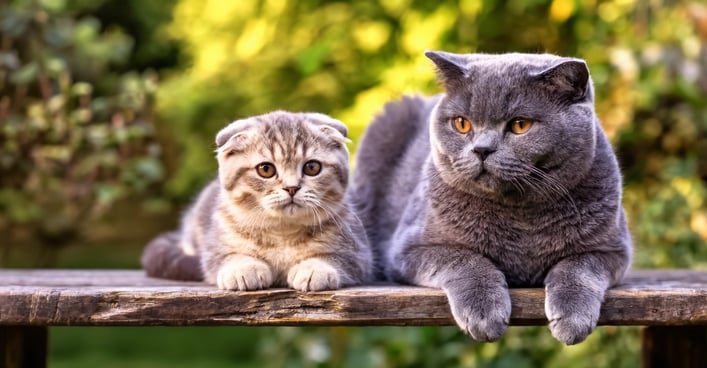
Scottish Fold vs British Shorthair: A 2026 Breed Comparison Guide
Compare the Scottish Fold and British Shorthair: from their distinct looks and personalities to critical health considerations and ethical ownership choices.
Share this page
Scottish Fold vs British Shorthair: A 2026 Breed Comparison Guide
Two beloved British cat breeds, the Scottish Fold and the British Shorthair, share a common heritage but present vastly different considerations for prospective owners. While both are known for their charming personalities, the Scottish Fold's distinctive folded ears come with significant genetic health and ethical concerns. This comprehensive guide compares their origins, appearance, health, temperament, and costs to help you make an informed and responsible decision.
Origins and History
Scottish Fold Origins
The breed began with a spontaneous genetic mutation. In 1961, a white barn cat named Susie with uniquely folded ears was discovered on a farm in Perthshire, Scotland.
Development Timeline:
1961: Susie is discovered.
1966: The breed is registered with the Governing Council of the Cat Fancy (GCCF), but registration was later suspended due to welfare concerns.
1970s: Exported to the United States, where breeding programs continued.
Genetic Foundation: The distinctive fold is caused by a dominant gene mutation. All Scottish Folds can trace their lineage back to Susie.
Homozygous cats (inheriting two copies of the gene) develop severe skeletal deformities.
Ethical breeding requires mating a Fold with a straight-eared cat (like a British or American Shorthair) to produce heterozygous offspring.
Breeding a Fold to another Fold is considered unethical and is strongly discouraged.
British Shorthair Origins
One of the oldest English cat breeds, the British Shorthair is descended from cats brought to Britain by Roman invaders, which later interbred with native European wildcats.
Development Timeline:
Roman Era: Foundation stock arrives in Britain.
1800s: Harrison Weir, the "Father of the Cat Fancy," establishes the first breed standard.
Early 1900s: Officially recognized as a distinct breed.
World War II: The breed nears extinction.
Post-war: Revived through careful outcrossing with breeds like the Persian.
Today: Remains one of the most popular cat breeds in the UK.
Physical Appearance Comparison
Size and Build
Feature
Scottish Fold
British Shorthair
Weight (Male)
9-13 lbs (4-6 kg)
12-18 lbs (5.5-8 kg)
Weight (Female)
6-9 lbs (2.7-4 kg)
9-15 lbs (4-7 kg)
Body Type
Medium, rounded
Cobby, powerful, and substantial
Build
Compact and well-padded
Heavy-boned and muscular
Head and Facial Features
Scottish Fold:
Head: Round with a flat top.
Eyes: Large, round, and expressive; typically gold or copper.
Ears: The defining feature. Small and folded forward (varying from a single loose fold to a tight triple fold).
Expression: Sweet, wide-eyed, and often described as "owl-like."
Cheeks: Full and rounded.
British Shorthair:
Head: Round, broad, and massive, especially in males.
Eyes: Large, round, and come in various colors (copper is classic for blues).
Ears: Small, rounded at the tips, and set wide apart.
Expression: Known for a permanent, dignified "Cheshire Cat" smile.
Cheeks: Very full, with pronounced jowls in males.
Coat Characteristics
Scottish Fold:
Length: Short to medium.
Texture: Dense, plush, and soft.
Colors/Patterns: All colors and patterns are accepted.
British Shorthair:
Length: Short.
Texture: Exceptionally dense and crisp with a "teddy bear" plushness.
Colors/Patterns: The classic blue (gray) is most iconic, but many colors and patterns are recognized.
Health Considerations
Scottish Fold Health Concerns
The folded ears are a sign of osteochondrodysplasia (SFOCD), a genetic disorder affecting cartilage and bone development throughout the body.
Key Facts about SFOCD:
Universal: All cats with folded ears have some degree of this condition.
Progressive: It worsens over time.
Painful: Can cause significant pain, arthritis, and lameness.
Common Symptoms:
Stiff gait, lameness, or reluctance to jump
Short, thickened, and inflexible tail
Swollen joints and abnormal bone growth
A characteristic "bunny-hopping" rear-leg gait
Ethical and Welfare Stance:
Due to the inherent pain associated with SFOCD, many animal welfare organizations oppose the breeding of Scottish Folds:
The UK's RSPCA and GCCF do not recognize the breed.
Breeding is banned in several countries.
Prospective owners are strongly encouraged to adopt, not shop, and be prepared for lifelong management of a painful condition.
Polycystic Kidney Disease (PKD): In some lines (reputable breeders test for this).
Hemophilia B: A bleeding disorder found in some bloodlines.
Overall: Considered a generally robust and healthy breed.
Personality and Temperament
Scottish Fold Personality
Disposition: Exceptionally sweet, gentle, and affectionate.
Energy Level: Calm and relaxed, with moderate playfulness.
Social: Often forms strong bonds with family, good with children and other pets.
Quirks: Known for sitting in the "Buddha position" (on their haunches), sleeping on their backs, and having a soft, quiet voice.
British Shorthair Personality
Disposition: Easygoing, dignified, and famously independent.
Energy Level: Low to moderate; enjoys play but is equally content lounging.
Social: Affectionate on their own terms. They are patient and tolerant but not overly demanding.
Quirks: Known for their quiet nature and observant, calm demeanor.
Temperament Comparison
Trait
Scottish Fold
British Shorthair
Energy Level
Low-Moderate
Low
Affection Level
High
Moderate (on their terms)
Independence
Moderate
High
Playfulness
Moderate
Low-Moderate
Vocalization
Low (soft voice)
Very Low
Lap Cat Potential
High
Moderate
Cost of Ownership
Initial Purchase Costs
Scottish Fold:
Quality
Price Range (USD)
Notes
Pet Quality
$1,000 - $2,000
Often straight-eared (Scottish Shorthair)
Folded Ears
$1,500 - $3,000
Serious ethical and health considerations
Show Quality
$2,500 - $4,000+
British Shorthair:
Quality
Price Range (USD)
Pet Quality
$800 - $1,500
Show Quality
$1,500 - $2,500+
Note: Adoption fees for either breed from a rescue are significantly lower ($50-$300).
Monthly & Annual Cost Comparison
Estimated Monthly Costs:
Category
Scottish Fold
British Shorthair
Premium Food
$40 - $70
$40 - $70
Litter
$20 - $30
$20 - $30
Pet Insurance
$35 - $60
$30 - $50
Joint Supplements
$20 - $40
$0
Monthly Total
$115 - $200
$90 - $150
Estimated Annual Healthcare Costs:
Expense
Scottish Fold
British Shorthair
Wellness Exam
$150 - $300
$150 - $300
Vaccinations
$80 - $150
$80 - $150
Joint Monitoring/X-rays
$200 - $600
$0
Pain Management
$50 - $150
$0
Annual Total
$1,030 - $1,900+
$710 - $1,100
Grooming and Care
Scottish Fold Grooming
Brushing: Weekly to remove loose hair.
Ear Care:Essential. The tight folds must be checked and gently cleaned weekly to prevent wax buildup and infection.
Nail Trimming: Every 2-3 weeks.
British Shorthair Grooming
Brushing: Weekly; more frequent during seasonal sheds.
Ear Care: Monthly check and clean.
Nail Trimming: Every 2-3 weeks.
Final Decision Guide
Consider a Scottish Fold Only If:
Primary Recommendation: Adopt, don't buy. If you are determined:
You are committed to adopting a Fold in need from a rescue or shelter.
You are fully prepared for potential lifelong pain management and higher veterinary costs.
You can provide a home that minimizes the need to jump (e.g., with ramps and steps).
You understand and accept the ethical controversy surrounding the breed.
Choose a British Shorthair If:
You desire a robust, generally healthy cat with a similar "cuddly bear" appearance.
You prefer an independent yet affectionate companion.
You want to avoid supporting breeding practices linked to inherent health problems.
You seek a predictable temperament and lower lifetime healthcare costs.
Conclusion
Both the Scottish Fold and British Shorthair are undeniably charming. However, the choice between them extends beyond aesthetics. The British Shorthair offers a wonderful temperament and iconic look without the severe, genetically linked health challenges of the Scottish Fold. For the vast majority of cat lovers seeking a healthy, happy, and ethical companion, the British Shorthair is the more responsible choice.
If you are drawn to the Scottish Fold's unique appearance, the most compassionate path is to provide a loving home to one through adoption, fully prepared for its specialized care needs.
Last Updated: February 2026 Always prioritize animal welfare. Consider adoption and research breeders meticulously, ensuring they conduct full health screenings and adhere to the highest ethical standards.
Get expert advice about cat care, behavior, nutrition, grooming, and training. Ask our AI cat care expert anything about your cat and receive professional guidance.