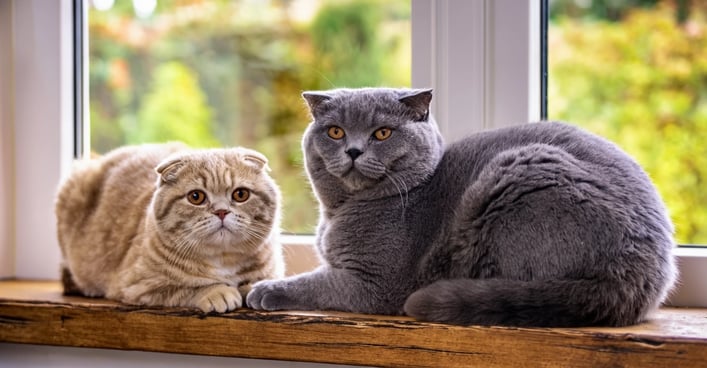
Scottish Fold vs British Shorthair: The Complete 2026 Breed Comparison Guide
Discover the key differences between Scottish Fold and British Shorthair cats, from their unique personalities and care needs to important health considerations, to find your perfect feline companion.
Share this page
Scottish Fold vs British Shorthair: The Complete 2026 Breed Comparison Guide
Scottish Fold and British Shorthair cats share British origins, rounded physiques, and famously calm demeanors, making them top choices for families and individuals seeking affectionate, low-key companions. However, their most distinctive features and critical health profiles differ significantly. This definitive guide provides a detailed comparison to help you make an informed decision between these two beloved breeds.
Historical Origins
Scottish Fold Origins
Accidental Discovery in Scotland:
Origin: Tayside, Scotland (1961)
Foundation Cat: A white barn cat named Susie with unique folded ears
Founder: Shepherd William Ross, who acquired one of Susie's kittens
Recognition: Gained formal recognition in the 1970s, though not without controversy regarding ear cartilage genetics
The Scottish Fold breed originated with Susie, a farm cat whose unusual folded ears were caused by a spontaneous dominant gene mutation affecting cartilage development. Her kittens inherited the trait, and William Ross, recognizing its uniqueness, began a formal breeding program. The breed's popularity soared due to its distinctive "owl-like" appearance and exceptionally sweet temperament.
Scottish Fold vs British Shorthair: The Complete 2026 Breed Comparison Guide - Articles
Development Story:
Important Ethical Note:
The gene responsible for the folded ears also impacts cartilage throughout the body, which can lead to painful osteoarthritis and skeletal abnormalities. This has led to significant ethical debates within the feline community.
British Shorthair Origins
An Ancient British Breed:
Origin: Great Britain
History: Ancestors arrived with Roman invaders nearly 2,000 years ago
Development: Natural evolution followed by selective breeding in the modern era
Recognition: One of the oldest pedigreed cat breeds, celebrated for its robustness
Development Story:
British Shorthairs descend from cats introduced to Britain by Roman legions. These cats interbred with native European wildcats, evolving naturally into a sturdy, resilient breed. Harrison Weir, the "father of the cat fancy," championed and standardized the breed in the late 19th century. Although numbers dwindled during the World Wars, dedicated breeders successfully revived the population.
Cultural Icon:
This breed is famously thought to have inspired the Cheshire Cat in Alice's Adventures in Wonderland and is the quintessential face behind the classic "I Can Has Cheezburger?" internet meme.
Physical Characteristics: A Side-by-Side Look
The Most Obvious Difference: Ear Structure
Scottish Fold Ears:
The Fold: Ears bend forward and downward in a distinctive fold.
Variation: Can be a single, double, or triple fold.
Development: Kittens are born with straight ears; the fold develops at 3-4 weeks of age.
Genetics: Not all kittens in a litter will have folded ears. The fold is caused by a dominant gene.
British Shorthair Ears:
Small, rounded at the tips.
Set wide apart on a broad head.
Always straight and erect.
Proportionate to the head size.
Body Type & Structure
Feature
Scottish Fold
British Shorthair
Body Type
Medium, rounded, well-padded
Large, stocky, powerfully muscular
Bone Structure
Medium, substantial
Heavy and dense
Chest
Broad and rounded
Deep and broad
Legs & Paws
Medium length, sturdy; rounded paws
Short, strong legs; round, firm paws
Tail
Medium length, tapering
Thick at base, rounded at tip
Adult Weight
6 - 13 lbs (2.7 - 5.9 kg)
9 - 17 lbs (4 - 7.7 kg)
Key Takeaway: British Shorthairs are notably larger and more substantial, often weighing several pounds more than their Scottish Fold counterparts.
Coat & Grooming
Scottish Fold Coat:
Length: Short to medium.
Texture: Dense, plush, and soft with a cashmere-like feel.
Care: Weekly brushing is sufficient to manage moderate shedding.
British Shorthair Coat:
Length: Short.
Texture: Extremely dense, crisp, and firm—often described as a "plush teddy bear."
Care: Requires weekly brushing, escalating to daily during seasonal heavy sheds.
Coat Comparison Summary:
Aspect
Scottish Fold
British Shorthair
Texture
Softer, cashmere-like
Crisper, firmer
Shedding
Moderate
Moderate to Heavy (seasonal)
Grooming Frequency
Weekly
Weekly, plus daily during shed seasons
Facial Features & Expression
Scottish Fold:
Round face with full cheeks.
Large, round eyes that create a sweet, wide-eyed expression.
Short nose with a gentle curve.
The folded ears contribute to a unique, owl-like appearance.
British Shorthair:
Notably round and massive head with full cheeks (especially in males).
Large, round eyes (copper is most iconic).
Short, broad nose with a firm chin and dense whisker pads.
Projects a calm, dignified, and teddy bear-like expression.
Temperament & Personality
Personality Overview
Trait
Scottish Fold
British Shorthair
Activity Level
Low to Moderate
Low
Playfulness
Moderate
Low to Moderate
Affection Level
High
Moderate
Independence
Low to Moderate
High
Social Needs
High
Moderate
Vocalization
Quiet
Quiet
Scottish Fold: The Affectionate Companion
People-Oriented: Forms strong, devoted bonds with family members and likes to follow them around.
Playful & Intelligent: Retains kitten-like playfulness, can learn tricks, and enjoys interactive games and puzzle toys.
Characteristic Behaviors: Known for sitting in the "Buddha position" and sometimes standing on hind legs like a meerkat.
Best For: Owners seeking a highly social, interactive lap cat.
British Shorthair: The Dignified Independent
Self-Sufficient: Content with its own company, making it ideal for working professionals.
Calm & Undemanding: Has a placid, easygoing nature and is not overly attention-seeking.
Loyal but Reserved: Bonds deeply but shows affection in a quiet, dignified manner. Often prefers to be near you rather than on your lap.
Best For: Those who want a low-maintenance, predictable, and calm companion.
Care & Maintenance
Exercise & Play Needs
Both breeds have low energy levels but require regular, gentle play to prevent obesity.
Scottish Fold: Benefits from 15-20 minutes of daily interactive play.
British Shorthair: Requires 10-15 minutes of daily play; highly prone to weight gain.
Critical Note: Portion control and weight management are essential for the long-term health of both breeds.
Grooming Requirements
Task
Scottish Fold
British Shorthair
Brushing
Weekly
Weekly (daily during heavy sheds)
Ear Care
Special Attention Needed: Folded ears must be checked and cleaned regularly to prevent infections.
Standard weekly check and clean.
Nail Trimming
Every 2-3 weeks
Every 2-3 weeks
Health & Lifespan: A Critical Comparison
Scottish Fold Health Profile
Primary Concern: Osteochondrodysplasia
This inherited skeletal disorder is directly linked to the folded ear gene.
It affects cartilage throughout the body, potentially causing:
Progressive, painful arthritis
Joint stiffness and malformation
Mobility issues and lameness
Ethical Breeding is Paramount:
Responsible breeders never mate two folded-ear cats together (fold-to-fold). They only pair a folded-ear cat with a straight-eared cat (often a British Shorthair or American Shorthair) to reduce, but not eliminate, the risk of severe skeletal issues.
Other Potential Issues:
Hypertrophic Cardiomyopathy (HCM)
Polycystic Kidney Disease (PKD)
Increased risk of ear infections due to ear structure
Average Lifespan: 11 - 14 years
British Shorthair Health Profile
Generally Robust Breed:
No breed-specific cartilage or skeletal disorders.
Long-Term Note: Scottish Folds may incur significant additional costs for arthritis management, including medication, therapeutic diets, and more frequent vet visits.
Ethical Considerations & Making Your Choice
The Scottish Fold Debate
Significant animal welfare concerns exist due to the deliberate breeding for a physical trait (folded ears) that is linked to a painful genetic disorder (osteochondrodysplasia). Some countries have restricted their breeding. Prospective owners must:
Seek only breeders who practice fold-to-straight breeding.
Be fully prepared for potential lifelong arthritis management.
Consider pet insurance early.
Strongly consider the straight-eared Scottish Fold variant, which offers the same wonderful personality without the folded ear gene expression.
Which Breed Is Right For You?
Choose a Scottish Fold if you:
Can commit to ethical sourcing from a responsible breeder.
Are prepared for potential health challenges and associated costs.
Desire an extremely affectionate, people-oriented "velcro" cat.
Have time for daily interaction and play.
Choose a British Shorthair if you:
Want a generally healthy, robust breed with a predictable health outlook.
Prefer an independent, low-maintenance companion.
Work outside the home or have a busier lifestyle.
Value a longer expected lifespan and fewer genetic health concerns.
Are a first-time cat owner.
Both breeds excel in:
Indoor-only or apartment living.
Quiet, calm households.
Families with respectful, gentle children.
Multi-pet homes (with proper introductions).
Final Verdict
The Scottish Fold and British Shorthair offer distinct versions of charming, easygoing companionship. The Scottish Fold wins on overt affection and unique looks but comes with serious ethical and health considerations. The British Shorthair provides comparable temperament benefits—calmness, loyalty, and adaptability—in a generally healthier, more robust package, making it the more practical and often recommended choice for most owners.
For those captivated by the Fold's personality but concerned about welfare, the straight-eared Scottish Fold or the beloved British Shorthair are excellent alternatives that provide all the charm without the associated health risks.
Related Reading for 2026:
British Shorthair Care: The Ultimate Guide
Understanding & Managing Feline Arthritis
Ethical Pet Ownership: Choosing a Responsible Breeder
Get expert advice about cat care, behavior, nutrition, grooming, and training. Ask our AI cat care expert anything about your cat and receive professional guidance.