Scottish Fold vs British Shorthair: The Definitive 2026 Breed Comparison
A detailed guide comparing Scottish Fold and British Shorthair cats, covering health, temperament, cost, and the critical ethical considerations for prospective owners.
Share this page
Scottish Fold vs British Shorthair: The Definitive 2026 Breed Comparison
By Emily Rodriguez, Certified Animal Behaviorist | Published: January 15, 2026 | Reading Time: 12 minutes
Introduction
While both the Scottish Fold and British Shorthair share British origins and a charmingly sturdy build, they are distinct breeds with profound differences. The Scottish Fold's iconic folded ears mask a serious genetic health condition, whereas the British Shorthair is celebrated for its robust health and easygoing nature. This comprehensive 2026 guide provides an honest comparison to help you make an informed, ethical decision.
Breed Histories and Origins
Scottish Fold Origins
Accidental Discovery (1961):
Origin: Perthshire, Scotland
Founding Cat: Susie, a white barn cat with a spontaneous genetic mutation.
Key Trait: A dominant gene affecting cartilage development, resulting in the signature folded ears.
Scottish Fold vs British Shorthair: The Definitive 2026 Breed Comparison - Articles
Development & Controversy:
The breed was established by breeding Susie's descendants, primarily with British Shorthairs. However, the gene responsible for the folded ears also causes osteochondrodysplasia, a debilitating skeletal disorder. This inherent health issue has made the breed highly controversial among veterinarians and welfare organizations worldwide.
British Shorthair Origins
Ancient and Established:
Origin: United Kingdom
Ancestry: Descended from cats brought by Roman invaders.
Development: Naturally evolved a dense, plush coat for the British climate. Officially standardized in the Victorian era.
Status: One of the oldest and most naturally developed pedigree cat breeds, prized for its health and temperament.
Physical Characteristics: A Side-by-Side Look
Size and Build Comparison
Feature
Scottish Fold
British Shorthair
Larger Breed
Male Weight
9-13 lbs
12-18 lbs
British Shorthair
Female Weight
6-9 lbs
8-14 lbs
British Shorthair
Body Type
Medium, rounded
Stocky, substantial, "cobby"
British Shorthair
Overall Impression
Compact and rounded
Powerful and dense
British Shorthair
Verdict: The British Shorthair is the more substantial and powerfully built of the two breeds.
The Defining Feature: Ears
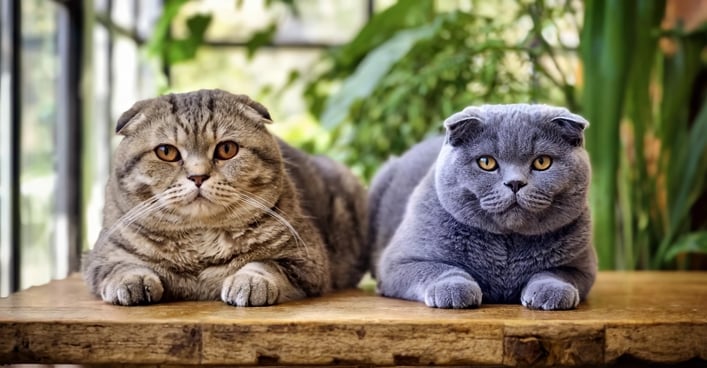
Scottish Fold: Ears fold forward and downward due to a cartilage defect. Kittens are born with straight ears; the fold develops at 3-4 weeks. Not all kittens in a litter will develop folds.
British Shorthair: Small, rounded, erect ears set wide apart, contributing to their open, "teddy bear" expression.
Coat and Appearance
Feature
Scottish Fold
British Shorthair
Coat Length
Short or long (Highland Fold)
Short only
Coat Texture
Dense and soft
Dense, crisp, and plush ("crisp pile carpet")
Signature Color
All colors/patterns accepted
Blue is most iconic, but all colors accepted
Eyes
Large, round, and wide-set
Large, round, typically copper or gold
Expression
Sweet, "owl-like" due to folded ears
Calm, round, and cherubic
Health Considerations: The Critical Divide
Scottish Fold Health Issues
The breed's defining trait is linked to a severe genetic condition:
Osteochondrodysplasia:
Cause: The same gene that folds the ears causes defective cartilage formation throughout the body.
Effects: Leads to progressive, painful arthritis, joint deformities, fusion, and mobility issues. Severity varies but all folded-ear cats are affected.
Ethical Stance: Breeding is opposed by major veterinary associations (e.g., Scottish Veterinary Association, International Cat Care) and is banned or restricted in several countries (Netherlands, Belgium, Austria).
Additional Concerns: Higher risk of ear infections (due to ear structure) and potential for cardiomyopathy.
British Shorthair Health Issues
A generally robust and healthy breed with a long lifespan (14-20 years). Primary concerns are manageable:
Hypertrophic Cardiomyopathy (HCM): A heart condition; responsible breeders screen for this.
Obesity: Their calm nature requires mindful diet and exercise.
Dental Disease: Regular dental care is recommended.
Health Comparison Summary
Factor
Scottish Fold
British Shorthair
Overall Health
Poor due to genetic disorder
Very Good
Genetic Burden
Severe (Osteochondrodysplasia)
Low to Moderate
Chronic Pain Risk
High (Inevitable)
Low
Typical Lifespan
11-14 years (often shorter)
14-20 years
Expected Vet Costs
Very High (Lifelong management)
Moderate
Ethical Concerns
Significant
Minimal
Temperament and Personality
Scottish Fold Personality
Nature: Sweet, gentle, affectionate, and often described as "people-oriented."
Activity: Moderately playful, known for sitting in a unique "Buddha" position.
Social: Adaptable, good with families and other pets, tends to follow owners.
Vocalization: Typically quiet with a soft voice.
Activity Level: Moderate (5/10)
British Shorthair Personality
Nature: Easygoing, calm, dignified, and independently affectionate. Not typically a "lap cat" but a loyal companion.
Activity: Low-energy; often happy to observe from a comfortable perch.
Social: Patient and excellent with children, but content with alone time.
Vocalization: Very quiet.
Activity Level: Low (3/10)
Temperament Comparison
Trait
Scottish Fold
British Shorthair
More Pronounced In
Playfulness
Moderate-High
Low
Scottish Fold
Independence
Moderate
High
British Shorthair
Sociability
High
Moderate
Scottish Fold
Adaptability
High
High
Tie
Demand for Attention
Moderate
Low
Scottish Fold
Cost of Ownership Analysis (2026 Estimates)
Initial Costs
Expense
Scottish Fold
British Shorthair
Purchase Price
$1,200 - $3,500
$900 - $3,000
Initial Vet Visit & Vaccinations
$300 - $600
$250 - $500
Initial Supplies
$300 - $600
$300 - $600
Total Initial Investment
$1,800 - $4,700
$1,450 - $4,100
Annual Ongoing Costs
Scottish Fold (Higher due to medical needs):
Food: $400 - $700
Veterinary Care & Pain Management: $1,300 - $2,500+
Insurance: $600 - $1,000
Annual Total: ~$2,300 - $4,200+
British Shorthair:
Food: $400 - $700
Routine Veterinary Care: $300 - $600
Insurance: $450 - $750
Annual Total: ~$1,150 - $2,050
Ethical Considerations: A Necessary Discussion
The Scottish Fold Controversy
Purchasing a Scottish Fold from a breeder directly supports the propagation of a known painful genetic disorder. Reputable animal welfare organizations globally advise against it.
Responsible Choice Paths:
Adopt, Don't Shop: If drawn to the personality, consider adopting a Scottish Fold or mix from a rescue. Be fully prepared for associated health costs.
Choose a Healthy Alternative: The British Shorthair offers a similar round-faced, sweet expression without the ethical and health dilemmas. Other alternatives include the American Shorthair or Exotic Shorthair.
Living Environment Needs
Scottish Fold: Requires an indoor-only environment with soft bedding, easy access to resources (consider ramps), and strict climate control. Their physical limitations must be accommodated.
British Shorthair: Highly adaptable to apartments or houses. An indoor or indoor/outdoor (in safe areas) lifestyle suits them. They need comfortable resting spots but are not demanding about vertical space.
Pros and Cons Summary
Scottish Fold
Pros:
Sweet, affectionate, and people-oriented temperament.
Unique and distinctive appearance.
Playful and adaptable to family life.
Cons:
Guaranteed genetic health disorder causing chronic pain.
Very high lifetime veterinary costs.
Significant ethical concerns; breeding is widely opposed.
Shorter lifespan.
Requires special environmental accommodations.
British Shorthair
Pros:
Generally excellent health and long lifespan.
Calm, easygoing, and low-maintenance temperament.
Patient and excellent with children.
Minimal ethical concerns regarding breed health.
Plush, easy-care coat.
Cons:
Can be prone to obesity without proper diet/exercise.
Independent; not overly cuddly or playful.
Can be expensive to purchase from a reputable breeder.
Final Verdict and Recommendation
Strong Recommendation: British Shorthair
For the vast majority of prospective owners seeking a healthy, long-lived, and emotionally stable companion with a classic look, the British Shorthair is the clear and responsible choice. It provides wonderful companionship without the heartbreak and financial strain of preventable genetic disease.
Choose a British Shorthair if: You value health, longevity, a calm demeanor, and ethical pet ownership.
If Considering a Scottish Fold
You should only proceed if you are committing to adopting a cat already in need (not buying from a breeder) and are fully prepared—financially and emotionally—for lifelong pain management and potential mobility challenges. Supporting the breeding of this cat perpetuates animal suffering.
Frequently Asked Questions (2026)
Q: Are Scottish Folds always in pain?
A: Yes, to varying degrees. All cats with the folded ear gene develop osteochondrodysplasia, a progressive and painful joint disease. Severity differs, but some level of discomfort and arthritis is inevitable.
Q: Why is breeding Scottish Folds considered unethical?
A: It intentionally breeds for a physical trait (folded ears) that is directly linked to a painful, lifelong skeletal disorder. Ethical breeding prioritizes health and temperament, not aesthetics that cause harm.
Q: Is it okay to buy a Scottish Fold from a breeder who tests for health problems?
A: No. The painful condition is caused by the very gene that creates the folded ears. There is no "healthy" folded-ear cat; testing cannot eliminate the fundamental genetic defect. Breeding any Scottish Fold, regardless of testing, perpetuates this issue.
Q: Do straight-eared Scottish Fold cats have health problems?
A: Yes. Even straight-eared Scottish Folds (often called "Straights") carry one copy of the defective gene and can still develop joint issues, though typically less severe than their folded-ear siblings.
Q: What is the best healthy alternative to a Scottish Fold?
A: The British Shorthair is the top alternative, offering a similar round face, sturdy build, and sweet nature without the associated health problems.
Disclaimer: This guide is intended for educational purposes. It presents factual information to promote informed and ethical decision-making in pet selection, with a strong emphasis on animal welfare. Always consult with a veterinarian for advice specific to your situation.
Get expert advice about cat care, behavior, nutrition, grooming, and training. Ask our AI cat care expert anything about your cat and receive professional guidance.