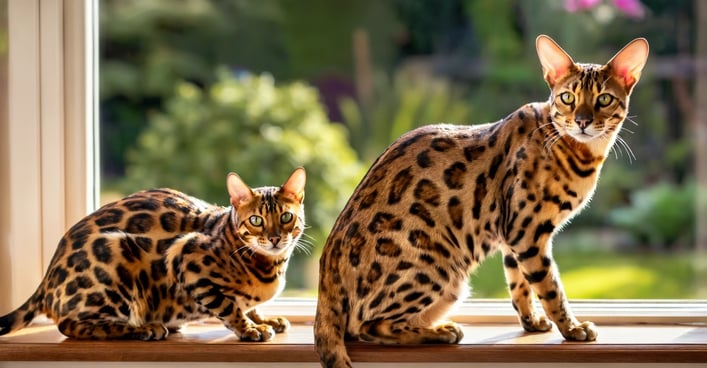
Savannah vs Bengal Cat: 2026 Breed Comparison Guide
Choosing between a Savannah and Bengal cat? Our 2026 guide compares size, personality, cost, legal issues, and care to help you decide on the perfect exotic feline companion.
Share this page
Savannah vs Bengal Cat: The Ultimate 2026 Breed Comparison
Two breeds captivate cat lovers seeking a touch of the wild: the statuesque Savannah and the muscular, spotted Bengal. Both boast stunning, exotic appearances that echo their wild ancestry, yet they differ profoundly in size, temperament, and legal status. This comprehensive 2026 guide breaks down every detail to help you choose the right extraordinary companion for your home.
Origins and History: A Tale of Two Hybrids
Savannah Cat Origins
The Savannah is a modern hybrid breed, developed by crossing domestic cats with the African Serval.
Key Historical Milestones:
1986: The first Savannah, named Sierra, was born from a Serval father and a domestic Siamese mother.
The breed is named after the Serval's native African savannah habitat.
Early generations (F1, F2) retain strong Serval traits.
Later generations (F3+) are more domesticated in temperament.
The International Cat Association (TICA) granted the breed championship status in 2012.
The Bengal was created by crossing domestic cats with the Asian Leopard Cat (ALC).
Key Historical Milestones:
1963: Breeder Jean Mill began the foundational breeding program.
The breed name derives from the ALC's scientific name, Prionailurus bengalensis.
Early generations (F1-F3) were direct hybrids.
By the F4 generation and beyond, Bengals are considered fully domestic in temperament.
The breed gained championship status with the Cat Fanciers' Association (CFA) in 1991.
Modern Note: Today's pet Bengals are almost exclusively SBT (Stud Book Tradition), meaning they are many generations removed from their wild ancestor and possess a predictable, domestic personality.
Physical Appearance: Spot the Difference
Size and Stature
Savannah Size by Generation:
Generation
Male Weight
Female Weight
Typical Height
F1-F2
17-25 lbs
13-20 lbs
14-17 inches
F3-F4
13-20 lbs
10-16 lbs
12-15 inches
SBT
12-18 lbs
9-15 lbs
11-14 inches
Bengal Size:
Gender
Weight Range
Typical Height
Male
10-18 lbs
10-14 inches
Female
8-12 lbs
9-12 inches
Key Distinction: Savannahs are notably taller and leaner with extremely long legs, while Bengals are more compact, muscular, and substantial in build. Both are larger than the average domestic cat.
Build and Body Type
Savannah Characteristics:
Tall, slender, and lanky physique
Exceptionally long legs and neck
Large, rounded ears with pronounced "ocelli" (eye spots on the back)
Deep chest and a long torso
Hooded eyes that contribute to an alert expression
Bengal Characteristics:
Powerful, athletic, and muscular build
Substantial body with a thick, tapered tail
Medium-length, strong legs built for leaping
Relatively small, rounded ears
Distinctive "nocturnal" eye shape
Coat Patterns and Colors
Savannah Coat:
Patterns: Bold, dark spots (sometimes elongated) or a marbled pattern.
Colors: Brown spotted tabby, silver spotted tabby, black (smoke), and snow.
Texture: Typically coarse to semi-coarse.
Bengal Coat:
Patterns: Prized for their rosettes (two-toned spots resembling a leopard's), spots, or marbling.
Colors: Brown, silver, and snow (seal lynx, seal mink, seal sepia).
Texture: Unique "pelt-like" feel—dense, soft, and luxurious.
Special Trait: The glitter gene, which makes the coat shimmer as if dusted with gold or pearl.
Personality and Temperament: Wild at Heart
Savannah Cat Personality
Savannahs are renowned for their:
Dog-like Devotion: They form intense bonds with their owners and often follow them from room to room.
High Intelligence: Excellent problem-solvers who can learn tricks, open doors, and play fetch.
Confident & Assertive: They are bold, curious, and rarely timid.
Vocal Communication: They use a wide range of chirps, meows, and hisses to communicate.
Love for Water: Many enjoy playing with faucets or even joining their owners in the shower.
Athletic Prowess: They are phenomenal vertical jumpers, easily reaching high shelves.
Bengal Cat Personality
Bengals are characterized by their:
Boundless Energy: They are perpetual motion machines with a strong need for activity.
Inquisitive Nature: They are clever and must investigate everything in their environment.
Confident & Bold: Outgoing and social, they often demand to be the center of attention.
Distinctive Vocals: They have unique voices and aren't shy about using them.
Water Fascination: Many are captivated by running water and may play in their water bowls.
Lifelong Playfulness: They retain their kitten-like exuberance well into adulthood.
Temperament Comparison Table
Trait
Savannah
Bengal
Energy Level
Very High
Very High
Affection Level
High (often dog-like)
Moderate to High
Independence
Moderate
Moderate
Vocalization
High
High
Playfulness
Very High
Very High
Trainability
Excellent
Excellent
Interest in Water
High
High
Grooming and Care: Low-Maintenance Coats
Both breeds are relatively easy to groom due to their short coats.
Savannah Grooming:
Brushing: Once a week to remove loose hair.
Shedding: Minimal to moderate.
Bathing: Rarely necessary unless they get into something messy.
Other: Monthly ear checks and nail trimming every 2-3 weeks.
Bengal Grooming:
Brushing: Once a week is sufficient.
Shedding: Very minimal (they have a single coat).
Bathing: Some Bengals enjoy it, making bath time easier.
Other: Similar nail and ear care as Savannahs. Their glitter coat shines with minimal effort.
Monthly Grooming Time Estimate: Approximately 1 to 1.5 hours for either breed.
Health and Lifespan
Savannah Health:
Average Lifespan: 12-20 years.
Common Concerns: Hypertrophic cardiomyopathy (HCM). Reproductive issues are common in F1-F3 males (often sterile). Later generations are generally robust.
Bengal Health:
Average Lifespan: 12-16 years.
Common Concerns: Hypertrophic cardiomyopathy (HCM), progressive retinal atrophy (PRA), and patellar luxation. Reputable breeders screen for these conditions.
Estimated Annual Healthcare Costs (2026)
Expense
Savannah
Bengal
Wellness Exam
$150 - $300
$150 - $300
Vaccinations
$80 - $150
$80 - $150
Genetic Screening
$150 - $300
$150 - $250
Pet Insurance (Monthly)
$40 - $70
$35 - $60
Annual Total
$890 - $1,740
$815 - $1,420
Legal Considerations: A Critical Factor
Savannah Cat Restrictions
Laws are primarily based on generation, with early generations (F1-F4) facing the most restrictions.
Location
F1-F2 Status
F3-F5 Status
SBT Status
New York City
Illegal
Illegal
Legal
Massachusetts
Illegal
Permit Required
Legal
Hawaii
Illegal
Illegal
Illegal
Georgia
Illegal
Illegal
Legal
Australia
Illegal
Illegal
Legal with Permit
Crucial Note: Always verify laws with your city, county, and state before considering a Savannah. Homeowners' associations, landlords, and insurers may also have restrictions.
Bengal Cat Restrictions
Bengals face far fewer legal hurdles. Most jurisdictions treat F4 and later generations (SBT) as domestic cats with no restrictions. Some areas may regulate F1-F3 hybrids. Always check local ordinances.
Cost of Ownership: Initial and Ongoing
Initial Purchase Price (2026 Estimates)
Savannah Cats:
Generation
Pet Quality
Show Quality
F1
$15,000 - $25,000+
$20,000+
F2
$5,000 - $10,000
$8,000 - $15,000
F3
$3,000 - $5,000
$5,000 - $8,000
F4+ / SBT
$1,000 - $3,000
$2,000 - $5,000
Bengal Cats:
Pet Quality: $1,000 - $2,500
Show Quality: $2,500 - $5,000+
Premium Colors (e.g., Silver): May add $500 - $1,000
Estimated Monthly Ongoing Costs
Category
Savannah
Bengal
High-Quality Food
$50 - $90
$50 - $90
Litter
$25 - $40
$25 - $40
Toys & Enrichment
$40 - $80
$40 - $80
Pet Insurance
$40 - $70
$35 - $60
Monthly Total
$155 - $280
$150 - $270
Living Environment & Lifestyle Fit
Ideal Home for a Savannah Cat
Space: Large homes with high ceilings and vertical space (cat trees, shelves).
Activity Level: Highly active households that can provide dedicated interaction.
Experience: Best for experienced cat owners, particularly for early generations.
Outdoor Access: A secure, outdoor "catio" enclosure is highly recommended.
Legal Compliance: Must be in an area where ownership is permitted.
Ideal Home for a Bengal Cat
Space: Ample room for running and climbing. They are notorious "escape artists," so a secure home is a must.
Activity Level: Families or individuals committed to multiple daily play sessions.
Enrichment: Constant mental stimulation is needed to prevent boredom (which can lead to mischief).
Experience: Helpful but not strictly required for later-generation Bengals.
Water Features: A cat water fountain can provide endless entertainment.
Exercise and Enrichment: Non-Negotiable Needs
Both breeds require 45-60 minutes of dedicated, interactive play daily.
Savannahs: Thrive with activities that utilize their jumping ability (feather wands, fetch). Leash training for outdoor exploration is highly successful.
Bengals: Love puzzle feeders, agility training, and rotating toy selections. They excel at learning tricks.
Pros and Cons Summary
Savannah Cat
Pros:
✅ Unmatched height and exotic, graceful appearance
✅ Extremely loyal, often compared to dogs
✅ Highly intelligent and trainable
✅ Long potential lifespan
✅ Generally healthy in later generations
Cons:
❌ Severe legal restrictions in many areas
❌ Prohibitively expensive for early generations
❌ Requires immense space and time commitment
❌ Can be too intense for first-time or sedentary owners
❌ May complicate housing and insurance
Bengal Cat
Pros:
✅ Breathtakingly beautiful, wild-looking coat with glitter
✅ More affordable and legally accessible than Savannahs
✅ Highly intelligent, playful, and entertaining
✅ Excellent family pets (F4+)
✅ Fewer generational legal issues
Cons:
❌ Very high energy—can be destructive if bored
❌ Demands constant mental and physical stimulation
❌ Strong prey drive
❌ Can be vocally demanding
❌ Some genetic health conditions to screen for
Final Decision: Which Cat Is Right for You?
Choose a Savannah Cat If...
You are captivated by their tall, leggy elegance and want the most exotic presence.
You live in an area with friendly laws and have a generous budget.
You have extensive space and experience with active, intelligent pets.
You desire a deeply loyal, dog-like companion and are ready for a significant commitment.
Choose a Bengal Cat If...
You adore the spotted/rosetted leopard look but need a more legally accessible option.
You want a highly interactive, entertaining cat with brilliant intelligence.
You have a active household ready to engage in daily play and training.
You seek an exotic breed with slightly fewer ownership hurdles and a lower entry cost.
Conclusion
Both the Savannah and Bengal offer a captivating blend of wild beauty and dynamic personality that is unmatched in the domestic cat world. The Savannah stands out as a loyal, leggy companion for those who can meet its legal and spatial challenges, while the Bengal delivers dazzling looks and clever antics in a more widely accessible package.
Your choice should hinge on a realistic assessment of your budget, local laws, living space, and lifestyle activity level. Whichever breed you choose, you are committing to a lifetime of providing exceptional stimulation, care, and companionship to a truly extraordinary feline.
Last Updated: February 2026 Disclaimer: Always verify the most current local and state laws before acquiring a Savannah or Bengal cat. Regulations can change.
Get expert advice about cat care, behavior, nutrition, grooming, and training. Ask our AI cat care expert anything about your cat and receive professional guidance.