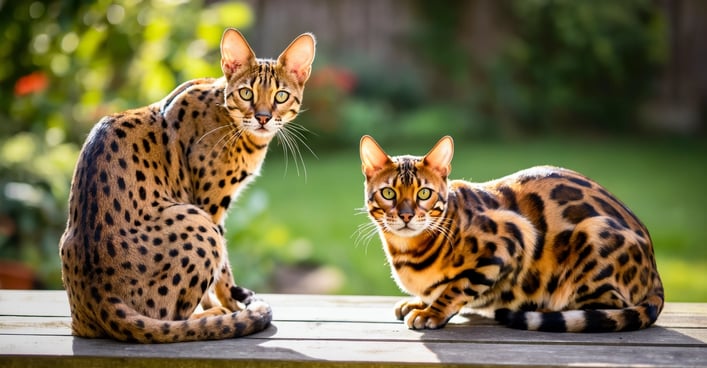
Savannah Cat vs Bengal Cat: The Ultimate 2026 Breed Comparison Guide
Choosing between a Savannah and a Bengal? Our complete guide compares personality, size, cost, and care to help you pick the right exotic spotted companion.
Share this page
Savannah Cat vs Bengal Cat: The Ultimate 2026 Breed Comparison Guide
Meta: Savannah vs Bengal—which exotic spotted cat is right for you? Compare personality, size, care requirements, and costs of these stunning hybrid breeds in our definitive guide.
Introduction
The Savannah and Bengal cats represent the pinnacle of wild aesthetics in domestic felines. Both boast stunning spotted coats and exotic appearances that turn heads, but beneath the surface, these breeds have distinct personalities, care requirements, and characteristics that set them apart.
This comprehensive 2026 comparison will help you understand which of these extraordinary breeds best fits your lifestyle, experience level, and home environment.
Loves extreme heights (provide very tall cat trees).
Common fascination with water.
Prone to destructive behavior if bored or under-stimulated.
Bengal Cat Personality
General Traits:
Highly intelligent and inventive
Very active and playful well into adulthood
Affectionate and social, but not overly clingy
Notably "talkative" with a wide range of chirps and meows
Famous for loving water
With Family:
Social, engaging, and likes to be involved in household activities
Playful and entertaining
May learn to fetch toys
Will climb on everything—cat-proofing is essential
Activity Level:
Very high. Needs dedicated active play sessions daily.
Thrives with interactive toys and puzzle feeders.
Water play (sinks, fountains, showers) is a common joy.
Can become mischievous or destructive if bored.
Personality Comparison Table
Trait
Savannah
Bengal
Energy Level
Extremely High
Very High
Intelligence
Exceptional
Very High
Affection Style
Selective, deep bonds
Social and engaging
Independence
Moderate
Moderate
Vocalization
Moderate
High ("talkative")
Trainability
High (dog-like)
High
Water Interest
Very Common
Very Common
Suitability for Beginners
F4+ only, with experience
With thorough preparation
Care and Lifestyle Requirements
Exercise and Stimulation Needs
Savannah Cat:
Critical: Minimum of 2-3 hours of active play and interaction daily.
Vertical space is non-negotiable (very tall cat trees, shelves).
A secure outdoor enclosure (catio) is strongly recommended.
Leash training is highly beneficial.
Puzzle feeders and rotating toys are mandatory to prevent boredom.
Bengal Cat:
High Needs: 1-2 hours of dedicated play daily.
Ample tall cat trees and climbing shelves.
Interactive play sessions (wand toys, laser pointers) are essential.
Provide water features (fountains, shallow pools) for play.
Puzzle toys and training sessions provide crucial mental stimulation.
Environmental Setup
Savannah Cat:
Secure, escape-proof home is a must.
Invest in very tall, sturdy climbing structures.
Supervised outdoor access or a secure enclosure is ideal.
Child locks on cabinets; they are adept at opening doors.
Ensure all windows and doors are securely screened.
Bengal Cat:
Comprehensive cat-proofing is essential.
Create a "highway" of climbing opportunities around the room.
Ensure safe access to water for play.
Protect valuables from being climbed on or knocked over.
Secure all screens—they are powerful jumpers.
Grooming and Diet
Grooming (Both Breeds):
Weekly brushing is sufficient to remove loose hair.
Both have minimal grooming needs and are good self-groomers.
Bathing is rarely needed, though some Bengals enjoy it.
Regular nail trimming is recommended.
Diet and Nutrition:
Savannah: Requires a high-quality, high-protein diet. May prefer raw or premium wet food. Larger portions than an average cat.
Bengal: Thrives on a high-protein diet. Quality wet food is recommended. Some lines can have sensitive stomachs, so avoid low-quality fillers.
For Both: Fresh water must always be available. Portion control is important to prevent obesity.
Health and Lifespan
Savannah Cat Health
Generally Healthy: Benefits from hybrid vigor due to outcrossing. No major breed-specific genetic issues are widely reported.
Considerations:
Early generations may have unique needs.
Proper socialization from a young age is critical.
Some veterinarians have specific protocols for rabies vaccination in hybrids.
Always check local and state laws regarding ownership.
Lifespan: 12-20 years, depending on generation and overall care.
Bengal Cat Health
Generally Healthy: A robust breed, but responsible breeders screen for known genetic conditions.
Potential Health Concerns to Screen For:
Hypertrophic Cardiomyopathy (HCM): A heart condition. Ask breeders for proof of parental screening.
Progressive Retinal Atrophy (PRA): Can lead to blindness. Genetic testing is available.
Pyruvate Kinase Deficiency (PK Def): A metabolic disorder. Reputable breeders test for it.
Lifespan: 12-16 years on average, with many living longer with excellent care.
Health Comparison Summary
Factor
Savannah
Bengal
Overall Health
Very Good
Good (with responsible breeding)
Genetic Testing
Limited
Well-established for major conditions
Hybrid Vigor
Strong
Moderate
Key Consideration
Legal ownership status
Importance of breeder health screening
Typical Lifespan
12-20 years
12-16 years
Cost of Ownership (2026 Estimates)
Initial Purchase & Setup Costs
Savannah Cat:
Item
Cost Range
F1 Savannah Kitten
$10,000 - $25,000+
F2 Savannah Kitten
$5,000 - $10,000
F3 Savannah Kitten
$3,000 - $5,000
F4+ Savannah Kitten
$1,000 - $3,000
Initial Vet Visit & Setup
$500 - $1,000
Total Initial (F4+)
$1,500 - $4,000
Bengal Cat:
Item
Cost Range
Pet Quality Kitten
$1,000 - $2,500
Show/Breeding Quality
$2,500 - $5,000+
Initial Vet Visit & Setup
$500 - $1,000
Total Initial
$1,500 - $6,000
Annual Recurring Costs
Savannah Cat (Annual):
Expense
Estimated Annual Cost
High-Quality Food
$600 - $1,200
Litter
$200 - $300
Routine Veterinary Care
$300 - $600
Toys, Enrichment & Replacements
$300 - $500
Pet Insurance (Highly Recommended)
$400 - $700
Total Annual
$1,800 - $3,300
Bengal Cat (Annual):
Expense
Estimated Annual Cost
High-Quality Food
$500 - $900
Litter
$200 - $300
Routine Veterinary Care
$300 - $500
Toys & Enrichment
$250 - $400
Pet Insurance
$300 - $500
Total Annual
$1,550 - $2,600
Lifetime Cost Estimate (15 Years):
Savannah (F4+): $28,500 - $53,500
Bengal: $24,750 - $45,000
Training and Intelligence
Both breeds are exceptionally smart and require positive, reward-based training and constant mental challenges.
Savannah Training Highlights:
Exceptional problem-solvers (can open doors, cabinets).
Excellent candidates for leash walking, fetch, and complex tricks.
Mental stimulation is not optional. Puzzle feeders, food-dispensing toys, and regular training sessions are mandatory.
Bengal Training Highlights:
Highly trainable and responsive to clicker training.
Enjoy agility courses and learning tricks.
Need a varied rotation of toys and games to prevent boredom. Teaching them to retrieve from water can be a fun activity.
Pros and Cons Summary
Savannah Cat
Pros:
Unmatched exotic and striking appearance
Exceptional intelligence and problem-solving skills
Potential for profound, dog-like loyalty
Unique and engaging personality
Generally robust health due to hybrid vigor
Cons:
Extremely high exercise and stimulation demands
Potential for destructive behavior if needs aren't met
Significant legal restrictions on early generations (F1-F3)
Very expensive to purchase, especially early gens
Not suitable for first-time cat owners
Requires a large amount of space and dedicated time
Bengal Cat
Pros:
Breathtakingly beautiful, wild-looking coat
Playful, social, and entertaining personality
Highly intelligent and trainable
Famous love of water play
No legal restrictions as a fully domesticated breed
More accessible price point than Savannahs
Cons:
Very high energy needs
Requires an actively engaged owner
Can be mischievous or destructive if bored
Often vocal, which may not suit all households
Will climb on everything—thorough cat-proofing needed
Prone to specific genetic conditions if not sourced responsibly
Making Your Choice: Which Cat Is Right For You?
Choose a Savannah Cat If...
You are a highly experienced cat owner.
You can dedicate 3+ hours daily to interactive play and engagement.
You have space for a large outdoor enclosure (catio).
You desire the most exotic appearance and dog-like traits.
You have verified that ownership is legal in your area.
Your budget accommodates high purchase and care costs.
You can extensively cat-proof your home.
Choose a Bengal Cat If...
You want an exotic appearance without legal complexities.
You can provide 2+ hours of active play daily.
You enjoy a social, talkative, and interactive companion.
You have ample vertical space for climbing.
You are prepared for a high-energy, intelligent pet.
You find their love of water endearing.
You are committed to sourcing a kitten from a reputable breeder who performs health screenings.
Frequently Asked Questions (FAQ)
1. Are Savannah cats good family pets?
F4 and later generation Savannahs can be excellent pets for experienced families with older children. F1-F3 generations are best for specialized, adult-only homes. All require immense commitment.
2. Do Bengal cats make good house pets?
Yes, for the right household. Bengals thrive with active families who can meet their high needs for play and interaction. They are not well-suited to sedentary lifestyles or being left alone for long periods.
3. Are Savannah cats legal everywhere?No. Laws vary dramatically by state, county, and city. Early generations (F1-F3) are restricted or banned in many areas, including Hawaii, New York City, and parts of Georgia. Always check your local ordinances before considering a Savannah.
4. Can these breeds live with other pets?
With careful, gradual introductions, both can coexist with cat-friendly dogs and other cats. However, their high prey drive makes them a serious threat to small pets like birds, rodents, or rabbits.
5. Can I leave them alone while I work?
Not ideally. Both breeds are prone to anxiety and boredom-induced destruction. If you work long hours, you must provide a companion animal (another active cat), arrange for a pet sitter, or invest in extensive automated enrichment.
6. Which breed is bigger?
Early-generation Savannahs (F1-F3) are dramatically larger and taller. Later-generation Savannahs (F4+) are closer in weight to Bengals but often retain a taller, lankier build.
Final Conclusion
Choosing between a Savannah and a Bengal is a decision that hinges on your lifestyle, experience, and resources. The Savannah offers an unparalleled exotic presence and unique challenges, particularly in early generations. The Bengal provides stunning wild beauty in a more consistently domestic (though still demanding) package.
Neither breed is a "low-maintenance" pet. They are commitments to a decade or more of active, engaged ownership. For the right person—someone who views a pet as a central part of daily life—both breeds offer rewards of intelligence, beauty, and companionship that are truly extraordinary.
Our strongest recommendation: Research exhaustively, connect with breed-specific rescue organizations, and if possible, foster or pet-sit before making your decision. Ensuring a match between your home and these remarkable cats is the first step to a successful, lifelong bond.
Disclaimer: This guide is for informational purposes. Laws regarding hybrid cat ownership change frequently. You are solely responsible for verifying all local, state, and federal regulations before acquiring any animal. Always seek a reputable breeder who prioritizes health, temperament, and ethics, or consider adoption from a breed-specific rescue.
Get expert advice about cat care, behavior, nutrition, grooming, and training. Ask our AI cat care expert anything about your cat and receive professional guidance.