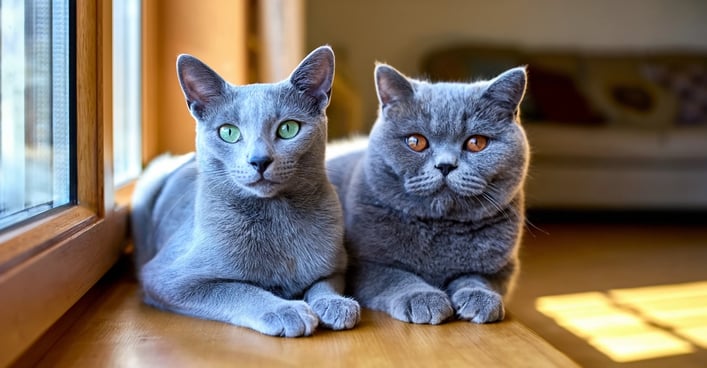
Russian Blue vs British Shorthair: The 2026 Breed Comparison Guide
Choosing between a Russian Blue and a British Shorthair? Our 2026 guide compares personality, care, health, and costs to help you find your perfect feline match.
Share this page
Russian Blue vs British Shorthair: The 2026 Breed Comparison Guide
Meta: Russian Blue vs British Shorthair—which breed is right for you? Compare personality, care requirements, health, and costs of these popular blue-gray cats.
Introduction
The Russian Blue and British Shorthair are two of the most sought-after blue-gray cat breeds, often mistaken for one another by casual observers. While they share a similar stunning coat color, these breeds possess distinct personalities, care needs, and physical characteristics.
This comprehensive 2026 comparison will clarify their differences and similarities, empowering you to choose the ideal feline companion for your lifestyle.
Weekly brushing recommended for dense, plush coat.
Sheds year-round with seasonal peaks; may need help reaching all areas.
Exercise & Diet
Russian Blue:
Exercise: Moderate needs. Enjoys climbing, jumping, and interactive play. Vertical space is essential.
Diet: Quality protein diet with portion control to maintain lean physique.
British Shorthair:
Exercise: Lower needs. Short play sessions suffice; prone to obesity, so encourage movement.
Diet: Weight management is crucial. Measured meals and portion control are mandatory.
Health and Lifespan
Russian Blue Health
Generally: A robust, healthy breed with no major widespread genetic issues.
Lifespan: 15-20+ years is common, with many living into their twenties.
Potential Concerns: Minimal; bladder stones are rare.
British Shorthair Health
Generally: A hardy breed but with a few known health considerations.
Lifespan: 14-20 years with proper care.
Potential Concerns: Prone to obesity. Genetic testing is available for Hypertrophic Cardiomyopathy (HCM), Hemophilia B, and Polycystic Kidney Disease (PKD).
Health Comparison Summary
Factor
Russian Blue
British Shorthair
Overall Health
Excellent
Very Good
Genetic Issues
Minimal
Few (Testable)
Average Lifespan
15-20+ years
14-20 years
Obesity Risk
Lower
Higher (Requires Management)
Ideal Living Environment
Best for Russian Blues
Ideal: Quiet, routine-oriented households with patient owners.
Good With: Older children, calm cats, respectful dogs, seniors, and working professionals.
Not Ideal For: Noisy/busy homes, families with very young children, or those wanting immediate affection.
Best for British Shorthairs
Ideal: Relaxed households, apartments, first-time owners, and busy families.
Good With: Children of all ages, other pets, dogs, and multi-pet households.
Not Ideal For: Those seeking a very active or consistently lap-seeking cat.
Cost Analysis (2026 Estimates)
Initial Costs
Russian Blue:
Item
Cost
Reputable Breeder
$600 - $1,500
Initial Vet Visit
$100 - $200
Supplies & Setup
$200 - $400
Spay/Neuter
$100 - $300
Total Initial
$1,000 - $2,400
British Shorthair:
Item
Cost
Reputable Breeder
$800 - $2,500
Initial Vet Visit
$100 - $200
Supplies & Setup
$200 - $400
Spay/Neuter
$100 - $300
Total Initial
$1,200 - $3,400
Annual & Lifetime Costs
Annual Costs (Food, Vet, Litter, etc.):
Russian Blue: $800 - $1,450
British Shorthair: $900 - $1,600
Estimated 15-Year Lifetime Cost:
Russian Blue: $13,000 - $24,000
British Shorthair: $14,500 - $27,400
Training and Intelligence
Russian Blue Trainability
Learning Ability: Excellent. Quick problem-solvers who enjoy clicker training and can learn tricks.
Tips: Use positive reinforcement, provide mental stimulation, and keep sessions short and engaging.
British Shorthair Trainability
Learning Ability: Moderate. Learns routines well but can be sensible and stubborn.
Tips: Keep it simple, use food rewards, be patient, and focus on basic commands.
Pros and Cons Summary
Russian Blue
Pros:
Hypoallergenic qualities (produces less Fel d 1 protein)
Extremely loyal and intelligent
Beautiful, unique appearance with a luminous coat
Long lifespan and generally excellent health
Cons:
Reserved with strangers; can be shy
Requires patience and a quiet environment
Not ideal for chaotic households
British Shorthair
Pros:
Easygoing, adaptable, and excellent with families
Independent "teddy bear" personality
Low-maintenance companionship
Available in many beautiful colors
Cons:
High predisposition to obesity
Not typically a cuddly lap cat
Some genetic health concerns to screen for
Making Your Choice: Which Cat is Right for You?
Choose a Russian Blue if you:
Desire a deeply loyal and intelligent companion.
Have a quieter, predictable household.
Are patient and appreciate subtle affection.
Have mild allergies (due to lower allergen production).
Enjoy interactive play with your pet.
Choose a British Shorthair if you:
Want an easygoing, undemanding companion.
Have children, other pets, or a busy lifestyle.
Are a first-time cat owner.
Prefer a calm, observant pet that is independent.
Live in an apartment.
Frequently Asked Questions (2026)
1. Are Russian Blue cats hypoallergenic?
While no cat is 100% hypoallergenic, Russian Blues produce lower levels of the Fel d 1 allergen, making them a better choice for some allergy sufferers. Always spend time with the breed before committing.
2. Do British Shorthairs like to be held and cuddled?
Most British Shorthairs prefer to sit beside you rather than on your lap. They are affectionate but on their own terms. Individual personalities vary, so meet the cat first.
3. Which breed is better for apartment living?
Both adapt well. British Shorthairs are particularly suited due to their calm, low-activity nature. Russian Blues need vertical space but do not require large floor areas.
4. Which breed has a longer lifespan?
Both are long-lived. Russian Blues often have a slight edge, with many living into their early 20s. British Shorthairs commonly live 15-20 years with proper care and weight management.
5. Are they good with dogs?
British Shorthairs are generally very tolerant and do well with respectful dogs due to their calm demeanor. Russian Blues can also adapt but require proper, gradual introductions and prefer calm canine companions.
Conclusion
The Russian Blue and British Shorthair offer two distinct paths to feline companionship. The Russian Blue is a sensitive, loyal intellectual who forms a deep bond with a chosen family. The British Shorthair is a gentle, undemanding teddy bear who brings calm affection to any home.
Your decision should hinge on your lifestyle, patience level, and the type of relationship you desire. Whichever breed you choose, you are welcoming a beautiful, loving companion capable of bringing joy for decades.
Final Advice: Always visit reputable breeders, meet adult cats of each breed, and prioritize individual personality alongside breed characteristics for the perfect match.
Disclaimer: Individual cats vary within breeds. This guide provides general breed tendencies. Always meet cats in person and consult with breeders and veterinarians when making your decision.
Get expert advice about cat care, behavior, nutrition, grooming, and training. Ask our AI cat care expert anything about your cat and receive professional guidance.