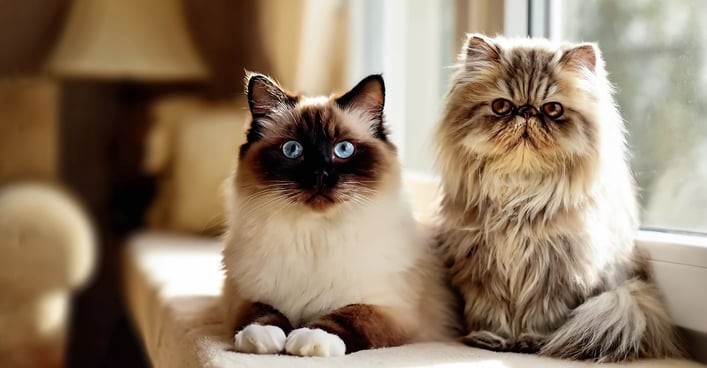
Ragdoll vs Persian Cat: The Ultimate 2026 Breed Comparison Guide
Choosing between a Ragdoll and a Persian? Our complete guide compares temperament, grooming, health, and costs to help you find your perfect feline companion.
Share this page
Ragdoll vs Persian Cat: The Ultimate 2026 Breed Comparison Guide
Ragdoll and Persian cats are two of the most iconic long-haired breeds, each offering a unique blend of beauty, personality, and care requirements. While both share luxurious coats and gentle natures, they differ dramatically in activity levels, grooming demands, and health considerations. This definitive guide for 2026 will help you understand these differences and choose the perfect companion for your lifestyle.
Historical Origins
Ragdoll Origins: The California Creation
Development Story:
The Ragdoll breed was developed in the 1960s in Riverside, California, by breeder Ann Baker. The foundation cat was a semi-feral white longhaired cat named Josephine, noted for her exceptionally docile temperament and tendency to go completely limp when handled. Baker selectively bred Josephine and her offspring, trademarking the "Ragdoll" name and establishing a unique breeding program. The breed quickly gained popularity for its large size, striking blue eyes, and famously relaxed disposition.
Name Origin: Derived from the breed's tendency to go limp like a ragdoll when picked up.
Persian Origins: The Ancient Aristocrat
Development Story:
Persian cats boast ancient lineage, originating from the high plateaus of Persia (modern-day Iran). Their long, dense coats evolved as protection against the cold climate. First imported to Europe in the 1600s, they became immediate status symbols among the nobility. Over centuries, selective breeding—particularly in England and America—has emphasized their luxurious coat and distinctive flat-faced (brachycephalic) features, especially in show lines.
Key Facts:
Origin: Persia (modern Iran)
First Imports: 1600s to Europe
Status: One of the oldest recognized cat breeds
Name Origin: Named for their country of origin.
Physical Characteristics: A Side-by-Side Look
Size and Build
Feature
Ragdoll
Persian
Male Weight
15-20 lbs (6.8-9.1 kg)
9-14 lbs (4.1-6.4 kg)
Female Weight
10-15 lbs (4.5-6.8 kg)
7-11 lbs (3.2-5.0 kg)
Body Type
Large, muscular, semi-longbody
Medium, cobby (stocky), compact
Bone Structure
Substantial and heavy
Medium and sturdy
Leg Length
Medium
Short
Overall Impression
Large, imposing, powerful
Compact, round, and substantial
Key Difference: Ragdolls are significantly larger and heavier than Persians, which impacts food costs, space needs, and how you handle them.
Coat and Grooming
Ragdoll Coat:
Length & Texture: Semi-longhaired with a silky, rabbit-like texture. Minimal undercoat reduces matting.
Shedding: Moderate.
Colors & Patterns: Colorpoint patterns only (seal, blue, chocolate, lilac, flame, cream) in colorpoint, mitted, or bicolor.
Persian Coat:
Length & Texture: Very long, flowing, and dense with a fine, cottony undercoat and silky topcoat. High matting tendency.
Shedding: Heavy.
Colors & Patterns: Virtually all colors and patterns (over 200 combinations), including solid, tabby, bicolor, and Himalayan (colorpoint).
Grooming Comparison Table:
Aspect
Ragdoll
Persian
Daily Brushing
Recommended
Required
Professional Grooming
Optional (for maintenance)
Often necessary (for dematting, hygiene clips)
Mat Prevention Effort
Moderate
Significant
Bathing Frequency
Every 4-6 weeks
Every 4-6 weeks
Face Cleaning
Occasionally
Daily (for tear stain prevention)
Head and Facial Features
Ragdoll:
Head: Broad, modified wedge shape.
Eyes: Large, oval, and always blue.
Nose: Medium length with a gentle curve.
Expression: Sweet and open.
Persian:
Head: Round and massive.
Eyes: Large, round, and come in various colors (copper, blue, green, odd-eyed).
Nose: Short, snub nose (extremely short in "show" or "peke-face" types).
Expression: Flat-faced (brachycephalic).
Important Note: Persian facial structure varies. "Doll face" or "traditional" Persians have a less extreme profile and fewer associated health issues than the flat-faced "show" type.
Temperament and Personality
Personality Traits at a Glance
Trait
Ragdoll
Persian
Activity Level
Low to Moderate
Very Low
Playfulness
Moderate
Low
Affection Level
Very High (dog-like)
High (on their terms)
Independence
Low (Velcro cat)
Moderate
Vocalization
Quiet, soft voice
Quiet
Social Needs
High (can get lonely)
Moderate
Ragdoll: The "Puppy Cat"
Signature Trait: Goes completely limp and relaxed when held.
Behavior: Tends to follow owners from room to room, greets them at the door.
Companionship: Highly interactive, playful, and gentle. Often enjoys fetch and can be leash-trained.
Best For: Families with children, multi-pet households, and owners seeking an engaged, affectionate shadow.
Persian: The "Lap Ornament"
Signature Trait: Sedentary, dignified, and calm.
Behavior: Prefers observing from a comfortable perch. Content to be a beautiful, decorative presence.
Companionship: Affectionate with trusted humans but less demanding. Enjoys short, gentle play sessions.
Best For: Quiet households, apartment dwellers, and those who appreciate a serene, low-energy companion.
Care and Lifestyle Requirements
Exercise and Space
Ragdoll: Needs 20-30 minutes of interactive play daily. Enjoys climbing cat trees and benefits from having space to move. Prone to obesity without activity.
Persian: 10-15 minutes of gentle play is sufficient. A true couch potato with minimal climbing instinct. Perfectly suited for small apartments.
Grooming Commitment
Ragdoll Grooming (Moderate):
Brush 2-3 times per week with a stainless steel comb.
Focus on areas behind ears and the "britches" (hind legs).
Professional grooming is optional but helpful during shedding seasons.
Persian Grooming (Intensive):
Daily brushing is non-negotiable to prevent painful mats.
Use a wide-tooth comb for the undercoat, followed by a finer comb.
Daily face cleaning to manage tear stains.
Professional grooming every 6-8 weeks is highly recommended for many owners.
Estimated Annual Grooming Costs:
Expense
Ragdoll
Persian
Brushes/Combs
$30 - $50
$40 - $60
Shampoo & Conditioner
$20 - $40
$30 - $50
Professional Grooming
$0 - $200
$300 - $600
Wipes & Cleaning Supplies
$20 - $40
$50 - $100
Annual Total
$70 - $330
$420 - $810
Health and Lifespan
Common Health Concerns
Ragdoll:
Hypertrophic Cardiomyopathy (HCM): A form of heart disease. Responsible breeders screen for this.
Polycystic Kidney Disease (PKD): Can occur, though less prevalent than in Persians. DNA testing is available.
Obesity: A risk due to their laid-back nature.
Average Lifespan: 12-17 years.
Persian:
Polycystic Kidney Disease (PKD):Very common. A DNA test is essential before purchasing a kitten.
Brachycephalic Syndrome: Breathing difficulties, especially in show-type Persians.
Dental Malocclusion: Misalignment of teeth due to facial structure.
Eye Conditions: Chronic tearing, entropion, and cherry eye.
Heat Sensitivity: Poor tolerance for hot environments.
Average Lifespan: 10-15 years (often shorter for extreme flat-faced types).
Estimated Annual Veterinary Costs:
Expense
Ragdoll
Persian
Routine Checkups/Vaccinations
$200 - $400
$300 - $500
Grooming-Related Issues (skin infections, mats)
Low
Moderate-High
Respiratory Issue Management
Low
Moderate-High
Kidney & Dental Monitoring
Moderate
Moderate-High
Annual Estimate
$400 - $700
$600 - $1,000+
Cost of Ownership Breakdown (2026 Estimates)
Initial Acquisition Cost
Source
Ragdoll
Persian
Reputable Breeder (Pet Quality)
$1,000 - $2,500
$800 - $2,000
Show Quality
$2,000 - $4,000
$1,500 - $3,500
Adoption/Rescue
$100 - $400
$100 - $400
Annual Care Costs
Expense
Ragdoll
Persian
High-Quality Food
$600 - $900
$400 - $700
Litter
$150 - $250
$150 - $250
Routine Veterinary Care
$400 - $700
$600 - $1,000
Grooming (Supplies & Pro)
$70 - $330
$420 - $810
Toys, Beds, & Supplies
$100 - $200
$50 - $150
Total Annual Range
$1,320 - $2,380
$1,620 - $2,910
Which Breed Is Right For You?
Choose a Ragdoll If You...
Desire a large, interactive, and dog-like companion.
Have time for daily play and don't mind a cat that follows you everywhere.
Want moderate grooming needs (a few times a week).
Live in a family-friendly or multi-pet home.
Are captivated by their signature blue eyes and floppy "ragdoll" relaxation.
Choose a Persian If You...
Prefer a calm, quiet, and dignified lap cat.
Have a serene, adult-oriented household or live in an apartment.
Are committed to (or can budget for) daily grooming and professional care.
Can provide a climate-controlled, indoor-only environment.
Cherish their luxurious, flowing coat and regal appearance.
Final Verdict
Both Ragdolls and Persians are exceptional companion breeds that offer a lifetime of love. Your choice ultimately hinges on your lifestyle:
The Ragdoll is for the active, engaged owner who wants a participatory family member with more manageable grooming.
The Persian is for the serene admirer who can dedicate significant time and resources to maintenance in exchange for a graceful, tranquil presence.
Whichever you choose, ensure you source your kitten from a responsible breeder who conducts essential health screenings (HCM for Ragdolls, PKD for Persians) or consider giving a deserving adult cat a home through breed-specific rescue.
Related Articles for 2026:
The Complete Guide to Ragdoll Cat Care
Persian Cat Grooming: A Step-by-Step Master Guide
Best Cat Brushes and Combs for Long-Haired Breeds
Understanding Brachycephalic Syndrome in Flat-Faced Cats
Get expert advice about cat care, behavior, nutrition, grooming, and training. Ask our AI cat care expert anything about your cat and receive professional guidance.