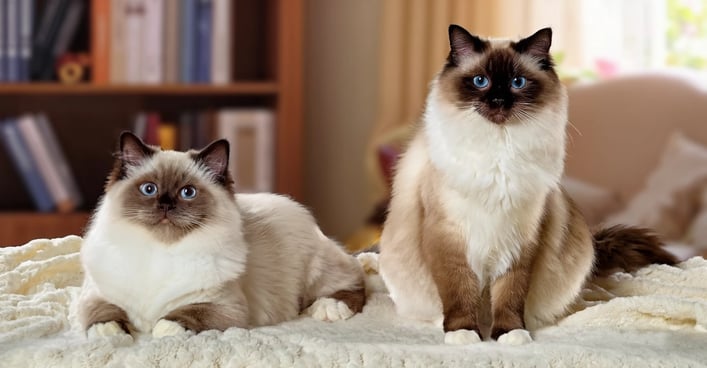
Ragdoll vs Birman Cat: A Complete 2026 Comparison Guide
Discover the key differences between Ragdoll and Birman cats, from temperament and grooming to health and cost, to find your perfect feline companion.
Share this page
Ragdoll vs Birman Cat: A Complete 2026 Comparison Guide
By Emily Rodriguez, Certified Animal Behaviorist | Published: January 15, 2026 | Reading Time: 12 minutes
Introduction
With their stunning blue eyes, semi-long coats, and gentle dispositions, Ragdoll and Birman cats are often confused. Both breeds are renowned for their affectionate, people-oriented natures, making them beloved family companions worldwide. This detailed 2026 guide compares their histories, personalities, care needs, and costs to help you make an informed decision for your home.
Breed Histories
Ragdoll Origins
Modern Development:
Origin: California, USA
Founder: Ann Baker in the 1960s
Ancestry: Persian/Angora-type cats, with possible Birman influence
Status: A relatively modern breed
Ann Baker's breeding program was shrouded in unsubstantiated claims, including wild or alien cat genetics. Modern DNA testing confirms standard domestic cat ancestry.
Ragdoll vs Birman Cat: A Complete 2026 Comparison Guide - Articles
Controversial Beginnings:
Name Origin:
The breed's name comes from their tendency to go completely limp and relaxed when held, much like a child's ragdoll toy.
Birman Origins
Ancient and Sacred:
Origin: Myanmar (Burma)
Sacred Status: Revered as temple cats
Legend: Believed to be created by divine intervention
Formal Recognition: 1920s in France
The Sacred Legend:
Legend tells of white temple cats whose fur turned golden and eyes sapphire blue upon their priest's death, with their paws remaining white as a symbol of purity. These distinctive "gloves" remain the breed's hallmark.
Historical Reality:
Birmans were likely developed through selective breeding of Siamese, Persian, and local Southeast Asian cats, refined further in France.
Physical Characteristics Comparison
Size and Build
Feature
Ragdoll
Birman
Larger Breed
Male Weight
15-20 lbs (6.8-9.1 kg)
10-15 lbs (4.5-6.8 kg)
Ragdoll
Female Weight
10-15 lbs (4.5-6.8 kg)
6-10 lbs (2.7-4.5 kg)
Ragdoll
Body Type
Large, heavy, muscular
Medium, stocky, substantial
Ragdoll
Bone Structure
Substantial, heavy-boned
Medium
Ragdoll
Length
Long, rectangular body
Medium length
Ragdoll
Size Verdict: Ragdolls are among the largest domestic cat breeds. Birmans are a medium-sized, solidly built breed.
Coat Comparison
Feature
Ragdoll
Birman
Length
Semi-long, plush, and fluffy
Semi-long, silky
Texture
Soft, dense, rabbit-like
Silky, single coat with minimal undercoat
Undercoat
Moderate
Minimal
Matting Tendency
Moderate (requires regular care)
Low
Grooming Needs
2-3 times weekly
Weekly
Shedding
Moderate, seasonal
Moderate
Coat Differences:
Ragdoll: Has a plush, dense coat that can mat without consistent grooming.
Birman: Features a silkier, easier-to-maintain coat that is less prone to tangling.
Indoor-only living (they lack strong survival instincts).
Families with gentle children.
Multi-pet households (with proper introductions).
Special Considerations:
Prone to separation anxiety; dislike being alone for long periods.
Prefer ground-level activities over climbing.
Their large size requires adequate space.
Best Home for a Birman
Ideal Environment:
Adapts to various household activity levels.
Homes with vertical space (cat trees, shelves).
Strictly indoor living.
Families or individuals seeking an interactive pet.
Gets along well with other pets.
Special Considerations:
More adaptable to change than Ragdolls.
Intelligent and playful, needing mental stimulation.
Also thrives on companionship and shouldn't be left alone excessively.
Pros and Cons Summary
Ragdoll Pros
Extremely affectionate and love being held.
Remarkably docile and floppy nature.
Exceptionally patient with children.
Quiet with minimal vocalization.
Dog-like, interactive companionship.
Strikingly beautiful appearance.
Calm presence ideal for relaxed homes.
Social and often good with strangers.
Ragdoll Cons
Health issues like HCM require monitoring.
Must be indoor-only due to low survival instincts.
Not avid climbers; limited interest in heights.
Prone to separation anxiety.
Moderate grooming needs to prevent mats.
Very large size requires ample space.
High initial purchase price.
Lower playfulness may not suit very active owners.
Birman Pros
Generally excellent health with few genetic problems.
Easier grooming needs due to silky coat.
Playful and retains kitten-like energy.
Intelligent and trainable.
Long lifespan, often reaching 18-20 years.
Adaptable to different home environments.
Beautiful, distinctive appearance with white gloves.
Gentle and sweet-natured.
Birman Cons
Limited availability compared to Ragdolls.
Can be expensive due to rarity.
Needs companionship to avoid anxiety.
Must be kept indoors.
Can gain weight if diet isn't managed.
May be reserved initially with new people.
Potential waitlists for kittens from reputable breeders.
Final Verdict: Which Cat Is Right For You?
Choose a Ragdoll If:
You desire an extremely docile, "floppy" cat that loves to cuddle.
You have a calm, quiet household and are home often.
You want a dog-like companion that follows you around.
You don't mind committing to regular grooming sessions.
You appreciate a large, plush, and stunning cat.
Choose a Birman If:
You want a playful yet gentle and intelligent companion.
You prefer a cat with lower-maintenance grooming needs.
You value a breed known for robust health and longevity.
You can provide vertical space for climbing and perching.
You are captivated by their sacred legend and unique white gloves.
Shared Qualities
Both breeds are:
Affectionate, people-oriented companions.
Colorpoint cats with beautiful blue eyes.
Best suited for indoor-only living.
Generally quiet and gentle.
Wonderful additions to families and require companionship.
Frequently Asked Questions (2026)
Q: Do all Ragdolls really go limp when picked up?
A: While this "ragdoll" trait is characteristic and gives the breed its name, individual cats vary. Many are exceptionally relaxed, but not every cat will display this behavior to the same degree.
Q: Are Birmans truly from ancient Burma?
A: Their romantic legend places them in Burmese temples. Historically, they were developed as a formal breed in 1920s France, likely from Siamese, Persian, and local cat ancestry.
Q: Which breed is more suitable for families with young children?
A: Both are excellent choices due to their gentle natures. Ragdolls are often more tolerant of frequent handling due to their extreme docility. Birmans are also gentle but may appreciate slightly calmer interactions.
Q: Can either breed go outside?
A: No. Both Ragdolls and Birmans are indoor-only cats. They lack strong survival instincts and are vulnerable to traffic, other animals, and disease outdoors.
Q: Which breed typically has a longer lifespan?
A: Birmans often live longer, with a typical range of 15-20 years. Ragdolls generally live 12-17 years, though with excellent care, many individuals exceed these averages.
Q: Are Ragdolls or Birmans hypoallergenic?
A: No cat breed is truly hypoallergenic. All cats produce the Fel d1 protein, the primary allergen. Some individuals may react less to one breed or cat, but this is unpredictable.
Q: Which is generally more expensive?
A: Both are pedigreed breeds with significant costs. Ragdolls are often more readily available, which can affect price. Birmans may command higher prices from specialist breeders due to their relative rarity. Always prioritize reputable breeders who conduct health testing.
Disclaimer: Individual cat personalities and needs can vary within any breed. This guide reflects general breed tendencies. Always spend time with a cat and consult with breeders or shelters before making your final decision.
Get expert advice about cat care, behavior, nutrition, grooming, and training. Ask our AI cat care expert anything about your cat and receive professional guidance.