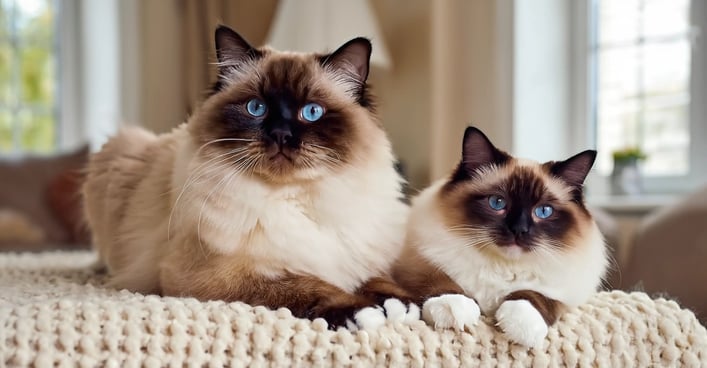
Ragdoll vs. Birman Cat: A Complete Breed Comparison Guide for 2026
Can't decide between a Ragdoll and a Birman? Compare their size, temperament, grooming needs, and health to find the perfect gentle, blue-eyed companion for your home.
Share this page
Ragdoll vs. Birman Cat: A Complete Breed Comparison Guide for 2026
With their stunning colorpoint coats, mesmerizing blue eyes, and famously gentle natures, Ragdolls and Birmans are two of the most sought-after cat breeds for families. While they share a similar elegant appearance, they possess distinct histories, personalities, and care needs. This detailed 2026 guide will help you understand the key differences and decide which affectionate "gentle giant" is the right fit for your lifestyle.
Origins and History: From California to Burma
Ragdoll Origins
Origin: United States (Riverside, California), 1960s
Developed by breeder Ann Baker from a white Angora-type cat named Josephine, the Ragdoll is a relatively modern breed. Its name derives from the breed's tendency to go completely limp and relaxed when held, much like a child's ragdoll toy. Early breeding practices were controversial and shrouded in marketing myths (like alien DNA experiments), but the breed's core traits—docility, large size, and pointed patterns—were firmly established.
Selectively bred for an exceptionally docile temperament.
Emphasis on large size, silky semi-longhair, and blue eyes.
Recognized by the Cat Fanciers' Association (CFA) in 1993.
Birman Origins
Origin: Burma (Myanmar), with modern development in France
The Birman, or Sacred Cat of Burma, is steeped in ancient legend. Lore tells of white temple cats with golden eyes whose fur transformed to a colorpoint pattern with blue eyes as a blessing, their paws remaining white as a symbol of purity. Historically, the breed was nearly lost during WWII but was rebuilt in France through careful outcrossing.
Key Historical Facts:
Origins are ancient but mysterious; first officially recognized in France in 1925.
Nearly extinct after WWII; revived using Persian and Siamese bloodlines.
Recognized by the CFA in 1967.
Physical Characteristics: Size, Coat, and Key Differences
Size Comparison: The Most Noticeable Difference
Feature
Ragdoll
Birman
Male Weight
15-20 lbs (can exceed 25 lbs)
10-15 lbs
Female Weight
10-15 lbs
6-10 lbs
Build
Large, substantial, rectangular
Medium, semi-cobby, rounded
Maturation
Slow; reaches full size around 4 years
Faster; full size by 2-3 years
The Ragdoll is a true giant, with males often rivaling small dogs in weight. The Birman is a more moderately sized, sturdy cat.
Coat and Coloring: Patterns Tell the Tale
Ragdoll Coat:
Texture: Semi-long, silky, with minimal undercoat.
Patterns: Comes in three patterns: Colorpoint (dark extremities), Mitted (colorpoint with white paws/chin), and Bicolor (with a white inverted 'V' on the face).
Colors: Seal, blue, chocolate, lilac, red, cream, plus tortie and lynx (tabby) variations.
Birman Coat:
Texture: Medium-long, silky single coat (no undercoat).
Pattern: Only one pattern: Colorpoint with pristine white "gloves" on all four paws. The white must be symmetrical.
Colors: Traditional seal, blue, chocolate, and lilac points, with tortie and lynx variations. The body has a distinctive golden-beige "goldening" hue.
Key Physical Differences at a Glance
Feature
Ragdoll
Birman
Size
Substantially larger
Moderate, medium-sized
Signature Marking
May have white (mitted/bicolor) or not
Always has white gloves
Paw Color
Same as point color unless mitted/bicolor
White gloves are mandatory
Eye Shape
Large, oval blue eyes
Almost round blue eyes
Head Shape
Broad, wedge-shaped
Rounded skull with full cheeks
Temperament and Personality: Gentle Giants with Different Vibes
Shared Wonderful Traits
Both breeds are celebrated for their:
Gentle, Patient Dispositions: Excellent with children and tolerant of handling.
Affectionate, "Velcro" Nature: They form strong bonds, follow owners, and love to be involved.
Quiet Voices: They communicate with soft chirps and meows, not loud yowls.
Social Butterflies: Typically get along very well with other cats, dogs, and people.
Ragdoll Personality: The Ultimate Lap Cat
Extremely Relaxed: Lives up to its name; many go limp when picked up.
Docile & Trusting: Remarkably calm, often to the point of lacking street smarts. Must be indoor-only.
Low to Moderate Energy: Content with lounging and observing. Enjoys play but isn't hyper.
Playfully Gentle: More active and inquisitive than the Ragdoll; retains kitten-like playfulness.
Intelligent & Interactive: Can learn tricks, play fetch, and enjoys puzzle toys.
Moderate Energy: Enjoys daily interactive play sessions and appreciates cat trees.
Perfect For: Active families, owners who want an engaging but mild-mannered companion.
Temperament Comparison Table
Trait
Ragdoll
Birman
Activity Level
Low
Moderate
Playfulness
Moderate
Moderate to High
Independence
Very Low (Very people-oriented)
Low (People-oriented)
Handling Tolerance
Exceptional
Very High
Intelligence
Average
Above Average
Best Environment
Calm, quiet homes
Adaptable to active homes
Care and Maintenance: Grooming, Health, and Cost
Grooming Needs
Both breeds have moderate, similar grooming requirements due to their silky coats that resist matting.
Frequency: Brush 2-3 times per week with a wide-tooth comb or slicker brush.
Shedding: Moderate; seasonal increases in spring/fall.
Special Note for Birmans: Their white gloves may require occasional gentle cleaning to stay pristine.
Health Considerations
Responsible breeding and screening are crucial for both breeds.
Common Health Concerns:
Hypertrophic Cardiomyopathy (HCM): A genetic heart condition. Annual screening via echocardiogram is recommended for both breeds.
Ragdoll-Specific: Prone to bladder stones (calcium oxalate) and have a higher obesity risk due to lower activity.
Birman-Specific: Some lines may have a predisposition to kidney issues and a rare genetic condition called hypotrichosis (hair loss).
Life Expectancy: Both can live long, healthy lives: 12-17 years for Ragdolls, 12-16 years for Birmans.
Cost Breakdown (2026 Estimates)
Initial Purchase from a Reputable Breeder:
Ragdoll: $800 - $3,500 (pet to show quality)
Birman: $600 - $3,000 (pet to show quality)
Always prioritize breeders who perform health screenings (HCM, genetic tests).
Approximate Monthly Care Costs:
Expense
Ragdoll
Birman
High-Quality Food
$40 - $60
$35 - $55
Litter
$20 - $30
$20 - $30
Insurance/Medical Fund
$30 - $50
$25 - $45
Supplies & Enrichment
$30 - $50
$30 - $55
Total Monthly
$120 - $190
$115 - $185
Which Breed Is Right For You? The Final Decision
Choose a Ragdoll If You Want:
A large, floppy, ultra-calm living "teddy bear."
A cat that epitomizes relaxation and is content being a lap cat.
An exceptionally patient pet for a quiet or gentle household.
You can commit to a strict indoor-only lifestyle to protect this trusting breed.
Choose a Birman If You Want:
A medium-sized, elegant cat with the iconic white gloves.
A gentle but more playful and interactive intelligence.
A companion that adapts well to an active family environment.
A cat with a fascinating legendary history and a sweet, innocent expression.
You'll Be Happy with Either Breed If:
You seek a devoted, affectionate, and gentle feline family member.
You have children or other pets.
You prefer a quiet, non-destructive companion.
You are committed to providing a safe, indoor-only home with plenty of love.
Conclusion
Both the Ragdoll and Birman offer unparalleled companionship, blending stunning beauty with a serene and loving temperament. Your choice ultimately hinges on your lifestyle:
The Ragdoll is the quintessential relaxed companion, offering profound calm and a larger-than-life cuddle presence.
The Birman is the playful and elegant charmer, providing gentle engagement and a touch of mischievous intelligence.
Whichever you choose, you are welcoming a devoted, beautiful soul into your home. The most critical step is finding a responsible, ethical breeder who prioritizes health and temperament, ensuring your new family member thrives for years to come.
Related Articles for 2026:
Best Family-Friendly Cat Breeds for Homes with Children
The Essential Guide to Indoor Cat Enrichment and Safety
Pro Grooming Tips for Silky Semi-Longhaired Cats
Understanding Feline HCM: Screening and Prevention for Breeders and Owners
Get expert advice about cat care, behavior, nutrition, grooming, and training. Ask our AI cat care expert anything about your cat and receive professional guidance.