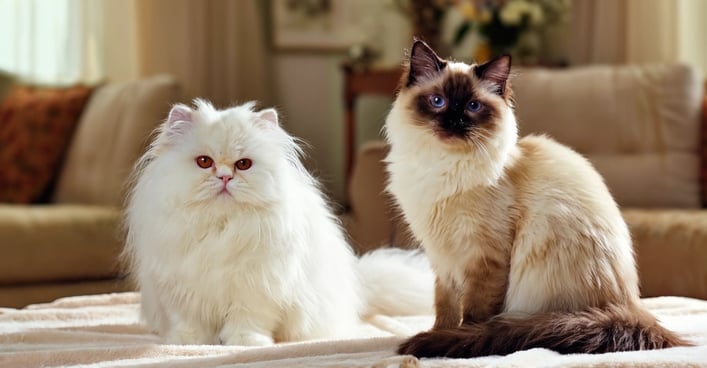
Persian vs Himalayan Cat: The Complete 2026 Breed Comparison
Deciding between a Persian and a Himalayan cat? Our 2026 guide compares their history, personality, grooming needs, and health to help you choose the perfect fluffy companion.
Share this page
Persian vs Himalayan Cat: The Complete 2026 Breed Comparison
Choosing between a Persian and a Himalayan cat? While both share the iconic flat face and luxurious long coat, they possess distinct personalities, histories, and care needs. This definitive 2026 guide provides a detailed comparison to help you select the ideal breed for your home and lifestyle.
Persian vs Himalayan Cat: The Complete 2026 Breed Comparison - Articles
Feature
Persian Cat
Himalayan Cat
Origin
Iran (Persia)
United States (Persian-Siamese Hybrid)
Weight
7-12 lbs
7-12 lbs
Lifespan
12-17 years
12-15 years
Coat
Long, dense, over 80 colors/patterns
Long, color-point pattern only
Personality
Calm, dignified, reserved, gentle
Playful, affectionate, social, intelligent
Grooming Needs
Very High (Daily)
Very High (Daily)
Exercise Needs
Low
Moderate
Eye Color
Copper, Blue, Green, Odd-eyed
Vivid Blue only
Origins and History
Persian Cat History
The Persian is one of the world's oldest and most iconic cat breeds. Originating from Persia (modern-day Iran), they were introduced to Europe in the 1600s, captivating aristocrats with their luxurious coats and distinctive features. By the late 19th century, selective breeding had solidified their flat-faced (brachycephalic) look and dense coat, making them a cornerstone of the pedigree cat world.
Himalayan Cat History
The Himalayan is not a naturally occurring breed but a deliberate hybrid. Developed in the 1930s and 1950s by crossing Persians with Siamese cats, breeders aimed to combine the Persian's luxurious coat and body type with the Siamese's striking color-point pattern. Named for the Himalayan rabbit, they are considered a color-point variety of the Persian by most major cat registries.
Physical Appearance
Persian Cat Appearance
Persians are the epitome of feline luxury with a distinctive, brachycephalic structure.
Head & Face: Large, round head with a pronounced flat face and short nose.
Eyes: Large, round, and expressive; colors include copper, blue, green, or odd-eyed.
Body: Cobby (stocky), low-to-the-ground body with short, thick legs.
Coat: An extremely long, thick, flowing double coat that comes in a vast array of over 80 colors and patterns.
Key Consideration: Their flat face requires daily cleaning to manage tear staining and can contribute to brachycephalic syndrome.
Himalayan Cat Appearance
Himalayans share the Persian's body but are defined by their unique coloring.
Color Points: Distinct dark coloring on the face (mask), ears, legs, paws, and tail.
Body Color: Lighter cream or white body, creating a beautiful contrast with the points.
Eyes: Always a striking, vivid blue, inherited from their Siamese ancestry.
Coat & Pattern: The same long, dense coat as the Persian, but only in color-point patterns (seal, blue, chocolate, lilac, flame, cream, tortie). The pattern is temperature-sensitive.
Personality and Temperament
Persian Personality
Persians are serene, gentle companions known for their quiet dignity.
Energy Level: Very low. They are champion loungers who prefer observation over activity.
Social Style: Reserved with strangers and affectionate on their own terms. They form deep bonds but are not overly demanding.
Vocalization: Typically very quiet, using soft chirps rather than loud meows.
Ideal For: Quiet, calm households without young children or chaotic activity. They are perfect indoor companions.
Himalayan Personality
Himalayans blend the Persian's sweetness with a dash of Siamese sparkle.
Energy Level: Moderate. They enjoy daily play sessions and interactive engagement.
Social Style: Outgoing, friendly, and highly social. They thrive on family interaction and can be more welcoming to strangers.
Vocalization: More vocal than Persians, but softer than a pure Siamese. They may "converse" with their owners.
Ideal For: Families or individuals seeking an interactive, playful, yet gentle cat that enjoys being part of daily activities.
Grooming Requirements: A Significant Commitment
Both breeds require extensive, daily grooming to prevent painful mats and maintain coat health. Expect to dedicate 30-45 minutes each day.
Essential Grooming Tasks for Both Breeds:
Daily Brushing: Use a stainless-steel comb to work through the entire coat, starting from the skin out.
Weekly Bathing: Regular baths (every 1-4 weeks) help manage oil and keep the coat clean and manageable.
Daily Facial Care: Gently wipe the face and eye corners with a damp cloth to prevent tear staining.
Routine Maintenance: Regular nail trimming, ear cleaning, and dental care.
Note: Many owners opt for a professional "lion cut" during warmer months to reduce grooming time and keep the cat cool.
Health Considerations
Due to their brachycephalic features and genetic predispositions, both breeds require vigilant, proactive healthcare.
Common Health Issues:
Brachycephalic Syndrome: Breathing difficulties due to shortened airways.
Polycystic Kidney Disease (PKD): A genetic kidney disorder. Reputable breeders test for this.
Progressive Retinal Atrophy (PRA): Can lead to blindness.
Dental Malocclusions: Crowded teeth due to the shortened jaw.
Hypertrophic Cardiomyopathy (HCM): A form of heart disease.
Himalayans inherit all Persian health concerns. Their breeding may sometimes accentuate respiratory or eye issues. Regular veterinary check-ups, including screening for PKD and HCM, are non-negotiable for both breeds.
Exercise, Training, and Intelligence
Exercise & Play
Persian: Satisfied with short, gentle play sessions (5-10 minutes). Provide window perches and low climbing trees.
Himalayan: Needs more engagement. Aim for 15-20 minutes of daily interactive play with wand toys, puzzles, and climbing structures.
Training & Intelligence
Persian: Intelligent but often disinterested in structured training. They respond best to patience and gentle, reward-based methods for basics like using a scratching post.
Himalayan: More trainable and mentally agile due to Siamese influence. They excel at clicker training, learning tricks, and solving puzzle feeders.
Cost Comparison (2026 Estimates)
Initial Investment
Expense
Persian
Himalayan
Kitten (Breeder)
$800 - $5,000+
$800 - $3,500+
Adoption Fee
$75 - $300
$100 - $300
Initial Vet & Supplies
$400 - $800
$400 - $800
Estimated Annual Costs
Expense
Cost (Both Breeds)
High-Quality Food
$300 - $700
Professional Grooming/Lion Cuts
$300 - $1,000
Routine & Preventative Vet Care
$300 - $800
Litter & Supplies
$200 - $400
Pet Insurance
$250 - $700
Annual Total
$1,350 - $3,600
Which Breed Is Right for You?
Choose a Persian If You Want:
A supremely calm, low-energy companion.
A quiet, dignified presence in your home.
A wide variety of coat colors and patterns.
A cat that is affectionate but content with independence.
To commit to extensive daily grooming.
Choose a Himalayan If You Want:
A playful, interactive, and social family member.
The stunning color-point contrast in a long-haired package.
A more trainable and engaging feline intelligence.
A gentle cat that actively seeks out companionship.
To commit to extensive daily grooming and daily playtime.
Living Environment & Family Fit
Best for Persians: Quiet, adult-only or older-children households. Stable, predictable environments without loud noises or high traffic.
Best for Himalayans: Families with gentle children, singles, or couples who are home often. They adapt better to multi-pet homes (with proper introductions) than Persians.
Both breeds are strictly indoor cats for their safety and to protect their coats.
Frequently Asked Questions (FAQ)
Q: Is a Himalayan just a color-point Persian?
A: Genetically and by registry standards (like CFA), yes—they are a color division of the Persian breed. However, their Siamese ancestry influences their personality, making them distinct in temperament.
Q: Which breed sheds more?
A: Both shed heavily due to their long coats. There is no significant difference. Daily grooming is the key to managing shedding for both.
Q: Are they good with dogs or other pets?
A: Himalayans, being more social, often adapt better to calm, cat-friendly dogs or other pets. Persians typically prefer to be the sole pet or live with another calm cat.
Q: Do their flat faces cause them pain?
A: The extreme brachycephalic structure can cause chronic discomfort, breathing difficulties, and dental issues. It's crucial to choose a breeder who prioritizes health and moderate facial structure over extreme flatness.
Q: Can I adopt an adult Persian or Himalayan?
A: Absolutely! Breed-specific rescues are excellent resources. Adopting an adult allows you to skip the kitten phase and provides a loving home to a cat in need, often with a known personality and lower cost.
Final Conclusion
Choosing between a Persian and a Himalayan ultimately comes down to your lifestyle and the feline personality you desire.
For a serene, majestic, and independent companion who is a living work of art, the Persian is unparalleled.
For a playful, affectionate, and engaging friend who combines beauty with a more interactive spirit, the Himalayan is a perfect choice.
The universal commitment for both is their substantial grooming needs and potential for health issues, requiring an owner who is dedicated, patient, and financially prepared.
Whichever luxurious breed you choose, providing a loving, attentive home will be rewarded with years of unparalleled beauty, companionship, and the unique joy only a long-haired feline can bring.
Get expert advice about cat care, behavior, nutrition, grooming, and training. Ask our AI cat care expert anything about your cat and receive professional guidance.