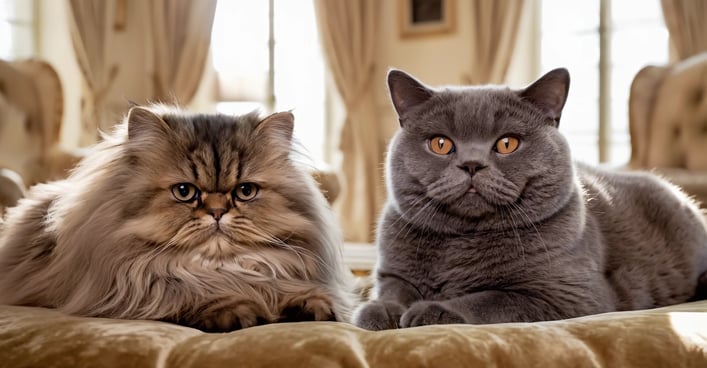
Persian Cat vs British Shorthair: 2026 Breed Comparison Guide
Choosing between a Persian and a British Shorthair? Our detailed 2026 guide compares temperament, grooming, health, and costs to help you find your perfect feline match.
Share this page
Persian Cat vs British Shorthair: The 2026 Breed Comparison Guide
Choosing between the luxurious Persian and the charming British Shorthair presents cat enthusiasts with a delightful dilemma. Both breeds offer distinct personalities, physical traits, and care requirements that appeal to different lifestyles. This comprehensive 2026 guide explores every aspect to help you determine your perfect feline companion.
Breed Histories and Origins
Persian Cat History
Ancient Origins
The Persian cat is one of the oldest and most prestigious breeds, with documented history dating back centuries. Long-haired cats from Persia (modern-day Iran) first arrived in Europe in the 1600s.
Development in Europe
17th Century: Introduced to Italy and France
19th Century: British breeders refined the breed's standard
Victorian Era: Became a status symbol among the aristocracy
Early 1900s: American breeders developed the flatter-faced "Peke-face" variety
Persian Cat vs British Shorthair: 2026 Breed Comparison Guide - Articles
Modern Persian Types
Traditional/Doll Face: Maintains a moderate, less extreme facial structure
Show/Peke Face: Features a brachycephalic (flat) face
Color Varieties: Solid, shaded, smoke, tabby, bicolor, and Himalayan (colorpoint)
British Shorthair History
Ancient Roots
The British Shorthair descends from cats brought to Britain by Roman invaders around 2,000 years ago. These working cats protected food stores and naturally evolved into a distinct landrace.
Breed Development
1800s: Harrison Weir organized the first cat shows, featuring British cats
Early 1900s: The breed standard was formally established
World Wars: Nearly extinct twice, revived through careful breeding and outcrossing to Persians
Modern Era: Recognized worldwide, most famous for its iconic blue coloration
Unique Heritage Notes
Lewis Carroll's Cheshire Cat was likely modeled on the British Shorthair
Originally called the "British Blue"
Outcrossing to Persians contributed to its cobby body and dense coat
Physical Characteristics: A Side-by-Side Look
Size and Build
Feature
Persian
British Shorthair
Weight Range
7-12 lbs (females), 9-14 lbs (males)
7-12 lbs (females), 9-17 lbs (males)
Body Type
Cobby, low to the ground
Cobby, muscular, and substantial
Bone Structure
Medium, sturdy
Heavy and substantial
Height
10-15 inches
11-14 inches
Length
14-18 inches
16-22 inches
Head and Facial Features
Persian:
Round, massive head with a sweet expression
Large, round eyes (copper, blue, or odd-eyed)
Short, snub nose and full cheeks
Small, rounded ears set far apart
British Shorthair:
Round head with full cheeks and a "teddy bear" expression
Large, round eyes (typically gold, copper, or green)
Broad, straight nose with a gentle stop
Medium-sized ears set wide apart
Coat Characteristics
Feature
Persian
British Shorthair
Length
Long, flowing
Short, dense
Texture
Fine and silky
Crisp and plush
Undercoat
Thick, woolly
Dense, close-lying
Grooming Needs
Daily brushing essential
Weekly brushing sufficient
Shedding
Moderate to heavy
Moderate
Matting Risk
High without consistent care
Low
Color Palettes:
Persian: Over 200 recognized color combinations including solids, silvers, tabbies, and colorpoints.
British Shorthair: Most famous for the British Blue, but also comes in solids, tabbies, bicolors, and colorpoints.
Temperament and Personality
Persian Personality Profile
Character: Sweet, gentle, docile, and dignified. They prefer calm, predictable environments.
Activity: Low energy. They enjoy lounging and observing over vigorous play.
Affection: Affectionate but not demanding. They bond closely with family but are often "nearby" rather than lap cats.
Vocalization: Quiet, with soft chirps and murmurs.
British Shorthair Personality Profile
Character: Easygoing, confident, independent, and good-natured. They adapt well to various situations.
Activity: Moderate energy. Playful but can entertain themselves.
Affection: Loyal and devoted, often following owners around, but typically prefer "four feet on the floor."
Vocalization: Generally quiet, with a soft, chirping voice when they do communicate.
Temperament Comparison Table
Trait
Persian
British Shorthair
Activity Level
Low
Moderate
Playfulness
Low-Moderate
Moderate
Affection Level
Moderate-High
Moderate
Independence
Moderate
High
Adaptability
Low-Moderate
High
Child Friendliness
Moderate (better with older, gentle children)
High
Stranger Friendliness
Low
Moderate
Trainability
Low-Moderate
Moderate
Health, Lifespan, and Care
Persian Health Overview
Primary Concerns:
Brachycephalic Syndrome: Breathing difficulties, dental crowding, and heat sensitivity due to the flat face.
Polycystic Kidney Disease (PKD): A genetic condition; responsible breeders test for it.
Other: Higher risk for eye staining, skin fold dermatitis, and dental disease.
Average Lifespan: 12-17 years (traditional), 10-15 years (extreme flat-face).
British Shorthair Health Overview
Primary Concerns:
Hypertrophic Cardiomyopathy (HCM): The most common heart disease in cats; screening is advised.
Hemophilia B: A genetic bleeding disorder.
Obesity: Prone to weight gain; portion control is crucial.
Other: Potential for dental disease and lower urinary tract issues.
Average Lifespan: 14-20 years.
Health Comparison Summary
Factor
Persian
British Shorthair
Overall Health
Moderate (more breed-specific issues)
Good
Lifespan
10-17 years
14-20 years
Veterinary Costs
Typically Higher
Moderate
Brachycephalic Issues
Yes
No
Grooming and Daily Care
Persian Grooming (High Maintenance)
Daily: 15-30 minutes of brushing to prevent mats, plus eye cleaning.
Weekly: Bathing is often necessary for show-quality coats.
Professional Grooming: Recommended every 4-8 weeks; "lion cuts" are a popular low-maintenance option.
British Shorthair Grooming (Low Maintenance)
Weekly: A quick 5-10 minute brush with a rubber mitt or bristle brush.
Seasonal: Increased brushing during shedding seasons.
Professional Grooming: Rarely needed.
Cost of Ownership (2026 Estimates)
Initial Costs
Source
Persian
British Shorthair
Pet Quality
$500-$1,500
$800-$2,000
Show Quality
$1,500-$5,000
$1,500-$4,000
Adoption
$75-$200
$75-$200
Annual Care Costs
Expense
Persian
British Shorthair
Food & Litter
$600-$1,200
$600-$1,050
Routine Veterinary
$300-$600
$200-$400
Grooming/Supplies
$500-$1,200
$100-$200
Insurance
$300-$600
$250-$500
Total Annual
$1,800-$3,800
$1,250-$2,350
Making Your Decision: Which Breed is Right for You?
Choose a Persian If You:
Enjoy and can commit to daily grooming rituals.
Prefer a serene, quiet, and low-activity companion.
Are frequently home and can provide a climate-controlled, calm environment.
Appreciate breathtaking, luxurious beauty and a decorative pet.
Choose a British Shorthair If You:
Want an affectionate but independent cat with minimal grooming needs.
Have a family with children or other pets.
Work outside the home and need a more adaptable companion.
Are a first-time cat owner seeking an easygoing, long-lived friend.
Final Verdict
There is no objectively "better" breed. The Persian offers serene devotion and unmatched beauty for dedicated owners willing to invest in high-maintenance care. The British Shorthair provides reliable, easygoing companionship with significantly lower grooming needs, fitting seamlessly into diverse lifestyles.
Your choice should be guided by your available time, lifestyle, and the type of feline relationship you desire. Always meet individual cats before deciding, as personality can vary.
Last Updated: 2026 | Always consult with breeders, rescues, and veterinarians to make an informed decision.
Get expert advice about cat care, behavior, nutrition, grooming, and training. Ask our AI cat care expert anything about your cat and receive professional guidance.