Back to Articles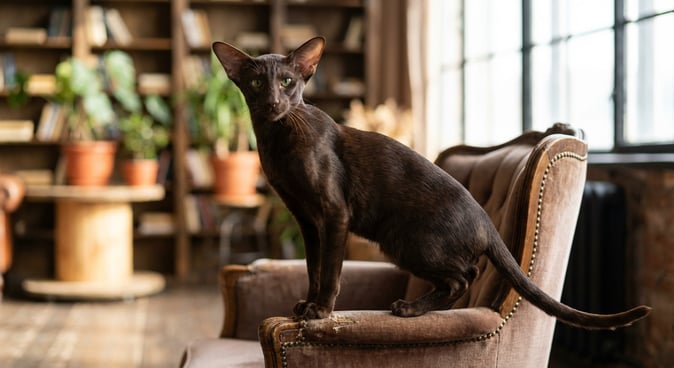
6 min read
Oriental Shorthair: The Rainbow of Feline Personalities
Born from a 1950s quest to splash the Siamese silhouette across every color of the spectrum, the Oriental Shorthair marries elegant lines with an artist’s palette of coats—and a personality just as vivid. Step inside to meet the rainbow-clad cousin of the Siamese and discover why no two cats in this breed ever paint the same picture.
If the Siamese and a box of crayons had a love child, it would be the Oriental Shorthair. This svelte extrovert pairs the classic wedge-shaped head and oversized ears of its Siamese cousins with a kaleidoscope of 300-plus coat colors. Owners joke that Orientals don’t just enter a room—they arrive with opinions, purrs, and a tail that never stops talking.
History & Origin
The Oriental Shorthair’s story begins in the 1950s–1960s when British and American breeders wanted to "paint" the Siamese in every imaginable color. By crossing Siamese with Russian Blues, Abyssinians, and domestic shorthairs, they kept the elegant body type but unlocked a full palette of patterns. The cats were first called "Foreign Shorthairs," but the name Oriental Shorthair stuck when CFA recognition arrived in 1977. Today the breed serves as living proof that personality and pigment can coexist in one graceful package.
Physical Characteristics
Oriental Shorthairs are long, lean, and leggy—picture a feline marathon runner. Adults weigh 3–5 kg (6–11 lb) and measure 30–40 cm (12–16 in) from shoulder to base of tail, yet feel surprisingly heavy when lifted thanks to dense muscle. The signature tubular body is topped by a flared, wedge-shaped head, enormous upright ears, and almond eyes that shimmer in green, blue, gold, yellow, or even odd-eyed combinations.
Their short, close-lying coat has a satin sheen and feels like warm silk under your fingers. Unlike many breeds, Orientals are coat-color anarchists: every shade and pattern is allowed, from ebony solid to tortoiseshell, smoke, shaded, tabby, bicolor, and beyond. No two look exactly alike, so adopters often choose "the one" based on the color that matches their sofa—or their soul.
The Oriental Shorthair is more than a pretty face in a Technicolor coat—it’s a loyal companion that insists on sharing every heartbeat of your day. If you’re ready for a cat that converses, explores, loves, and lives in high definition, this sleek extrovert might just be your technicolor soulmate.
Tags
Oriental Shorthairactive catstalkative breedshypoallergenic mythsSiamese relativesfamily pets