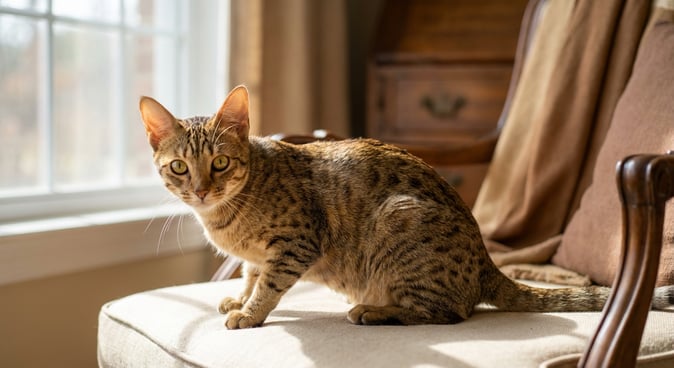
Born from a happy accident in 1964, the Ocicat’s wild-looking spots belie its entirely domestic DNA—no jungle genes required. Discover how a single surprise kitten evolved into a playful, people-loving breed that turns heads with every stride.
Imagine a miniature wild cat prowling through your living room—sleek, spotted, and alert—yet purring contentedly as it curls up beside you. That’s the Ocicat, an all-American breed that pairs the exotic beauty of a jungle cat with the loving nature of the most domestic lap cat. Developed entirely from household felines, this breed proves you don’t need wild DNA to turn heads.
The Ocicat’s story begins in 1964 in Berkeley, Michigan, when breeder Virginia Daly attempted to create a Siamese with Abyssinian-colored points. Her first litter produced an unexpected kitten with golden spots on an ivory coat. Named Tonga, he looked so much like the endangered ocelot that the family dubbed him an "ocicat." While Tonga was neutered and sold as a pet, his striking pattern sparked a breeding program that later introduced American Shorthair blood for greater substance and silver colors. By 1987 the Cat Fanciers’ Association granted championship status, and today the Ocicat is admired worldwide—without a drop of wild blood in its veins.
Ocicats are muscular, medium-to-large cats weighing 3.5–7 kg (8–15 lb) and measuring 35–45 cm (14–18 in) from shoulder to tail base. Their short, satiny coat lies close to the body, accentuating an athletic frame built for sprinting and leaping. Each hair is banded with several colors, creating the signature thumb-shaped spots that run in neat rows along the spine and sides. Twelve standard colors include tawny, chocolate, cinnamon, blue, lavender, and fawn, plus corresponding silver varieties. Eyes are large, almond-shaped, and glow in gold, green, or copper, rimmed with dark "mascara" that gives a perpetual alert expression. Strong legs, a moderately long tail, and a slightly squared muzzle complete the wild look.
The Ocicat delivers the best of both worlds: the breathtaking beauty of a wild feline and the dependable warmth of a household pet. Their spots may capture your eye, but it’s their boundless affection, intelligence, and playful spirit that capture your heart. For those ready to share an active, involved life with a truly unique companion, the Ocicat is ready to leap—quite literally—into your arms.
Despite their untamed appearance, Ocicats are pure companion animals. They score top marks (5/5) for affection, friendliness, and intelligence, making them feline extroverts who greet visitors at the door and follow owners from room to room. Curious and confident, they learn to open doors, fetch toys, and happily walk on a leash or ride in the car. Their playful energy (4/5) endures well into adulthood, yet they balance antics with a strong cuddle drive, often sleeping under covers or perched on a warm lap. Ocicats dislike being left alone for long hours; they thrive in households with children, other cats, or friendly dogs who can match their social nature.
Grooming an Ocicat is refreshingly simple. The short coat sheds minimally (2/5) and needs only a weekly rubber-brush session to remove dead hairs and add shine. Regular nail trimming, ear cleaning, and dental care—especially to offset their slight predisposition to gingivitis—complete the routine. Because of their high exercise needs (4/5), provide tall cat trees, window perches, interactive puzzle feeders, and daily play sessions that mimic hunting: wand toys, laser pointers, or fetch with crinkle balls. Rotate toys to prevent boredom, and consider clicker training; these cats master tricks as readily as many dogs. A balanced diet measured in meals (rather than free-feeding) helps maintain their muscular frame and prevents obesity.
Ocicats are generally robust with a 12–18 year lifespan. Responsible breeders screen for hereditary issues, yet owners should watch for two conditions: renal amyloidosis, a protein deposit that can affect kidney function, and hypertrophic cardiomyopathy (HCM), which echoes in many pedigreed lines. Annual veterinary exams, baseline cardiac ultrasounds after age two, and routine bloodwork help catch problems early. Dental checkups mitigate gingivitis, while keeping indoor-only lifestyles protects against infectious diseases and accidents. With preventive care, most Ocicats remain active well into their senior years.
Choose an Ocicat if you want an interactive, dog-like cat that enjoys travel, trick training, and constant companionship. They’re ideal for families with respectful children, multi-pet households, or individuals who work from home and can offer daily enrichment. Pass if you’re away long hours and can’t provide a pet companion or stimulating environment; boredom may lead to mischief or excessive vocalization (3/5). Allergy sufferers should note the breed is not hypoallergenic, though the short coat produces less dander than some double-coated breeds. Ultimately, the Ocicat rewards engaged owners with unwavering loyalty and a touch of the wild without ever needing a jungle.
Get AI-powered advice about your cat's health and care. Enter your cat's information and start a conversation with our veterinary assistant.
Start Chat with AIGet expert advice about cat care, behavior, nutrition, grooming, and training. Ask our AI cat care expert anything about your cat and receive professional guidance.
Start Chat with Expert