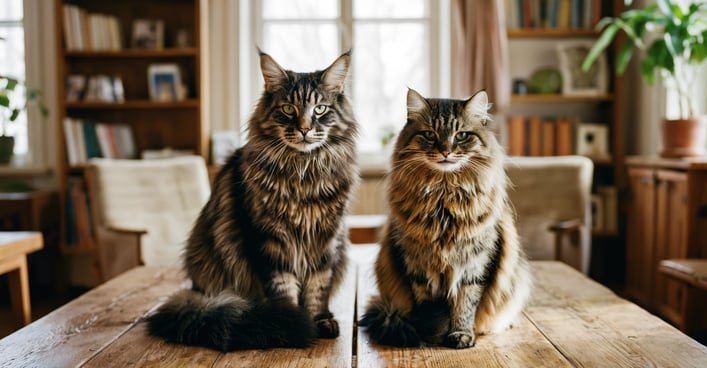
Norwegian Forest Cat vs Siberian: The 2026 Breed Comparison Guide
Deciding between a Norwegian Forest Cat and a Siberian? Our complete guide compares their looks, personality, hypoallergenic traits, and care to help you choose your perfect northern companion.
Share this page
Norwegian Forest Cat vs Siberian: The 2026 Breed Comparison Guide
Two majestic, long-haired breeds from the world's coldest climates often capture the hearts of cat lovers: the Norwegian Forest Cat from Scandinavia and the Siberian from Russia. Both evolved naturally to survive harsh winters, resulting in stunning coats, robust builds, and hardy dispositions. This comprehensive guide for 2026 breaks down their key similarities and differences to help you decide which northern beauty is the right fit for your home.
Origins and History: A Tale of Two Forests
Norwegian Forest Cat Origins
The Norwegian Forest Cat, or Norsk Skogkatt, is deeply woven into Norse mythology and Viking lore. Believed to have traveled on Viking ships, they developed their distinctive traits in Norway's dense, snowy woodlands.
Historical Timeline:
Mythology: Featured as the cats pulling Freya's chariot.
Viking Era (800-1050 AD): Served as ship's cats, controlling rodents.
Norwegian Forest Cat vs Siberian: The 2026 Breed Comparison Guide - Articles
Mid-20th Century:
1970s: A dedicated breeding program revived the breed.
1994: Received official recognition from the Cat Fanciers' Association (CFA).
Siberian Origins
The Siberian Forest Cat evolved over centuries in the vast Russian taiga. They are celebrated in Russian folklore and are considered a national treasure.
Historical Timeline:
Early Records: First documented references around 1000 AD.
13th Century: Mentioned in Russian manuscripts.
1980s: The first formal breed standard was established in Russia.
1990s: Introduced to the United States, gaining international popularity.
Physical Appearance: A Side-by-Side Look
Size and Build
Feature
Norwegian Forest Cat
Siberian
Male Weight
13-22 lbs (5.9-10 kg)
15-20 lbs (6.8-9 kg)
Female Weight
9-12 lbs (4-5.4 kg)
10-15 lbs (4.5-6.8 kg)
Body Type
Long, muscular, and sturdy
Powerful, barrel-chested, and rounded
Length
Substantial, with a very long tail
Medium to long
Full Maturity
Reached at approximately 5 years
Reached at approximately 5 years
Coat Characteristics
Norwegian Forest Cat Coat:
Type: Water-resistant double coat.
Length: Long and flowing.
Texture: Coarse guard hairs over a dense, woolly undercoat.
Distinctive Features: Dramatic ruff (mane), full "britches" on hind legs, and an extremely bushy tail.
Adaptation: Designed to repel snow and moisture.
Siberian Coat:
Type: Unique triple coat (guard hairs, awn hairs, and down).
Length: Medium to long.
Texture: Incredibly dense; texture varies significantly by season.
Distinctive Features: A full ruff and britches, though less dramatic than the Norwegian's.
Adaptation: Provides superior insulation against extreme cold. Shows dramatic seasonal changes.
Head and Facial Features
Norwegian Forest Cat:
Head Shape: Distinct triangular shape.
Eyes: Large, almond-shaped.
Ears: Large with prominent lynx tips and tufts.
Profile: Straight nose line.
Expression: Alert, intelligent, and somewhat wild.
Siberian:
Head Shape: Rounded, modified wedge.
Eyes: Large, almost round, and very expressive.
Ears: Medium-sized with lynx tufts.
Profile: Gently rounded.
Expression: Sweet, open, and friendly.
Personality and Temperament: Independent vs. Devoted
Norwegian Forest Cat Personality
Known as "Wegies," they are:
Independent Thinkers: Enjoy their own company and are self-sufficient.
Master Climbers: Natural athletes who love vertical spaces.
Gentle Giants: Patient and calm with family members.
Selectively Affectionate: They choose when to cuddle on their own terms.
Moderately Energetic: Exhibit playful bursts followed by long naps.
Quiet Communicators: Use soft chirps and trills rather than loud meows.
Siberian Personality
Siberians are often described as:
Dog-Like Companions: Form strong, devoted bonds with their families.
Perpetually Playful: Maintain a kitten-like zest for life into adulthood.
Highly Affectionate: Seek out human interaction and enjoy being involved in activities.
Intelligent and Trainable: Can learn tricks and often enjoy puzzle toys.
Moderate to High Energy: Require regular interactive play sessions.
Vocal: Communicate with pleasant chirps, trills, and meows.
Temperament Comparison
Trait
Norwegian Forest Cat
Siberian
Independence
High
Moderate
Affection Level
Moderate (on their terms)
High (consistently demonstrative)
Energy Level
Moderate
Moderate to High
Vocalization
Low to Moderate
Moderate
Playfulness
Moderate
High
Social Needs
Moderate
Moderate to High
Grooming and Care: Managing the Magnificent Coats
Norwegian Forest Cat Grooming
Surprisingly manageable for a long-haired breed:
Brushing: 2-3 times per week is usually sufficient.
Shedding: Heavy seasonal shedding ("blowing coat") typically in spring/fall.
Matting: Minimal if brushed regularly due to the texture of the coat.
Bathing: Rarely necessary.
Siberian Grooming
Requires a consistent routine, especially during seasonal changes:
Brushing: 2-3 times per week, increasing during shedding seasons.
Shedding: Very heavy seasonal coat blow.
Matting: Can occur around the ruff and britches during heavy sheds if not groomed.
Bathing: Rarely needed, but their triple coat takes longer to dry.
Health, Lifespan, and Costs
Health Overview
Norwegian Forest Cat:
Average Lifespan: 14-16 years.
Common Concerns: Hypertrophic cardiomyopathy (HCM), hip dysplasia. Generally a robust breed.
Siberian:
Average Lifespan: 12-18 years.
Common Concerns: Hypertrophic cardiomyopathy (HCM). Known for generally excellent health and a strong genetic foundation.
Cost of Ownership (2026 Estimates)
Initial Purchase/Adoption:
Norwegian Forest Cat: $800-$2,500 (Pet to Show Quality) or $100-$300 (Adoption).
Siberian: $1,200-$4,000 (Pet to Show Quality) or $100-$400 (Adoption).
Estimated Monthly Ongoing Costs: $135-$230 for both breeds, covering premium food, litter, insurance, and supplies.
The Hypoallergenic Question
This is a key differentiator for many potential owners.
Norwegian Forest Cat: They produce a typical amount of the Fel d 1 allergen and are not considered hypoallergenic. They are not recommended for people with cat allergies.
Siberian: Many (but not all) Siberians produce significantly lower levels of the Fel d 1 protein. They are often tolerated by people with mild to moderate allergies. Always spend time with a specific cat before committing if allergies are a concern.
Which Breed Is Right For You?
Choose a Norwegian Forest Cat If You Want:
A majestic, independent companion with a wild spirit.
A cat that appreciates vertical space and climbing.
A quieter, more reserved family member.
A relatively low-maintenance longhaired cat (grooming-wise).
A pet for a home without allergy sufferers.
Choose a Siberian Cat If You Want:
A playful, dog-like shadow that follows you around.
A highly affectionate and interactive family cat.
A potential option if you have mild cat allergies.
An intelligent companion that enjoys games and training.
A cat known for its sweet, gentle temperament with children and other pets.
Final Thoughts
Both the Norwegian Forest Cat and the Siberian are extraordinary breeds that bring the beauty and resilience of northern forests into your home. The Norwegian is the dignified, independent climber, while the Siberian is the devoted, playful friend. Your choice should align with your lifestyle, activity level, and whether allergies are a factor. Whichever you choose, you'll gain a loyal and magnificent companion for years to come.
Get expert advice about cat care, behavior, nutrition, grooming, and training. Ask our AI cat care expert anything about your cat and receive professional guidance.