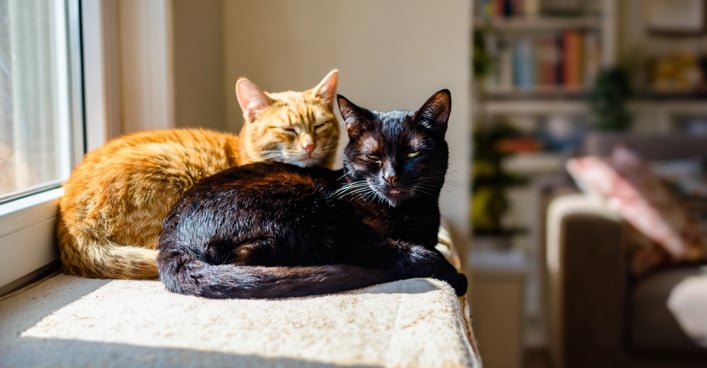
Multi-Cat Household Harmony: Your 2026 Guide to Peaceful Cat Families
Master the art of peaceful multi-cat living. Our 2026 guide provides proven strategies for reducing conflict, managing resources, and fostering harmony in your feline family.
Share this page
Multi-Cat Household Harmony: Your 2026 Guide to Peaceful Cat Families
Creating a harmonious multi-cat household enriches feline lives through companionship and play. However, it also introduces complexities related to territory, resources, and social dynamics. Success requires understanding feline nature and implementing strategic management to prevent the stress and conflict common in multi-cat homes. This comprehensive 2026 guide delivers evidence-based strategies for achieving lasting peace.
Understanding Feline Social Structure
Cats Are Not Pack Animals
Unlike dogs, cats possess a unique social framework:
They evolved as solitary hunters.
They are socially flexible but not inherently group-living.
They are naturally territorial.
They can be resource guardians.
Key Implication: Successful cohabitation requires intentional management and environmental design, not just hope.
Spend focused, individual time with each cat daily.
Conduct monthly weight checks at home.
Establish and note each cat's "normal" baseline for habits and behavior.
Disease Prevention Best Practices
Keep all cats on a veterinarian-recommended vaccination schedule.
Maintain consistent parasite prevention (fleas, ticks, worms) for every cat.
Quarantine new cats (or cats returning from a hospital stay) for a brief period.
Schedule annual wellness exams for every cat, even if they seem healthy.
When to Seek Professional Help
Consult a Veterinary Behaviorist If You Observe:
Serious fights resulting in injuries (bites, scratches).
Persistent inappropriate elimination despite medical clearance and optimized litter box setup.
One cat becomes completely withdrawn, hiding constantly and not engaging.
Non-recognition aggression that doesn't resolve with re-introduction.
Redirected aggression episodes that are frequent or severe.
Red Flags Indicating Serious Problems
Any fight where blood is drawn.
A cat who hides for more than 24 hours and refuses to eat or drink.
Consistent elimination outside the litter box by multiple cats.
Visible signs of extreme stress (e.g., constant vocalizing, excessive shedding).
Understanding the Cost of Multi-Cat Care (2026 Estimates)
Annual Expenses Multiply
Item
Single Cat
3 Cats
5 Cats
Routine Veterinary Care
~$350
~$1,050
~$1,750
High-Quality Food
~$700
~$2,100
~$3,500
Litter
~$250
~$750
~$1,250
Toys, Beds, & Supplies
~$250
~$750
~$1,250
Estimated Annual Total
~$1,550
~$4,650
~$7,750
Planning for Unexpected Costs
Emergency veterinary care (cost is multiplied by the number of cats at risk).
Professional behavioral consultation fees.
Potential property damage (scratching, spraying).
Additional pet deposits or fees for rentals.
Determining the "Right" Number of Cats for Your Home
Key Factors to Consider
Factor
Its Impact
Physical Space
More square footage and vertical space allow for more cats comfortably.
Your Time
Each cat requires individual attention, play, and care.
Financial Resources
Costs increase exponentially, not linearly.
Existing Cat Personalities
Some cats are true "only-children" and will never accept a companion.
General Maximum Recommendations
Studio/Small 1-Bedroom Apartment: 1-2 cats.
1-2 Bedroom Home: 2-3 cats.
House with Multiple Rooms: 3-5 cats, only with exceptional resource management and space.
More than 5: Requires cattery-level management, significant space, and is not recommended for most households.
Success Stories: Harmony is Achievable
Common Factors in Successful Multi-Cat Homes
Patience with Introductions: Never rushing the process.
Abundant Resources: Faithfully following the "+1" rule for all key items.
Investing in Vertical Space: Creating a three-dimensional environment.
Providing Individual Attention: Ensuring no cat feels neglected.
Committing to Patience: Understanding relationships can take months or years to develop.
Seeking Help Early: Consulting professionals at the first sign of serious trouble.
A Realistic Goal: Not all cats will be cuddly friends. Success is defined as peaceful coexistence—where cats live together without stress, fear, or conflict.
Frequently Asked Questions (2026 Edition)
Q: How many cats is too many?A: The limit depends entirely on your space, time, financial resources, and ability to manage the environment. The quality of life and care you can provide is far more important than any specific number.
Q: Will getting another cat help my lonely cat?A: It depends on your cat's temperament. Some cats are genuinely solitary and will be stressed by a newcomer. Others thrive with feline companionship. Consider a cat's age, history, and personality before deciding.
Q: How long does it take for new cats to get along?A: Basic tolerance can take 2-4 weeks with a proper introduction. Developing a true friendship can take months, or it may never happen. Peaceful coexistence is a successful and valid outcome.
Q: Why have my cats suddenly started fighting after years of peace?A: Sudden aggression is often triggered by: Redirected aggression (after seeing an outdoor cat), Non-recognition aggression (one cat smells different post-vet visit), a new resource competition (like a favored sleeping spot), or an underlying medical issue causing pain or irritability in one cat.
Q: Is it better to adopt two kittens or one?A: For kittens, adopting two is often highly recommended. They socialize each other, burn off energy through play, and learn appropriate bite inhibition. Adopting a pre-existing bonded pair from a shelter is an excellent way to ensure harmony from the start.
Last Updated: 2026 | Achieving multi-cat harmony is an ongoing process that requires thoughtful planning, abundant resources, and a deep respect for feline nature.
Get expert advice about cat care, behavior, nutrition, grooming, and training. Ask our AI cat care expert anything about your cat and receive professional guidance.