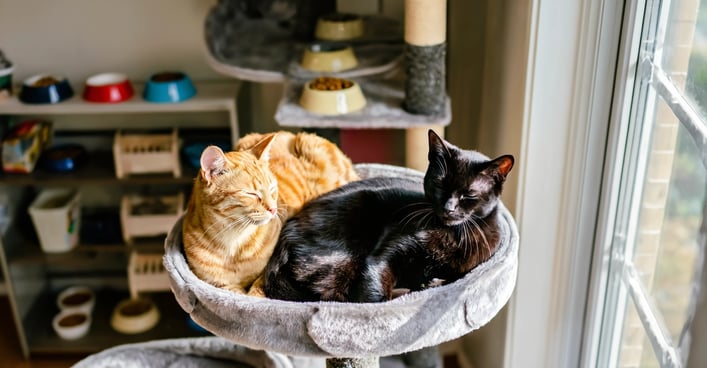
Multi-Cat Household Harmony: Your 2026 Guide to Peaceful Feline Coexistence
Learn expert strategies for creating a peaceful multi-cat home. From the essential N+1 resource rule to conflict resolution, this guide helps you foster feline harmony.
Share this page
Multi-Cat Household Harmony: Your 2026 Guide to Peaceful Feline Coexistence
Creating a thriving multi-cat household offers cats companionship, mental stimulation, and social enrichment. However, it also presents unique challenges that require thoughtful planning. Unlike dogs, cats are solitary hunters by nature who form social groups only when resources are abundant. Successfully maintaining harmony means designing an environment that respects their territorial instincts while encouraging positive relationships.
Whether you're introducing a second cat or managing a larger feline family, this comprehensive guide provides evidence-based strategies for building a peaceful, multi-cat home.
Advanced age with a very established, rigid routine
When to Seek Professional Consultation:
Certified Cat Behavior Consultant (IAABC)
Veterinary Behaviorist (Dip ACVB)
Experienced rescue or shelter behavior team
Choosing a Compatible Companion
Strategic Age Pairing:
Resident Cat Age
Ideal Newcomer Age
Key Reasoning
Kitten (<1 year)
Similar age kitten
Matched energy levels, social learning
Young Adult (2-5 years)
Kitten or similar age
High bonding potential, playmate energy
Adult (6-9 years)
Younger adult (2-5 years)
Less threatening, potential for mentorship
Senior (10+ years)
Consider very carefully
Often strongly prefer a quiet, solitary life
Understanding Gender Dynamics:
Opposite-sex pairs are often the easiest introduction.
Two females can sometimes be challenging if both are assertive.
Two males may have more territorial disputes unless well-socialized.
Crucial Note: Individual personality always matters more than gender. All cats must be spayed or neutered to minimize hormonal aggression and territorial behaviors.
Personality Matching is Key:
Confident cats generally tolerate newcomers better.
Timid cats need a patient, gentle, and non-threatening companion.
High-energy cats require an active play partner.
Laid-back cats do best with similarly relaxed companions.
The Essential "N+1" Resource Rule
The Golden Formula for Harmony
Number of cats (N) + 1 = Minimum number of each critical resource. This prevents competition and reduces stress.
Placement Strategy: Distribute boxes in different rooms and on different levels. Ensure each has an escape route and varying privacy levels. Never cluster all boxes in one location.
2. Food and Water Stations:
Provide separate feeding locations, ideally in different rooms.
Use visual barriers (like a corner or a cardboard divider) if needed to prevent staring and guarding.
Multiple fresh water sources (bowls, fountains) are essential and should be placed away from food stations.
3. Resting & Sleeping Areas:
Provide more resting spots than cats. Choice and ownership are critical.
Offer variety: high perches, enclosed beds, sunny window seats, and cool floor spots.
4. Scratching Posts/Surfaces:
Have at least one per cat, plus one extra.
Place in multiple locations (near sleeping areas, entryways).
Offer different materials (sisal, carpet, cardboard) and orientations (vertical, horizontal, angled).
Vertical space allows cats to establish hierarchy through height rather than conflict and provides safe observation points.
Designing Your Home for Multiple Cats
Strategic Territory Design
Core Territory: Each cat needs a secure, private space they don't have to defend.
A private sleeping nook (a cubby, high shelf, or separate bed).
Uncontested access to at least one set of resources (litter, food, water).
Clear escape routes from any shared space.
Shared Territory: Neutral zones for positive interaction.
Open spaces with multiple entry/exit points.
Ample vertical space for comfortable co-occupancy.
Enrichment items for all (interactive toys, puzzle feeders).
Traffic Flow: Design your space to avoid forced confrontations.
Create multiple pathways through main rooms.
Eliminate dead ends where a cat could be cornered.
Use wide doorways or consider cat flaps in interior doors.
Environmental Enrichment for a Group
Individual Play: Dedicate 10-15 minutes of one-on-one play with each cat daily. This strengthens your bond and ensures no cat feels neglected.
Group Play: Use interactive toys like feather wands that allow multiple cats to engage without competing for a single object. Supervise initially to prevent over-excitement.
Scent & Sensory Enrichment:
Rotate cat-safe herbs like catnip, silvervine, and valerian root.
Install bird feeders outside windows for "cat TV."
Provide varied textures (rough scratching posts, soft blankets, cool tiles).
The Step-by-Step Introduction Protocol
Phase 1: Scent Exchange (Days 1-3)
Goal: Create familiarity before any visual contact.
Methods:
Exchange bedding between the resident cat and newcomer.
Rub a soft cloth on one cat's cheeks (where scent glands are) and place it near the other.
Feed cats on opposite sides of a closed door, so they associate the other's scent with positive experiences.
Phase 2: Visual Introduction (Days 3-7+)
Goal: Controlled, positive visual contact.
Methods: Use a baby gate, a cracked door secured with door stoppers, or two stacked baby gates. Keep initial sessions short (5-10 minutes) and always pair with high-value treats or play.
Phase 3: Controlled Physical Contact (Days 7-14+)
Goal: Supervised, brief meetings in a neutral space.
Process:
Keep sessions short (under 10 minutes).
Ensure multiple escape routes and hiding spots.
Immediately separate at the first sign of tension (hissing, stiff posture, staring).
End every session on a positive note with treats.
Important: This timeline is flexible. Some pairs need days, others need weeks or months. Let the cats' comfort levels set the pace.
Introducing a Cat to an Existing Group
Introduce the newcomer to the most confident and friendly resident cat first.
Once that relationship is stable, introduce the newcomer to the next cat individually.
Final group integrations should be supervised and in a large, neutral space.
Recognizing and Managing Feline Conflict
Types of Cat Aggression
Play Aggression: Pouncing, chasing with roles reversing. No injuries or fearful body language.
Fear-Based Aggression: Hissing, growling, defensive posturing. One cat is clearly the victim trying to escape.
Territorial Aggression: Stalking, ambushing, blocking access to resources. It is often one-sided (one aggressor, one victim).
Redirected Aggression: Aggression triggered by an outside stimulus (e.g., seeing an outdoor cat) but directed at a nearby feline housemate. This can severely damage relationships.
Subtle Warning Signs of Trouble
Silent Staring or "hard" eye contact between cats.
DO: Make a loud, startling noise (clap, shake a can of coins), toss a pillow or blanket between them, or use a spray bottle (as a last resort).
Safely separate cats into different rooms to cool down.
Long-Term Management & Reintroduction:
Separate Completely: Return to Phase 1 (scent exchange) with no visual contact.
Expand Resources: Add more litter boxes, feeding stations, and vertical spaces.
Restart Gradual Introductions: Follow the scent-visual-supervised contact protocol from the beginning.
Seek Professional Help: Consult a certified behaviorist if conflicts persist. Medication (like anti-anxiety drugs) may be a necessary tool to facilitate reintroduction.
Feeding & Health Management in a Multi-Cat Home
Strategic Feeding Practices
Separate Feeding Stations: Feed cats in different rooms or use visual barriers. This is crucial for preventing food guarding and for managing special diets.
Scheduled Meals vs. Free Feeding: Scheduled meals are superior in multi-cat homes. They allow you to monitor each cat's appetite, administer medication, and prevent one cat from dominating the food bowl.
For Special Diets: Use microchip-activated feeders (like SureFeed) or feed cats in separate, closed rooms to ensure each cat eats only their prescribed food.
Health Monitoring Challenges & Solutions
In a multi-cat home, it's easy to miss early signs of illness.
Create an Individual Monitoring Routine:
Daily: Note each cat's appetite, litter box use, and activity level.
Weekly: Perform a quick physical check—feel for weight changes, check coat quality, and observe eyes/nose.
Sick Cat Protocol: Isolate a contagious or recovering cat in a comfortable "safe room" with its own resources to prevent stress and bullying.
Behavioral Dynamics & Special Considerations
Understanding Social Hierarchy
Cats establish subtle hierarchies. Acceptable signs include one cat grooming another (allogrooming) or one cat having first choice of a prime sleeping spot—as long as the other cat has equal access to other resources and shows no stress.
Problematic signs include one cat constantly hiding, being blocked from food/water, or showing weight loss due to stress.
Bonded Pairs
Recognize bonded pairs by their mutual grooming, sleeping curled together, and playing gently. They may become distressed if separated. Always keep bonded pairs together and ensure they are adopted out as a unit if rehoming is necessary.
Cost Considerations for 2026
Estimated Initial Setup Investment
Category
2 Cats
3 Cats
4 Cats
Litter Boxes
$40 - $100
$60 - $150
$80 - $200
Food/Water Stations
$50 - $120
$75 - $180
$100 - $240
Vertical Space (Trees, Shelves)
$120 - $400
$180 - $600
$240 - $800
Scratching Posts
$70 - $250
$105 - $375
$140 - $500
Bedding & Hideaways
$50 - $120
$75 - $180
$100 - $240
Toys & Enrichment
$60 - $180
$90 - $270
$120 - $360
Total Initial Investment
$390 - $1,170
$585 - $1,755
$780 - $2,340
Projected Ongoing Monthly Costs
Category
2 Cats
3 Cats
4 Cats
High-Quality Food
$80 - $200
$120 - $300
$160 - $400
Litter
$35 - $100
$52 - $150
$70 - $200
Veterinary Care (Wellness Fund)
$60 - $180
$90 - $270
$120 - $360
Flea/Heartworm Preventatives
$30 - $60
$45 - $90
$60 - $120
Total Monthly (Average)
$205 - $540
$307 - $810
$410 - $1,080
When Multi-Cat Living Isn't Working
Despite best efforts, some cats are fundamentally incompatible. Consider rehoming as a last resort if you observe:
Chronic, unmanageable stress in one or more cats (persistent hiding, over-grooming, anxiety).
Ongoing aggression causing injury or severe fear, even after professional behavior intervention.
A severe decline in quality of life for any cat in the home.
Rehoming one cat to a suitable, single-cat home is a kinder option than forcing a lifetime of misery and stress on both animals.
Conclusion: The Path to Feline Harmony
A harmonious multi-cat household is an achievable and rewarding goal, but it requires more than hope—it demands preparation, patience, and proactive management. Adhering to the "N+1" resource rule, executing patient, scent-based introductions, and continuously observing your cats' subtle communications form the foundation of success.
Remember, the goal is not just cohabitation, but a thriving environment where each cat feels secure and enriched. Your commitment to understanding and meeting the complex needs of multiple cats creates a home where feline friendships can blossom, providing you with the unique joy of watching your cats groom, play, and lounge together in true harmony.
Get expert advice about cat care, behavior, nutrition, grooming, and training. Ask our AI cat care expert anything about your cat and receive professional guidance.