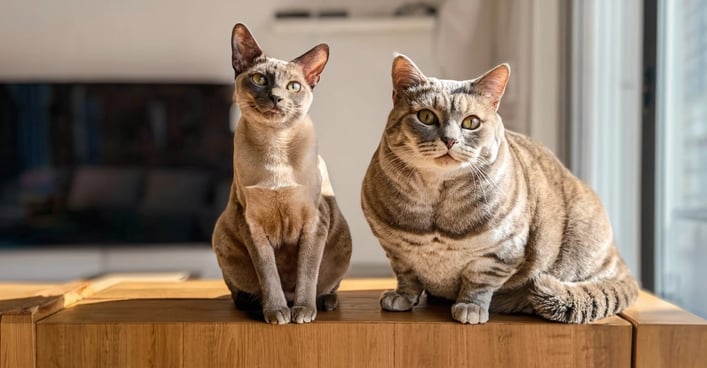
Manx vs Japanese Bobtail: The 2026 Breed Comparison Guide
Choosing between a Manx and a Japanese Bobtail? Our 2026 guide compares their tails, health, personality, and care to help you find your perfect feline match.
Share this page
Manx vs Japanese Bobtail: The 2026 Breed Comparison Guide
Two feline breeds captivate cat lovers with their distinctive tails—or notable lack thereof. The tailless Manx from the Isle of Man and the pom-pom-tailed Japanese Bobtail from Japan offer more than just unique appearances; they possess contrasting histories, temperaments, and care needs. This comprehensive 2026 guide provides the insights you need to decide which bob-tailed companion is the right fit for your home.
Origins and History
Manx Origins
The Manx breed developed naturally on the isolated Isle of Man in the Irish Sea. A spontaneous genetic mutation for taillessness became prevalent within the island's closed gene pool. Folklore whimsically claims the Manx lost its tail when Noah shut the Ark door on it!
Manx vs Japanese Bobtail: The 2026 Breed Comparison Guide - Articles
Origin:
First Show Appearance: Late 1800s
Genetic Cause: Natural mutation affecting spine development
Status: One of the oldest recognized cat breeds
Inheritance: The tailless gene is dominant
Japanese Bobtail Origins
Documented in Japan for over a millennium, the Japanese Bobtail is steeped in culture and art. The famous "Maneki-neko" (beckoning cat) figurine is modeled after this breed, symbolizing good fortune.
Key Historical Facts:
Origin: Japan, with roots in Southeast Asia
First Documentation: 6th-7th century AD
Genetic Cause: A different, natural short-tail mutation
Cultural Role: Traditional symbol of luck and prosperity
Inheritance: The short-tail gene is recessive
Understanding Tail Genetics
Manx Tail Types
Type
Description
Show Standard
Rumpy
Complete absence of a tail vertebrae
Preferred for show
Rumpy-Riser
A small bump or rise of cartilage
Acceptable for show
Stumpy
A short, movable tail stub
Pet quality
Longy
A tail of nearly normal length
Pet quality
Japanese Bobtail Tail Types
Feature
Description
Length
Typically 2-4 inches when straightened
Appearance
Resembles a rabbit's tail or fluffy pom-pom
Structure
Uniquely kinked, curved, or bent (no two are identical)
Fur
Longer hair creates a distinct plume effect
Show Standard
A visible, expressive tail is required
Key Genetic Differences
Manx:
The tailless (M) gene is dominant.
Inheriting two copies (homozygous) is often lethal for embryos.
Associated with Manx Syndrome, a spinal defect, in some cats.
Directly affects the development of the sacral vertebrae.
Japanese Bobtail:
The short-tail (jb) gene is recessive.
No associated health issues; the mutation is benign.
Tail structure is independent of spinal health.
Involves a completely different genetic mechanism than the Manx.
Physical Appearance Comparison
Size and Build
Feature
Manx
Japanese Bobtail
Weight (Male)
10-12 lbs (4.5-5.5 kg)
7-10 lbs (3-4.5 kg)
Weight (Female)
8-10 lbs (3.5-4.5 kg)
5-7 lbs (2.5-3 kg)
Body Type
Stocky, rounded, and substantial
Slender, athletic, and elegant
Bone Structure
Heavy and cobby
Fine to medium
Overall Build
Compact and powerful
Lithe and graceful
Coat Characteristics
Manx Coat:
Length: Short or long-haired (Cymric) varieties.
Texture: Dense, plush double coat.
Feel: Often compared to rabbit fur.
Colors & Patterns: All are accepted.
Shedding: Moderate, with seasonal increases.
Japanese Bobtail Coat:
Length: Short or long-haired varieties.
Texture: Soft, silky, and fine.
Feel: Smooth and flowing.
Colors & Patterns: All are accepted; the calico "Mi-Ke" is especially prized.
Shedding: Moderate.
Head and Facial Features
Manx:
Head: Round with full cheeks.
Eyes: Large, round, and expressive.
Ears: Medium-sized, wide-set.
Expression: Sweet and open.
Japanese Bobtail:
Head: Clearly triangular or wedge-shaped.
Eyes: Large, oval, and often slanted.
Ears: Large, upright, and high-set.
Expression: Alert, intelligent, and inquisitive.
Personality and Temperament
Manx Personality
Manx cats are renowned for their:
Dog-like loyalty and strong attachment to their family.
Playful, energetic nature with strong hunting instincts.
High intelligence, making them trainable.
Good adaptability to various living situations.
Generally good rapport with respectful children.
Japanese Bobtail Personality
Japanese Bobtails are characterized by their:
Outgoing, social, and highly friendly demeanor.
Exceptional intelligence and problem-solving skills.
Vocal nature; they "converse" with soft, chirping meows.
High energy and athletic, almost acrobatic, play style.
Strong affinity for family life and interaction.
Temperament Comparison
Trait
Manx
Japanese Bobtail
Energy Level
Moderate to High
High to Very High
Affection Level
High
High
Independence
Moderate
Low to Moderate
Vocalization
Moderate
High
Playfulness
High
Very High
Trainability
Good
Excellent
Grooming and Care Requirements
Manx Grooming
Brushing: 2-3 times per week to manage the dense undercoat.
Shedding: Moderate; more frequent brushing during seasonal changes.
Bathing: Rarely necessary.
Nail Trimming: Every 2-3 weeks.
Special Care: For "rumpy" types, gently clean the rear area to maintain hygiene.
Japanese Bobtail Grooming
Brushing: 2-3 times per week to maintain silkiness and prevent mats in longhairs.
Shedding: Moderate.
Bathing: Rarely needed.
Nail Trimming: Every 2-3 weeks.
Special Care: Handle their unique tail gently; it's not a handle.
Grooming Time Commitment
Task
Manx
Japanese Bobtail
Weekly Brushing
20-30 minutes
20-30 minutes
Seasonal Shedding Care
~45 min/week
~45 min/week
Overall Maintenance
Moderate
Moderate
Estimated Monthly Time
~2 hours
~2 hours
Health and Lifespan
Manx Health Overview
Average Lifespan: 8 to 14 years.
Common Health Considerations:
Manx Syndrome: A serious spinal/neurological defect affecting some tailless (rumpy) individuals. Symptoms can include incontinence, hind-leg weakness, or spina bifida.
Arthritis: More common in cats with spinal abnormalities.
Corneal Dystrophy: An eye condition.
Megacolon: A chronic constipation disorder.
Ethical Note: Reputable breeders perform health screenings and often prefer to breed "stumpy" or "longy" types to reduce health risks.
Japanese Bobtail Health Overview
Average Lifespan: 15 to 18 years.
Common Health Considerations:
Generally Robust: No known breed-specific genetic disorders.
They are prone to the same common feline ailments as any other cat (e.g., dental disease).
Known for a strong, healthy constitution.
Healthcare Cost Comparison (2026 Estimates)
Expense
Manx
Japanese Bobtail
Annual Wellness Exam
$150 - $300
$150 - $300
Core Vaccinations
$80 - $150
$80 - $150
Breed-Specific Screening
$200 - $500 (for Manx Syndrome)
N/A
Monthly Pet Insurance
$35 - $60
$25 - $40
Estimated Annual Total
$1,085 - $2,210
$530 - $1,030
Cost of Ownership
Initial Purchase Costs
Source
Manx
Japanese Bobtail
Pet Quality (Breeder)
$400 - $800
$600 - $1,200
Show Quality (Breeder)
$800 - $1,500
$1,200 - $2,500
Adoption / Rescue
$75 - $200
$100 - $300
Monthly Ongoing Costs
Category
Manx
Japanese Bobtail
High-Quality Food
$30 - $50
$30 - $50
Litter
$15 - $25
$15 - $25
Pet Insurance
$35 - $60
$25 - $40
Toys & Treats
$15 - $25
$20 - $30
Monthly Total
$95 - $160
$90 - $145
Living Environment & Lifestyle
Ideal Home for a Manx
Families: Good with gentle, supervised children.
Other Pets: Usually accepting of cat-friendly dogs and other cats.
Activity Level: Enjoys interactive play but may have mobility limits.
Space: Adaptable to apartments or houses.
Key Consideration:Imperative to source from a breeder who prioritizes health testing.
Ideal Home for a Japanese Bobtail
Families: Excellent with active, engaging families.
Other Pets: Thrives with playful feline or dog companions.
Activity Level: High; needs daily mental and physical stimulation.
Space: Adaptable, but appreciates vertical space for climbing.
Key Consideration: Best for owners who can provide consistent interaction.
Exercise and Play Needs
Manx Exercise
Daily Play: 20-30 minutes of interactive play (feather wands, laser pointers).
Play Style: Enjoys "hunting" games that engage their instincts.
Considerations: Some individuals may need modified play due to spinal health.
Japanese Bobtail Exercise
Daily Play: 30-45 minutes of vigorous, engaging activity.
Play Style: Loves fetch, puzzle toys, and acrobatic leaps. Highly inventive.
Athleticism: Superb jumpers and climbers; a cat tree is highly recommended.
Pros and Cons Summary
Manx: At a Glance
Advantages (✅)
Uniquely tailless, striking appearance.
Extremely loyal and devoted "shadow" companion.
Playful and intelligent.
Adaptable to different living environments.
Challenges (❌)
Risk of severe Manx Syndrome and associated health problems.
Generally shorter average lifespan.
Higher potential for ongoing veterinary costs.
Ethical debates surround breeding for taillessness.
Japanese Bobtail: At a Glance
Advantages (✅)
Unique, healthy pom-pom tail with no associated defects.
Exceptional longevity and robust health.
Highly entertaining, social, and interactive.
Excellent with families and other pets.
Challenges (❌)
Can be quite vocal and demand attention.
High energy requires committed daily engagement.
May be less readily available from breeders.
Ethical Considerations
Manx Breeding Ethics
This breed presents significant ethical questions:
The dominant tailless gene is directly linked to potentially fatal spinal defects.
Many advocates recommend breeding only "stumpy" or "longy" cats to promote health.
Prospective owners should prioritize adoption or seek breeders who conduct rigorous health screenings and are transparent about risks.
Japanese Bobtail Breeding Ethics
This breed is considered ethically sound:
The recessive short-tail gene causes no pain, disability, or health issues.
The breed has a long, documented history of vitality.
Standard ethical breeding practices apply, with no inherent welfare concerns.
Final Decision Guide
Choose a Manx If...
You are deeply drawn to the tailless aesthetic and understand the risks.
You have found a reputable source (breeder or rescue) that prioritizes health.
You desire a loyal, somewhat dog-like companion with a calm-to-moderate energy level.
You are financially and emotionally prepared for potential health challenges.
Choose a Japanese Bobtail If...
You want a unique cat without breed-specific health baggage.
You prefer an active, athletic, and highly intelligent feline.
You seek a long-lived companion (15+ years).
You enjoy a vocal, interactive cat and have an engaging household.
You appreciate the cultural heritage and elegant appearance.
Conclusion
Both the Manx and the Japanese Bobtail offer unparalleled uniqueness and deep companionship, but they cater to different priorities. The Japanese Bobtail stands out as the lower-risk choice, boasting a worry-free genetic profile, longer lifespan, and exuberant personality. The Manx, while profoundly loyal and distinctive, requires careful, informed selection and preparedness for its associated health considerations.
Your choice ultimately hinges on what you value most: the singular look of the tailless Manx with its dedicated companionship, or the vibrant, healthy, and playful spirit of the Japanese Bobtail. Whichever you choose, you're welcoming a remarkable and loving member into your family.
Get expert advice about cat care, behavior, nutrition, grooming, and training. Ask our AI cat care expert anything about your cat and receive professional guidance.