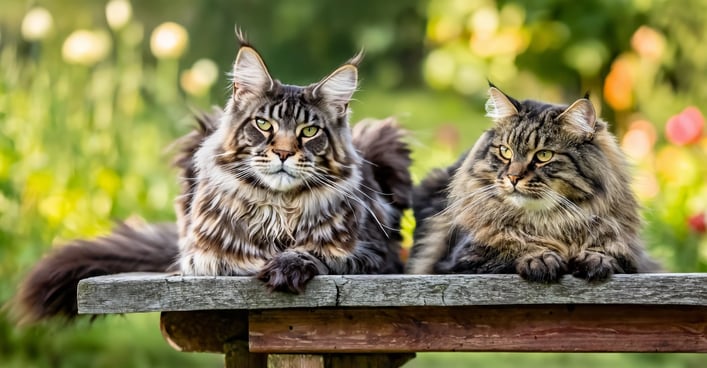
Maine Coon vs Norwegian Forest Cat: The Ultimate 2026 Comparison Guide
Discover the key differences between Maine Coon and Norwegian Forest Cats. Our 2026 guide compares size, personality, health, and care to help you choose your perfect gentle giant.
Share this page
Maine Coon vs Norwegian Forest Cat: The Ultimate 2026 Comparison Guide
By Emily Rodriguez, Certified Animal Behaviorist | Published: January 15, 2026 | Reading Time: 14 minutes
Introduction
At first glance, the majestic Maine Coon and the elegant Norwegian Forest Cat appear strikingly similar. Both are large, long-haired breeds boasting tufted ears, impressive ruffs, and adaptations for cold climates that speak to their northern heritage. However, beneath their fluffy exteriors lie distinct personalities, health profiles, and care needs. This comprehensive 2026 guide delves into every detail to help prospective owners distinguish between these gentle giants and make an informed decision for their perfect feline companion.
Maine Coon vs Norwegian Forest Cat: The Ultimate 2026 Comparison Guide - Articles
Emerged: Early 19th century
Status: Official state cat of Maine
Popular Legend: Descended from Marie Antoinette's cats (unverified myth)
Accepted Reality: Likely descended from long-haired European cats brought by sailors and early settlers.
Historical Role:
Maine Coons were valued as working cats on farms and sailing vessels, prized for their exceptional hunting skills and thick, weather-resistant coats. Their substantial size was a key survival trait in the harsh New England winters.
Norwegian Forest Cat: The Viking Companion
Ancient Heritage:
Origin: Norway
History: Referenced in Norse mythology, potentially as the cats that drew Freya's chariot
Modern Recognition: Breed preservation efforts began in the 1930s
CFA Recognition: 1984
Status: National cat of Norway
Historical Role:
Legend holds that these robust cats traveled with Vikings, serving as essential ship mousers. They developed naturally through survival of the fittest in Norway's dense forests, enduring extreme winters to become the breed we know today.
Physical Characteristics: A Side-by-Side Look
Size and Build Comparison
Feature
Maine Coon
Norwegian Forest Cat
Which is Larger?
Male Weight
13-18 lbs (5.9-8.2 kg)
13-16 lbs (5.9-7.3 kg)
Maine Coon
Female Weight
8-12 lbs (3.6-5.4 kg)
8-12 lbs (3.6-5.4 kg)
Tie
Length (with tail)
Up to 40 inches (102 cm)
Up to 36 inches (91 cm)
Maine Coon
Height
10-16 inches (25-41 cm)
9-12 inches (23-30 cm)
Maine Coon
Body Type
Rectangular, muscular
Athletic, triangular
Different builds
Bone Structure
Heavy, substantial
Moderate, refined
Maine Coon
Size Verdict: Maine Coons are generally the larger breed, with some males exceeding 20 pounds. Norwegian Forest Cats are impressively big but typically more moderate in frame and weight.
Coat and Appearance Breakdown
Feature
Maine Coon
Norwegian Forest Cat
Coat Texture
Shaggy, uneven length
Even, silky topcoat with dense woolly undercoat
Coat Length
Long, shorter on shoulders/chest
Long, consistently full all over
Water Resistance
Good
Excellent (considered the most water-repellent cat breed)
Neck Ruff
Moderate to heavy
Heavy, dramatic "mane"
Tail
Long, plume-like
Long, exceptionally bushy (like a fox tail)
Ears
Large, prominent lynx-like tufts
Medium-large, heavily tufted
Paws
Large, well-tufted
Large, tufted
Head Shape
Square muzzle, strong cheekbones
Triangular, refined with a straight nose profile
Distinctive Maine Coon Features:
Pronounced lynx-like ear tufts
Square muzzle and strong chin
Historically often polydactyl (extra toes)
Long, rectangular body silhouette
Shaggy, "unkempt" coat of uneven length
Distinctive Norwegian Forest Cat Features:
Equilateral triangular head with straight nose line
Almond-shaped, expressive eyes
Exceptionally bushy, flowing tail
Even, double-layered coat with a woolly undercoat
A more "wild" and natural forest appearance
Temperament & Personality: Beyond the Fluff
Maine Coon: The Gentle Canine-Cat
Core Personality Traits:
Dog-like Devotion: Often follows owners and greets them at the door.
Gentle Giant: Remarkably careful and aware of their large size.
Perpetually Playful: Maintains kitten-like curiosity and playfulness well into adulthood.
Conversationalist: Communicates with chirps, trills, and meows (rarely loud).
Independent yet Social: Content alone but thrives on family interaction.
Water Fascination: Frequently intrigued by running water; may play in water dishes.
Characteristic Behaviors:
Can learn to retrieve toys (playing fetch).
Intelligent; may figure out how to open doors or cabinets.
Often adapts well to harness and leash training.
Typically excellent with children and other pets.
Not usually a "lap cat" due to size, but will stay close by.
Activity Level: Moderate to High (6/10)
Norwegian Forest Cat: The Independent Climber
Core Personality Traits:
Born Climbers: Have an innate love for high places and vertical territory.
Independent Spirit: More self-sufficient and less demanding than Maine Coons.
Selectively Social: Forms deep, loyal bonds with family but on their own terms.
Quiet Companion: Has a soft voice and is not typically demanding.
Strong Hunting Instinct: Possesses a notable prey drive.
Reserved Demeanor: Often cautious or aloof with strangers initially.
Characteristic Behaviors:
Excellent, agile climbers who require tall, sturdy cat trees.
May exhibit hunting behavior, presenting "gifts" of caught prey.
Warms up slowly to strangers but is deeply affectionate with trusted family.
Playful in a more deliberate, observant manner.
Prefers to survey their domain from an elevated perch.
Activity Level: Moderate (5/10)
Personality Comparison at a Glance
Trait
Maine Coon
Norwegian Forest Cat
More Pronounced In
Affection Level
High
Moderate-High
Maine Coon
Independence
Moderate
Higher
Norwegian Forest Cat
Vocalization
Moderate (chirps, trills)
Low
Maine Coon
Playfulness
High
Moderate
Maine Coon
Climbing Desire
Moderate
Very High
Norwegian Forest Cat
Trainability
High
Moderate
Maine Coon
Social with Strangers
Friendly, welcoming
Reserved, cautious
Maine Coon
Care & Maintenance Requirements
Grooming Needs
Maine Coon Grooming:
Frequency: 2-3 times per week (daily during heavy shedding seasons).
Essential Tools: Wide-tooth comb, slicker brush, metal comb.
Matting Risk: Moderate, especially under the arms, belly, and chest.
Shedding: Significant seasonal shedding (spring and fall).
Bathing: Rarely needed unless soiled.
Time Commitment: 20-30 minutes per grooming session.
Norwegian Forest Cat Grooming:
Frequency: 2-3 times per week (increase during seasonal "coat blow").
Essential Tools: Metal comb, slicker brush, undercoat rake.
Matting Risk: Moderate, due to the dense, woolly undercoat.
Shedding: Profuse seasonal shedding; the "coat blow" can be dramatic.
Bathing: Rarely needed; their coat is highly water-repellent.
Time Commitment: 20-30 minutes per session.
Estimated Annual Grooming Costs (2026):
Expense
Maine Coon
Norwegian Forest Cat
Brushes & Tools
$40 - $80
$40 - $80
Professional Grooming (Optional)
$200 - $400
$200 - $400
Shampoo/Conditioner
$30 - $60
$30 - $60
Annual Total
$270 - $540
$270 - $540
Health Profile Comparison
Common Maine Coon Health Concerns:
Hypertrophic Cardiomyopathy (HCM): A form of heart disease.
Hip Dysplasia: A malformation of the hip joint.
Spinal Muscular Atrophy (SMA): A genetic neuromuscular disorder.
Polycystic Kidney Disease (PKD): Development of cysts in the kidneys.
Glycogen Storage Disease Type IV (GSD IV): A rare metabolic disorder.
Hypertrophic Cardiomyopathy (HCM): Heart disease (lower prevalence than in MC).
Eosinophilic Granuloma Complex: A group of inflammatory skin conditions.
Retinal Dysplasia: A non-progressive eye condition.
Health Comparison Summary:
Factor
Maine Coon
Norwegian Forest Cat
Overall Health
Good
Very Good
Genetic Issue Prevalence
Moderate
Low
Heart Disease (HCM) Risk
Higher
Moderate
Average Lifespan
12 - 15 years
14 - 16 years
Typical Veterinary Costs
Moderate-High
Moderate
Recommended Health Screening for Both Breeds:
Annual veterinary check-ups.
HCM screening via echocardiogram (consult your vet on frequency).
Hip evaluations (if available/indicated).
Breed-specific genetic testing from reputable breeders.
Lifestyle, Exercise & Environment
Maine Coon Requirements
Daily Needs:
20-30 minutes of active, interactive play.
Mental stimulation via puzzle feeders and food-dispensing toys.
Ample horizontal space to roam, explore, and run.
Opportunities for water play (e.g., cat water fountains).
Ideal Home Environment:
Spacious living areas.
Access to extra-large, sturdy cat trees (rated for 20+ lbs).
Dedicated interactive play sessions with their human.
Secure window perches for bird-watching entertainment.
Norwegian Forest Cat Requirements
Daily Needs:
Essential: Access to vertical climbing structures.
15-20 minutes of active play simulating hunting.
High observation perches to satisfy their need to survey.
Interactive toys that engage their problem-solving skills.
Ideal Home Environment:
Tall cat trees (6+ feet) and wall-mounted shelving systems.
Multiple elevated window perches.
Scratching posts at various heights.
A calm household where they can retreat to high spaces.
Cost of Ownership Analysis (2026 Estimates)
Initial Acquisition & Setup Costs
Expense
Maine Coon
Norwegian Forest Cat
Purchase Price (Pet Quality)
$800 - $2,000
$800 - $1,500
Purchase Price (Show Quality)
$2,000 - $4,000
$1,500 - $3,000
Initial Supplies (Carrier, Bed, etc.)
$400 - $600
$400 - $600
Spay/Neuter Surgery
$200 - $500
$200 - $500
Initial Total Range
$1,400 - $3,100
$1,400 - $2,600
Estimated Annual Recurring Costs
Expense
Maine Coon
Norwegian Forest Cat
High-Quality Food (Large Breed)
$500 - $700
$500 - $700
Litter
$200 - $300
$200 - $300
Grooming (Tools & Professional)
$270 - $540
$270 - $540
Routine Veterinary Care
$400 - $800
$300 - $600
Toys, Treats, & Supplies
$150 - $300
$100 - $200
Pet Insurance
$400 - $700
$300 - $500
Annual Total Range
$1,920 - $3,340
$1,670 - $2,840
Projected Lifetime Cost (14-Year Average)
Category
Maine Coon
Norwegian Forest Cat
Initial Costs (Averaged)
~$2,000
~$1,800
Annual Costs x 14 Years
$26,880 - $46,760
$23,380 - $39,760
Emergency Medical Fund
$3,000 - $7,000
$2,000 - $5,000
Total Lifetime Estimate
$31,880 - $55,760
$27,180 - $46,560
Compatibility with Families & Other Pets
Maine Coon Compatibility
Typically Excellent With:
Other cats (known for their gentle, pacifying nature).
Cat-friendly, respectful dogs.
Children of all ages (supervised, as with any pet).
Smaller pets like rabbits (if introduced very carefully and supervised).
Important Considerations:
Their large size may unintentionally intimidate smaller pets.
Play can be boisterous; they may not recognize their own strength.
Can be "bull in a china shop" and accidentally knock items over.
Early and positive socialization is highly beneficial.
Norwegian Forest Cat Compatibility
Typically Excellent With:
Other respectful, calm cats.
Gentle, calm dog breeds.
Older children who understand cat body language.
Important Considerations:
Strong innate prey drive; not recommended with small pets like rodents or birds.
May not tolerate rough or invasive handling.
Require clear escape routes and their own high spaces away from other pets.
Can be territorial over preferred climbing structures with other cats.
Pros and Cons Summary
Maine Coon: Advantages & Challenges
Pros:
Dog-like Personality: Interactive, devoted, and often trainable.
Gentle Demeanor: Remarkably careful and patient despite their size.
Family-Friendly: Excellent, tolerant companions for children.
High Trainability: Can learn tricks, walk on a leash, and play fetch.
Unique Water Interest: Their fascination with water provides unique entertainment.
Pleasantly Vocal: Communicative with charming chirps and trills.
Social Butterfly: Usually welcoming and friendly with visitors.
Adaptable: Can adjust to various living situations with adequate space.
Cons:
Substantial Size: Requires more space and oversized accessories (beds, carriers, litter boxes).
Significant Shedding: Heavy seasonal shedder; not for the tidiness-obsessed.
Health Considerations: Higher predisposition to HCM and hip dysplasia.
Higher Food Costs: Large cats have correspondingly large appetites.
Litter Box Logistics: Needs very large litter boxes, and more litter is used.
Potential for Clumsiness: Can accidentally swipe items off surfaces.
Premium Price Tag: Purchase price from reputable breeders is high.
Sturdy Furniture Needed: Standard cat trees are often insufficient; need heavy-duty options.
Norwegian Forest Cat: Advantages & Challenges
Pros:
Breathtaking Appearance: Possesses a wild, elegant, and natural beauty.
Generally Healthy Breed: Fewer common genetic health issues than many purebreds.
Athletic Climber: Their agility and love for heights are mesmerizing to watch.
Independent Nature: Well-suited for owners with full-time jobs.
Quiet Companion: Not prone to loud or demanding vocalizations.
Low-Maintenance Coat: Despite the length, the weather-resistant coat is relatively easy to care for.
Long Lifespan: Often lives 14-16 years with proper care.
Intelligent Problem-Solver: Enjoys interactive puzzles and challenges.
Cons:
Reserved with Strangers: Not immediately affectionate or outgoing with new people.
Strong Prey Drive: May view small household pets as prey.
Vertical Space Mandatory: Requires significant investment in climbing structures.
Intense Seasonal Shedding: The "coat blow" can be overwhelming.
Selective with Affection: Bonds deeply but strictly on their own terms and timeline.
Not a "Cuddlebug": More independent and less lap-oriented than some owners desire.
Limited Availability: Can be harder to find than Maine Coons from ethical breeders.
Similar Expense: Carries a purchase and care cost comparable to the Maine Coon.
Final Verdict: Which Breed is Right for You?
Choose a Maine Coon If You Want:
✓ A highly social, "dog-like" feline companion.
✓ An interactive, trainable pet who engages in play.
✓ A gentle giant that is famously good with children.
✓ Space to accommodate a very large cat.
✓ A vocal cat who "talks" with pleasant chirps.
✓ To manage seasonal shedding and potential breed-specific health screenings.
✓ A welcoming cat who will likely greet your guests.
Choose a Norwegian Forest Cat If You Prefer:
✓ A cat with stunning, wild natural beauty and elegance.
✓ To provide a home with extensive vertical climbing space.
✓ A generally healthy, long-lived breed with fewer genetic concerns.
✓ A more independent, self-sufficient feline personality.
✓ A quiet companion who isn't demanding.
✓ To watch incredible climbing agility and problem-solving skills.
✓ A deep, loyal bond that develops on the cat's terms.
Key Similarities to Remember
Both of these magnificent breeds:
Require committed, regular grooming (2-3 times weekly).
Are large cats with correspondingly large appetites and budgets.
Possess weather-resistant, double-layered coats.
Benefit from proactive health screening, particularly for HCM.
Are generally healthy and robust with responsible care.
Make exceptionally rewarding companions for the right, prepared home.
Frequently Asked Questions (FAQ)
Q: Which breed sheds more?A: Both are heavy shedders. Norwegian Forest Cats have a more dramatic seasonal "coat blow," where they shed their dense undercoat all at once, typically in spring. Maine Coons tend to shed more consistently year-round with seasonal peaks.
Q: Can these large breeds live happily in an apartment?A: Yes, with important caveats. Norwegian Forest Cats must have ample vertical space (tall cat trees, shelves). Maine Coons need sufficient horizontal room to move and play. Both require dedicated environmental enrichment regardless of home size.
Q: Which breed is generally better with young children?A: Maine Coons are widely renowned for their patient, gentle, and tolerant nature with children of all ages. Norwegian Forest Cats often do better with older, calmer children who respect their space.
Q: Do Maine Coons and Norwegian Forest Cats get along with each other?A: Yes, their similar size, energy levels, and origins often make them compatible housemates, provided they are properly introduced. Many enthusiasts successfully keep both breeds.
Q: Which is more expensive to own over the cat's lifetime?A: Maine Coons typically have slightly higher lifetime costs. This is due to their potential for higher veterinary costs related to breed-specific health issues and their marginally larger size, which increases food and supply expenses.
Q: Are either of these breeds hypoallergenic?A: No. Neither the Maine Coon nor the Norwegian Forest Cat is hypoallergenic. All cats produce the Fel d1 protein, the primary allergen, in their saliva and skin glands. Regular grooming can help reduce loose hair and dander.
Q: Which breed has a longer average lifespan?A: Norwegian Forest Cats often have a slight edge, with an average lifespan of 14-16 years. Maine Coons typically live 12-15 years. Individual lifespan depends heavily on genetics, diet, and preventive healthcare.
Disclaimer: Individual cats have unique personalities that may vary from general breed tendencies. This guide provides a comprehensive comparison based on breed standards and typical traits. Always spend time with an individual cat and consult with breeders or shelters to ensure a good match for your lifestyle.
Get expert advice about cat care, behavior, nutrition, grooming, and training. Ask our AI cat care expert anything about your cat and receive professional guidance.