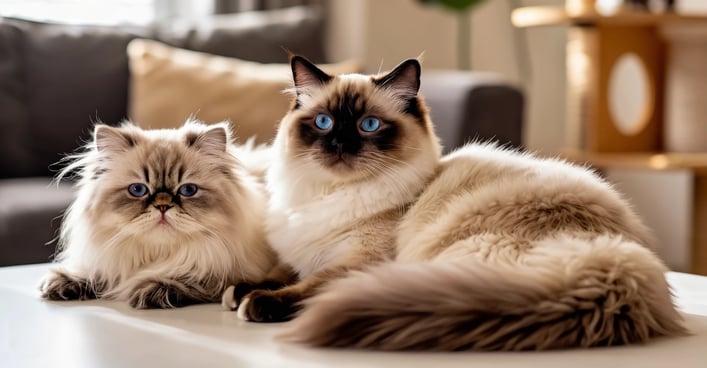
Himalayan vs Ragdoll Cat: The 2026 Guide to Choosing Your Fluffy Companion
Can't decide between a Himalayan and a Ragdoll? Our detailed 2026 guide compares temperament, grooming, health, and costs to help you choose the perfect fluffy feline for your home.
Share this page
Himalayan vs Ragdoll Cat: The 2026 Guide to Choosing Your Fluffy Companion
Himalayan and Ragdoll cats are two of the most sought-after long-haired breeds, renowned for their luxurious coats and gentle, affectionate natures. While they share a love for lounging and cuddles, their origins, physical traits, and care needs are distinctly different. This comprehensive 2026 guide provides a detailed comparison to help you decide which beautiful, fluffy companion is the ideal match for your lifestyle.
Breed Origins and History
Himalayan Background
Origin: United States, 1930s.
Creation: A deliberate cross between the Persian and Siamese breeds.
Registry Recognition: Officially accepted by the Cat Fanciers' Association (CFA) in 1957.
Other Names: Often called the Colorpoint Persian or "Himmie."
Original Purpose: To combine the Persian's luxurious coat and body type with the Siamese's striking color points.
Ragdoll Background
Origin: Riverside, California, USA, in the 1960s.
Creator: Breed founder Ann Baker.
Registry Recognition: Gained CFA acceptance in 1993.
Unique Trait: Known for their docile temperament and tendency to go limp when held.
Original Purpose: Bred specifically to be a large, affectionate, and placid companion cat.
Key Takeaway: Ragdolls are a significantly larger breed, often weighing 5 or more pounds heavier than their Himalayan counterparts.
Coat and Facial Features
Himalayan Coat:
Length & Texture: Very long, thick, and fine with a dense undercoat.
Maintenance:Daily grooming is essential to prevent severe matting.
Shedding: Heavy, especially during seasonal changes.
Color Pattern: Exclusively colorpoint (darker colors on the face, ears, paws, and tail).
Ragdoll Coat:
Length & Texture: Semi-long, silky, and plush with a minimal undercoat.
Maintenance: Brushing 2-3 times per week is typically sufficient.
Shedding: Moderate.
Color Patterns: Colorpoint, mitted, and bicolor.
Facial Structure (The Critical Difference):
Feature
Himalayan
Ragdoll
Face
Flat or "peke-faced" (brachycephalic)
Wedge-shaped, moderately rounded
Nose
Very short and snub
Medium length
Eyes
Large, round, and vivid blue
Large, oval, and always blue
Expression
Sweet, sometimes severe due to flat face
Gentle, soft, and open
Himalayans have an extreme flat face, which requires special care, while Ragdolls have standard feline facial proportions.
Temperament and Personality
Himalayan Temperament
Activity Level: Low to moderate. They are calm and serene.
Vocalization: Quiet, with a soft, gentle voice.
Affection Style: A true lap cat that enjoys close, quiet companionship.
With Strangers: Can be reserved or shy initially.
Best For: Homes with predictable routines and a peaceful atmosphere.
Ragdoll Temperament
Activity Level: Low, but they retain a playful, kitten-like demeanor into adulthood.
Vocalization: Quiet, often communicating with soft chirps and meows.
Affection Style:Extremely affectionate; famous for going completely limp ("ragdoll") when picked up.
With Strangers: Generally friendly and trusting.
Best For: Families, including those with children and other pets. They are dog-like in their devotion.
Temperament Comparison at a Glance
Trait
Himalayan
Ragdoll
Affection Level
High (8/10)
Exceptional (10/10)
Activity Level
Low (4/10)
Low (3/10)
Playfulness
Moderate (5/10)
Moderate-High (6/10)
Vocalization
Low (3/10)
Very Low (2/10)
Independence
Moderate (5/10)
Low (2/10) - Very social
Child Friendly
Good (7/10)
Excellent (10/10)
Stranger Friendly
Moderate (5/10)
Good (7/10)
Grooming and Maintenance
Himalayan Grooming Needs (High Maintenance)
Daily: 15-20 minutes of thorough brushing to prevent mats; cleaning of eye tear stains and facial folds.
Weekly: Ear cleaning, nail trimming, and a deeper conditioning brush.
Professional: A grooming session every 6-8 weeks is highly recommended. "Lion cuts" are common for manageability.
Ragdoll Grooming Needs (Moderate Maintenance)
Weekly: 10-15 minutes of brushing 2-3 times per week is usually adequate.
Bi-Weekly: Check ears, trim nails, and ensure coat is mat-free.
Professional: Optional, perhaps every 3-4 months for a tidy-up.
Grooming Time & Cost Investment
Frequency
Himalayan
Ragdoll
Daily
20-30 minutes
5 minutes
Weekly
1+ hour
30 minutes
Annual Grooming Cost
$400-$800
$100-$200
Health and Lifespan
Common Himalayan Health Concerns
Due to their brachycephalic (flat-faced) structure:
Breathing Difficulties & Heat Sensitivity: Require a cool, climate-controlled environment.
Dental Issues: Crowded teeth can lead to periodontal disease.
Eye Conditions: Prone to excessive tearing and cherry eye.
Polycystic Kidney Disease (PKD): A genetic condition with a significant carrier rate.
Average Lifespan: 9-15 years.
Common Ragdoll Health Concerns
Hypertrophic Cardiomyopathy (HCM): A form of heart disease; responsible breeders screen for this.
Urinary Tract Issues: Such as crystals or stones.
Obesity: They love food and are not highly active, so portion control is key.
Average Lifespan: 12-17 years.
Health Comparison Summary
Factor
Himalayan
Ragdoll
Overall Robustness
Moderate
Good to Excellent
Genetic Issue Prevalence
More common
Fewer
Typical Veterinary Costs
Higher
Moderate
Lifespan
Generally shorter
Generally longer
Cost of Ownership (2026 Estimates)
Initial & Annual Costs
Expense
Himalayan
Ragdoll
Kitten from Breeder
$800-$2,500
$800-$2,000
Annual Food
$600-$900
$600-$900
Annual Grooming
$400-$800
$100-$200
Annual Veterinary Care
$500-$1,000
$300-$600
Total Annual Cost
$1,800-$3,200
$1,300-$2,200
Lifetime Cost (Est. 12-15 Years)
Himalayan: $21,600 - $48,000
Ragdoll: $15,600 - $33,000
Pros and Cons Summary
Himalayan Pros & Cons
Pros:
✅ Unmatched, stunning beauty with a luxurious coat.
✅ Exceptionally calm and quiet, perfect for apartments.
✅ A devoted and predictable lap cat.
Cons:
❌ Very high grooming demands (daily brushing).
❌ More health concerns related to their flat face.
❌ Higher overall cost of care and maintenance.
Ragdoll Pros & Cons
Pros:
✅ Legendarily affectionate and gentle temperament; great with families.
✅ Much lower grooming needs than most long-haired breeds.
✅ Generally healthier and longer-lived with fewer genetic issues.
Cons:
❌ Must be indoor-only cats; they lack survival instincts.
❌ Can be needy and dislike being left alone for long periods.
❌ Their large size means more food and larger supplies.
Which Breed Is Right for You?
Choose a Himalayan If:
You are captivated by extreme feline beauty and don't mind the daily upkeep.
You can provide a cool, air-conditioned, and quiet home.
You are prepared for potentially higher veterinary costs.
You want a serene, less demanding companion (emotionally).
Choose a Ragdoll If:
Your top priority is an incredibly affectionate, dog-like companion.
You have a family, children, or other pets.
You want a long-haired cat but prefer moderate grooming.
You seek a generally healthier breed with a longer lifespan.
Final Verdict
Both the Himalayan and Ragdoll offer incredible companionship in a fluffy package. The Himalayan is the choice for the dedicated enthusiast who sees the intensive grooming as a labor of love for its breathtaking beauty. The Ragdoll is often the more practical choice for most families, offering easier care, robust health, and an unbeatable, floppy, affectionate personality.
Finding a Reputable Breeder or Rescue
Essential Questions to Ask:
Can you provide documentation of genetic health testing (PKD for Himalayans, HCM for Ragdolls)?
May I meet the kitten's parents to observe their temperament?
What is your socialization process for kittens?
What does your health guarantee and contract cover?
Red Flags to Avoid:
Breeders who won't allow you to visit their facility.
No proof of health screening for parents.
Multiple litters or breeds always available.
Prices significantly below the market average.
Last Updated: 2026 | Remember, both breeds thrive in loving, committed homes. Always consider adopting from breed-specific rescues or shelters.
Get expert advice about cat care, behavior, nutrition, grooming, and training. Ask our AI cat care expert anything about your cat and receive professional guidance.