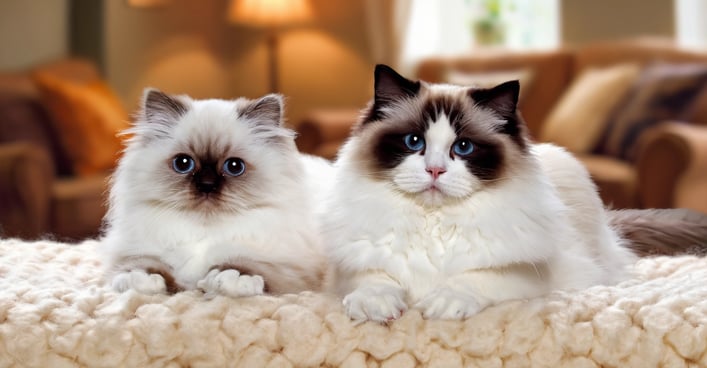
Himalayan vs Ragdoll: The 2026 Breed Comparison Guide
Choosing between a Himalayan and a Ragdoll? Our guide compares their grooming needs, health, temperament, and costs to help you find your perfect blue-eyed companion.
Share this page
Himalayan vs Ragdoll: The 2026 Breed Comparison Guide
When searching for a gentle, long-haired cat with captivating blue eyes, the Himalayan and Ragdoll are two of the most popular contenders. While they share a stunning appearance, their origins, care needs, and personalities differ significantly. This comprehensive 2026 guide will help you determine which of these affectionate breeds best suits your lifestyle.
Breed Overview
Himalayan Cats
Origin and History
The Himalayan, sometimes called the Colorpoint Persian, was developed in the 1930s by crossing Siamese and Persian cats. Breeders aimed to combine the Persian's luxurious coat with the Siamese's distinct colorpoint pattern. Named after the similar markings of Himalayan rabbits, the breed was formally recognized by the Cat Fanciers' Association (CFA) in 1957. Today, they are cherished for their elegant, doll-like appearance and serene demeanor.
Distinctive Feature: A classic Persian "cobby" body with Siamese-style points.
Lifespan: 9-15 years
Body Type: Compact, substantial, and low to the ground.
Ragdoll Cats
Origin and History
The Ragdoll breed originated in 1960s California, developed by Ann Baker from a foundation cat named Josephine. Known for her exceptionally docile nature, Josephine's lineage produced large, pointed cats with a unique tendency to go limp when held—inspiring the "Ragdoll" name. Despite early controversy, the breed gained widespread recognition and is now one of the world's most popular, adored for its gentle, dog-like devotion.
Coat: Semi-long, silky, and plush with minimal undercoat.
Colors & Patterns: Seal, blue, chocolate, lilac, red, cream in colorpoint, mitted, or bicolor patterns.
Eyes: Large, oval, and vivid blue.
Distinctive Feature: Famous for relaxing completely when picked up.
Lifespan: 12-17 years
Body Type: Large, muscular, and rectangular.
Physical Characteristics: A Side-by-Side Look
Body Type & Structure
Feature
Himalayan
Ragdoll
Build
Cobby, compact, substantial
Large, heavy-boned, rectangular
Legs
Short and sturdy
Medium to long and sturdy
Head
Round with a flat, brachycephalic face
Broad, modified wedge
Movement
Elegant but not athletic
Graceful and deliberate
Coat & Grooming Profile
Aspect
Himalayan
Ragdoll
Coat Length
Very long (4-6+ inches)
Semi-long (2-3 inches)
Texture
Fine, silky, dense undercoat
Silky, plush, "rabbit-like"
Shedding
Heavy seasonal shedding
Moderate, year-round
Grooming Frequency
Daily brushing essential
Brushing 2-3 times per week
Matting Risk
Very High
Low
Facial Features & Health Impact
Himalayan: Features a flat (brachycephalic) face like its Persian ancestors. This contributes to a sweet expression but can lead to breathing difficulties, dental issues, and excessive tearing.
Ragdoll: Has a broader face with a medium-length nose and no brachycephalic traits, resulting in fewer associated health problems.
Temperament and Personality
Himalayan Personality Traits
Calm and Serene: Prefers a quiet, predictable environment and moves with dignified grace.
Affectionate but Selective: Forms strong bonds with family but can be reserved with strangers. Enjoys affection on its own terms.
Quiet Companion: Communicates subtly with expressive eyes rather than frequent vocalizations.
Low Energy: Content with short play sessions and long naps. An ideal lap cat for calm households.
Ragdoll Personality Traits
The Ultimate "Floppy" Cat: Famous for going completely limp and relaxed when held.
Devoted and Social: Forms intense bonds, often following owners from room to room. Craves companionship.
Gentle and Tolerant: Exceptionally good with children, other pets, and handling. Has a very soft voice.
Playfully Relaxed: Maintains a moderate, kitten-like playfulness into adulthood but is never hyperactive.
Temperament Summary
Trait
Himalayan
Ragdoll
Energy Level
Very Low
Low to Moderate
Affection Level
Moderate
Very High
Independence
Moderate
Low (Very people-oriented)
Vocalization
Very Low
Low
Tolerance for Handling
Low to Moderate
Very High
Suitability for Families with Kids
Good (in calm settings)
Excellent
Lap Cat Potential
Moderate
Very High
Grooming and Maintenance
Himalayan: A High-Maintenance Beauty
Himalayan coats require a significant commitment to prevent painful mats.
Daily: 15-30 minutes of thorough combing, plus cleaning eye discharge.
Weekly: Many need bathing and blow-drying.
Professional Grooming: Often required monthly, adding $600-$1,200+ to annual costs.
Ragdoll: Manageable Luxury
Ragdoll grooming is far less intensive.
Weekly: Brushing 2-3 times is usually sufficient to maintain coat health.
Bathing: Rarely needed unless the cat gets dirty.
Professional Grooming: Seldom necessary, making annual costs significantly lower ($50-$200).
Health, Lifespan, and Considerations
Common Health Issues
Himalayan Health Notes:
Brachycephalic Syndrome: Predisposed to breathing issues, dental problems, and heat sensitivity.
Polycystic Kidney Disease (PKD): An inherited condition from Persian lines. Reputable breeders test for this.
Eye Conditions: Prone to excessive tearing and corneal ulcers.
Average Lifespan: 9-15 years.
Ragdoll Health Notes:
Hypertrophic Cardiomyopathy (HCM): A genetic heart disease. Ethical breeders screen their breeding stock.
Bladder Stones: Some predisposition to calcium oxalate stones.
Obesity: Can be prone to weight gain; diet and play should be monitored.
Average Lifespan: 12-17 years.
Cost of Ownership (2026 Estimates)
Initial Investment
Expense
Himalayan
Ragdoll
Kitten (from Reputable Breeder)
$1,000 - $3,000
$1,200 - $3,000
Initial Vet & Supplies
~$700 - $1,400
~$700 - $1,400
Total Initial Cost
$1,700 - $4,400
$1,900 - $4,400
Annual Ongoing Costs
Expense
Himalayan
Ragdoll
Food & Litter
$750 - $1,500
$750 - $1,500
Routine Veterinary Care
$400 - $800
$400 - $800
Grooming (Key Difference)
$600 - $1,600
$50 - $150
Pet Insurance
$300 - $600
$300 - $600
Total Annual Cost
$2,050 - $4,500
$1,500 - $3,050
Over a 12-15 year lifespan, the Himalayan's extensive grooming needs result in a significantly higher total cost of ownership.
Which Breed Is Right For You?
Choose a Himalayan If You:
Are captivated by the classic Persian look with colorpoints.
Can commit to daily, extensive grooming sessions.
Prefer a quieter, more sedentary companion.
Live in a calm, adult-oriented, and climate-controlled home.
Are prepared for potential brachycephalic-related health issues.
Choose a Ragdoll If You:
Want a large, affectionate "puppy-cat" that follows you around.
Prefer a moderate, weekly grooming routine.
Have children or other pets and need a highly tolerant cat.
Love the idea of a cat that goes limp and relaxed in your arms.
Seek a generally healthier breed with a longer potential lifespan.
Key Similarities
Despite their differences, both breeds share:
Striking blue eyes and colorpoint coat patterns.
Gentle, sweet, and non-aggressive dispositions.
A requirement to be indoor-only cats for their safety.
Quiet voices and a preference for peaceful homes.
A deep capacity for love and companionship.
Final Verdict
Your choice between a Himalayan and a Ragdoll ultimately hinges on your lifestyle and commitment level.
The Himalayan is the epitome of feline elegance but demands an owner ready for the high maintenance of its coat and potential health needs. It's perfect for a serene home where its beauty can be meticulously cared for.
The Ragdoll offers equally stunning looks with far easier care, a more robust constitution, and an irresistibly affectionate, social personality. It is often the more practical and adaptable choice for families, first-time owners, or those wanting a velcro-cat companion.
Both breeds will reward a dedicated owner with years of gentle love and breathtaking beauty. Ensure you source your kitten from a responsible breeder who conducts essential health screenings (PKD for Himalayans, HCM for Ragdolls) to give your new friend the healthiest start possible.
Disclaimer: Individual cats may vary. This guide provides general breed standards and considerations. Always spend time with a breed before committing and choose ethical breeders or rescue organizations.
Get expert advice about cat care, behavior, nutrition, grooming, and training. Ask our AI cat care expert anything about your cat and receive professional guidance.