catscare.xyz Your comprehensive guide to cat breeds, care, and everything feline.
Language & Social Links Connect © 2026 catscare.xyz. All rights reserved.
Himalayan vs Persian Cat: 2026 Complete Breed Comparison Guide Discover the key differences between Himalayan and Persian cats, from their origins and personalities to grooming needs and health considerations, to help you choose your perfect feline companion.
Himalayan vs Persian Cat: 2026 Complete Breed Comparison Guide
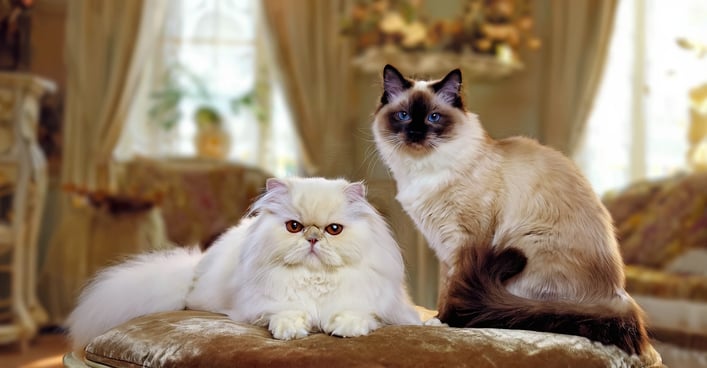
Himalayan and Persian cats are closely related breeds, both celebrated for their luxurious long coats and distinctive flat-faced features. While they share many care requirements and a similar appearance, the Himalayan introduces unique colorpoint patterns to the classic Persian foundation.
Breed Origins and History
Persian Origins
Ancient Beginnings:
One of the world's oldest recognized cat breeds.
Originated in Persia (modern-day Iran) and Turkey.
First imported to Europe in the 1600s.
Became a status symbol in Victorian England.
Selective breeding for the signature flat face intensified in the 1800s.
Development:
Original Persians had a less extreme facial structure.
Modern breeding has emphasized a flatter, brachycephalic face.
Over 200 color and pattern varieties have been developed.
Recognized by the Cat Fanciers' Association (CFA) in the early 1900s.
Consistently ranks among the most popular cat breeds globally.
Himalayan Origins
Himalayan vs Persian Cat: 2026 Complete Breed Comparison Guide - Articles A Planned Hybrid:
Created by intentionally crossing Persians with Siamese cats.
Primary goal: Achieve the Persian body type with Siamese colorpoint markings.
First organized breeding programs began in the 1930s.
Named for their resemblance to Himalayan rabbits, which share similar coloration.
Initially classified by the CFA as a separate breed.
Classification has been a topic of long-standing debate among registries.
Since 1984, the CFA considers the Himalayan a color division of the Persian breed.
Some international registries still maintain it as a distinct breed.
Responsible breeding often includes outcrossing to Persians.
Functionally considered a colorpoint Persian.
Adheres to the Persian breed standard in all aspects except color and eye color.
Breeding between Persians and Himalayans is permitted within the same registry.
Physical Characteristics Comparison
Size and Build Feature Persian Himalayan Male Weight 9-14 lbs (4-6.5 kg) 9-14 lbs (4-6.5 kg) Female Weight 7-11 lbs (3-5 kg) 7-11 lbs (3-5 kg) Body Type Cobby, compact, massive Cobby, compact, massive Bone Structure Heavy and substantial Heavy and substantial Legs Short and thick Short and thick
Identical Structure: Both breeds share the quintessential Persian "cobby" body type. The primary physical distinction is their coloring.
Head and Face Feature Persian Himalayan Head Shape Round and massive Round and massive Face Structure Extremely flat (brachycephalic) Extremely flat (brachycephalic) Profile Pronounced nose break, flat face Pronounced nose break, flat face Eyes Large, round, wide-set; various colors Large, round, wide-set; blue only Nose Short and snub Short and snub Expression Sweet, "pansy-like" Sweet, "pansy-like"
Brachycephalic Considerations: This extreme facial structure can lead to several health considerations for both breeds:
Breathing difficulties (Brachycephalic Airway Syndrome)
Chronic eye drainage and tear staining
Increased risk of dental malocclusions
Reduced heat tolerance
Coat Characteristics Feature Persian Himalayan Length Very long, flowing Very long, flowing Texture Fine, silky, stands away from body Fine and silky Undercoat Dense and cottony Dense and cottony Grooming Needs Daily brushing/combingDaily brushing/combingMatting Tendency Very High Very High Shedding Heavy, year-round Heavy, year-round
Solids: White, Black, Blue, Red, Cream.Silver & Golden: Chinchilla, shaded, smoke.Patterns: Tabby, Calico, Tortoiseshell, Bicolor.Parti-Color: Van, Harlequin. Himalayan Colors (Colorpoint Pattern Only):
Traditional Points: Seal, Blue, Chocolate, Lilac.Red Series Points: Flame (Red), Cream.Tortie Points: Seal-Tortie, Blue-Cream, etc.Lynx (Tabby) Points: Various colors with tabby striping on points.
Temperament and Personality
Persian Personality
Exceptionally calm, placid, and serene.
Quiet and generally undemanding.
Affectionate but not overly clingy.
Very low activity level; true couch potatoes.
Possess a sweet, gentle, and patient disposition.
Ideal for calm, quiet households.
Behavioral Characteristics:
Prefer lounging and observing over vigorous play.
Perfectly content as indoor-only companions.
Thrive on gentle petting and quiet companionship.
Not typically avid climbers or high jumpers.
May engage in short, gentle play sessions.
Seek out warm, soft spots for napping.
Have a quiet voice and rarely vocalize.
Tolerant of gentle, respectful children.
Activity Level: Very LowVocalization: Very QuietIndependence: ModerateIntelligence: Moderate
Himalayan Personality
Inherits the Persian's calm and gentle nature.
May display a slightly higher activity level than the Persian.
Deeply affectionate and people-oriented.
Generally quiet and soft-spoken.
Sweet-tempered and devoted companions.
Behavioral Characteristics:
Temperament is overwhelmingly similar to the Persian.
Might show more interest in interactive toys.
Still considered a low-energy breed.
Love comfort and will seek out warm laps.
Excellent lap cats with a peaceful presence.
Activity Level: LowVocalization: Very QuietIndependence: ModerateIntelligence: Moderate
Temperament Comparison Summary Trait Persian Himalayan Affection Level High High Playfulness Low Low to Moderate Independence Moderate Moderate Good with Children Good (with gentle handling) Good (with gentle handling) Good with Other Pets Good Good Energy Level Very Low Low Vocalization Very quiet Very quiet Lap Cat Tendency High High Grooming Tolerance Variable (daily grooming essential) Variable (daily grooming essential)
Health Comparison
Shared Health Concerns Both breeds face identical health challenges due to their shared brachycephalic structure and Persian genetics.
Breathing difficulties and snoring.
Stenotic nares (narrowed nostrils).
Elongated soft palate.
Exercise and heat intolerance.
Polycystic Kidney Disease (PKD):
An inherited condition causing cysts to form in the kidneys.
A reliable DNA test is available; always request proof of testing .
Can lead to progressive kidney failure.
Progressive Retinal Atrophy (PRA):
An inherited degenerative eye disease.
DNA test available to identify carriers.
Eventually leads to blindness.
Hypertrophic Cardiomyopathy (HCM):
A form of heart disease common in cats.
Annual echocardiogram screening is strongly recommended.
Grooming-Related Health Issues Both Breeds Require Vigilance For:
Skin infections and dermatitis under mats.
Frequent hairballs due to excessive grooming.
Severe matting that can restrict movement and cause sores.
Chronic tear staining leading to facial skin irritation.
Lifespan and Health Summary
Persian: 10-15 yearsHimalayan: 10-15 years Lifespan is highly dependent on genetics, preventative care, and management of breed-specific issues.
Recommended Health Testing (Estimated Costs):
PKD DNA Test: $50 - $100PRA DNA Test: $50 - $100Annual HCM Screening (Echo): $300 - $500Annual Wellness Exam & Bloodwork: $300 - $600
Care Requirements
Grooming Needs: A Non-Negotiable Commitment Daily Requirements (For Both Breeds):
A full 15-30 minute brushing/combing session to prevent mats.
Gentle face cleaning to manage tear stains.
Wiping away eye drainage.
A thorough check for any new tangles or mats.
Weekly/Bi-Weekly Requirements:
Bathing every 2-4 weeks is common to keep the coat clean and manageable.
Nail trimming.
Ear cleaning.
Application of a coat conditioner if bathing.
Professional Grooming Options:
"Lion Cut" (Summer Shave): $60 - $120Full Professional Groom & Bath: $80 - $150 per sessionRecommended Frequency: Every 4 to 8 weeks for professional maintenance. Estimated Annual Grooming Costs:
Item Annual Cost Estimate Quality Brushes & Combs $50 - $150 Specialty Shampoos & Conditioners $75 - $150 Professional Grooming (4-6x/year) $320 - $900 Cleaning Wipes & Supplies $50 - $100 Total Annual Grooming $495 - $1,300
Environmental & Lifestyle Needs Temperature Control is Critical:
Essential air conditioning in warm or humid weather.Provide heated beds or pads in cooler months.
Strictly indoor-only lifestyle to protect their coat and manage heat sensitivity.Ensure access to cool, tiled surfaces or cooling mats.
Minimal physical exercise requirements.
Short, interactive play sessions with wand toys or laser pointers.
Provide comfortable perches at low heights.
Puzzle feeders can provide gentle mental stimulation.
Costs of Ownership
Initial Costs (Kitten) Expense Persian Himalayan Kitten from Reputable Breeder $1,000 - $3,000+ $1,000 - $3,000+ Initial Veterinary Exam $100 - $250 $100 - $250 Initial Vaccinations & Deworming $100 - $200 $100 - $200 Spay/Neuter Surgery $300 - $600 $300 - $600 Microchip Implantation $50 - $100 $50 - $100 Starter Supplies (Carrier, Litter Box, etc.) $300 - $600 $300 - $600 Total Initial Investment $1,850 - $4,750+ $1,850 - $4,750+
Annual Recurring Costs Expense Persian Himalayan High-Quality Food $500 - $800 $500 - $800 Litter $250 - $500 $250 - $500 Routine Veterinary Care (Wellness) $400 - $800 $400 - $800 Pet Insurance Premiums $500 - $900 $500 - $900 Grooming (Home & Professional) $500 - $1,300 $500 - $1,300 Toys, Treats, & Miscellaneous $150 - $300 $150 - $300 Total Annual Cost $2,300 - $4,600 $2,300 - $4,600
Estimated Lifetime Cost (12 Years) Breed Conservative Estimate Comprehensive Estimate (with insurance/pro care) Persian $28,000 - $55,000 $50,000 - $90,000+ Himalayan $28,000 - $55,000 $50,000 - $90,000+
These estimates include routine care but not major, unexpected medical emergencies.
Choosing Between the Breeds
Choose a Persian If:
You desire the widest possible variety of coat colors and patterns.
Solid, tabby, bicolor, or smoky coats appeal to you more than colorpoints.
You prefer the look of eye colors that complement the coat (copper, green, blue-eyed whites).
You want the classic, traditional Persian appearance in all its colorful forms.
You are fully prepared for the intensive, daily grooming regimen.
Choose a Himalayan If:
You are captivated by the striking contrast of the Siamese-style colorpoint pattern.
Brilliant blue eyes are a must-have feature for you.
You want the quintessential Persian personality paired with a specific, dramatic look.
Seal point, blue point, or flame point coloring is your ideal.
You understand and accept the identical, high-maintenance grooming needs.
Key Similarities Between Breeds Ultimately, Persians and Himalayans share far more than they differ:
Identical body structure, size, and bone density.The same brachycephalic facial structure and associated health considerations.
Identical high-maintenance, daily grooming requirements.The same calm, placid, and gentle temperament.
A strict indoor-only lifestyle necessity.
Sweet, quiet, and affectionate personalities.A strong preference for comfort, warmth, and a peaceful home.
Conclusion The Persian and Himalayan are, for all practical purposes, a single breed distinguished primarily by color genetics. Your choice between them ultimately boils down to aesthetic preference: the vast rainbow of Persian colors versus the elegant, contrasted colorpoint pattern of the Himalayan.
Both breeds demand a significant and unwavering commitment. Prospective owners must be prepared for daily grooming sessions, regular professional grooming assistance, vigilant health monitoring, and the financial responsibility that comes with a brachycephalic breed.
For the right person or family—one that values tranquil companionship, stunning beauty, and can meet their substantial care needs—both the Persian and Himalayan offer a uniquely gentle, loving, and serene presence in the home for years to come.
Cat's Doctor Get AI-powered advice about your cat's health and care. Enter your cat's information and start a conversation with our veterinary assistant.
Start Chat with AI Cat's Expert Get expert advice about cat care, behavior, nutrition, grooming, and training. Ask our AI cat care expert anything about your cat and receive professional guidance.
Start Chat with Expert