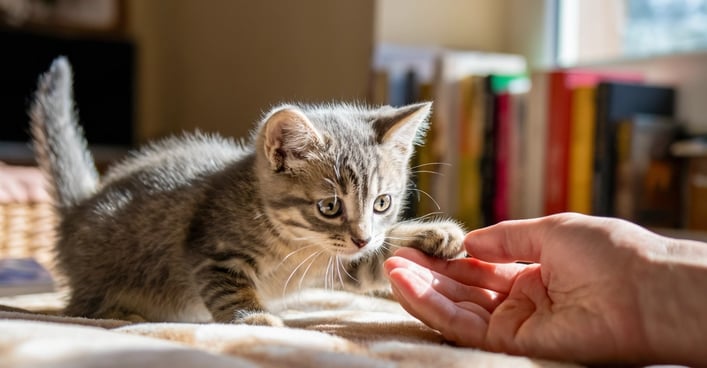
The Essential Kitten Socialization Guide: Building Confidence in the First 12 Weeks
A complete, week-by-week guide to socializing your kitten during the critical developmental window. Learn proven techniques to raise a confident, well-adjusted, and happy feline companion.
Share this page
The Essential Kitten Socialization Guide: Building Confidence in the First 12 Weeks
The first 12 weeks of a kitten's life are a critical developmental window that shapes their personality, confidence, and adaptability for life. Proper socialization during this period creates a well-adjusted adult cat who can handle stress, change, and new experiences with ease. This comprehensive guide provides everything you need to know to successfully socialize your kitten during this foundational time.
Understanding the Critical Socialization Period
Developmental Timeline
0-2 Weeks: The Neonatal Period
Eyes and ears begin to open.
Kittens are completely dependent on their mother.
Minimal human interaction is needed; focus remains on maternal care.
2-4 Weeks: The Transitional Period
Kittens start to walk and their first teeth emerge.
The Essential Kitten Socialization Guide: Building Confidence in the First 12 Weeks - Articles
This is the most impressionable time.
Fear responses start to develop.
Play behavior matures rapidly.
A critical window for learning opens.
7-12 Weeks: Peak Socialization
The optimal period for socialization.
The brain is highly plastic, enabling rapid learning.
The foundation for adult personality is solidified.
12-16 Weeks: Socialization Window Closes
The primary window closes, making new learning harder.
Fear responses become more fixed.
Adult behavioral patterns begin to form.
Why This Period Is Irreplaceable
Neurological Development:
The brain is forming crucial neural connections.
Pathways for confidence versus fear are established.
Lifelong stress response patterns are developing.
Learning capacity is at its peak.
Long-Term Impact:
Adult temperament is largely determined.
Reactivity to new situations is set.
The foundation for the human-animal bond is created.
Core coping mechanisms are established.
Core Socialization Goals
Primary Objectives for Success
Human Bonding: Build trust with all family members, comfort with handling, positive human associations, and a desire for human interaction.
Environmental Confidence: Foster comfort in the home environment, adaptation to household sounds, and confidence in exploring various rooms.
Animal Relationships: Encourage appropriate cat-cat interactions, dog tolerance, acceptance of other pets, and the ability to read animal body language.
Goals: Accept human touch, begin forming an individual identity, and associate human scent with safety.
Weeks 5-6: Expanded Exploration
Daily Activities:
Increase handling to 10-15 minutes daily.
Introduce different floor surfaces (carpet, tile).
Allow exploration of various safe rooms.
Introduce interactive toys and begin gentle grooming practice.
Goals: Encourage confident play and exploration, solidify enjoyment of human interaction, and establish litter box habits.
Weeks 7-8: Intensive Socialization
Daily Activities:
Multiple short handling sessions throughout the day.
Meet 1-2 new, calm people daily.
Introduce the cat carrier as a safe space.
Practice first nail trim and gentle bathing.
Explore different textures (towels, blankets, cardboard).
Goals: Build confidence with strangers, acceptance of gentle restraint, familiarity with grooming, and a positive carrier association.
Weeks 9-10: Real-World Preparation
Daily Activities:
Practice veterinary-style handling (checking paws, ears, mouth).
Take short, positive car rides (carrier secured).
Expose to recorded household sounds (vacuum, doorbell).
Introduce calm, supervised children.
Allow safe outdoor enclosure exposure if applicable.
Goals: Prepare for vet visits, build travel tolerance, develop noise resilience, and teach appropriate child interaction skills.
Weeks 11-12: Consolidation & Mastery
Daily Activities:
Reinforce all previous positive learning.
Introduce one new, mild challenge weekly.
Continue meeting new people in controlled settings.
Maintain all positive associations with handling and environments.
Goals: Solidify learning, generalize confidence to novel situations, and ensure the kitten is adaptable and prepared for its future home.
Essential Socialization Experiences
Exposure to Human Diversity
Introduce Your Kitten To:
Men, women, and supervised children.
People of different ethnicities, heights, and sizes.
Individuals wearing hats, glasses, uniforms, or using mobility aids.
People with different voice tones and volumes (always calm).
Interaction Style: Always be gentle and calm. Allow the kitten to approach first. Have new people offer high-value treats. Never force interaction.
Systematic Handling Exercises
Daily Handling All Kittens Should Accept:
Body Part
Technique
Goal Duration
Ears
Gentle touch and lift
10 seconds
Mouth
Open gently, touch gums
5 seconds
Paws
Hold, gently extend claws
10 seconds
Belly
Brief touch while relaxed
5 seconds
Tail
Gentle handling from base to tip
5 seconds
Whole Body
Pick up, hold, and support
30 seconds
Advanced Handling Practice: Gentle restraint (as at a vet), towel wrapping, brushing, nail trimming practice, and teeth inspection.
Environmental Enrichment & Desensitization
Surface Exposure: Carpet, hardwood, tile, grass (safe), and concrete.
Sound Desensitization (Start Low & Slow): Vacuum cleaner (in another room), doorbells, phone rings, TV/music, kitchen sounds, and thunder recordings.
Object Introduction: Cardboard boxes, paper bags (handles removed), various toys, cat trees, carriers, and new furniture.
Animal Interactions (Always Supervised)
Other Cats: Supervised play with friendly, vaccinated adults or similar-aged kittens to learn appropriate play and body language.
Dogs: Only with calm, cat-friendly dogs on a leash. Ensure the kitten always has an escape route and create positive associations with treats.
Other Animals: Supervised exposure only, with absolute priority given to the kitten's safety. Never force interaction.
Proven Socialization Tools & Techniques
Positive Reinforcement
Reward-Based Learning is Key:
Immediately reward brave or calm behavior with treats, praise, or play.
Never use punishment—it creates fear, not confidence.
Be consistent with rewards to build strong associations.
High-Value Treats: Small soft treats, lickable treats (Churu), tiny pieces of cooked chicken, or plain baby food (no onion/garlic).
Play-Based Socialization
Use Appropriate Toys: Wand toys (for interactive play), small balls, crinkle toys, cat tunnels, and puzzle feeders.
Effective Play Sessions: Schedule multiple 10-15 minute sessions daily. Be involved and interactive. Always end on a positive note.
Crate/Carrier Training: Creating a Safe Haven
A 4-Week Positive Association Plan:
Week 1: Leave the carrier out with the door open. Place treats and meals near it.
Week 2: Place treats, toys, and soft bedding inside the carrier. Keep the door open.
Week 3: Begin closing the door for brief periods (seconds, then minutes) while kitten eats inside. Carry the carrier short distances indoors.
Week 4: Progress to very short car rides that end with a fun experience (like playtime at home).
Common Socialization Mistakes to Avoid
❌ Waiting Too Long: Starting socialization after the 12-week window closes.
❌ Overwhelming the Kitten: Introducing too many new stimuli too quickly.
❌ Forced Interaction: Holding or restraining a kitten against its will.
❌ Using Punishment: This damages trust and increases fear.
❌ Being Inconsistent: Sporadic socialization efforts are ineffective.
❌ Isolation: Preventing the kitten from having new, positive experiences.
Recognizing & Responding to Overwhelm
Stress Indicators: Hiding and refusing to come out, excessive vocalization, aggressive behavior (hissing, swatting), loss of appetite, trembling, dilated pupils, or flattened ears.
The Right Response: Immediately stop the activity. Return to the last step where the kitten was comfortable. Proceed more slowly the next time. Never force continued exposure.
Special Considerations
Orphaned Kittens
Require more intensive, gentle human interaction.
May lack innate cat social skills and need to be taught appropriate play.
Often need extra patience and a potentially extended socialization period.
Feral or Very Shy Kittens
May need a significantly extended, slower timeline.
Start with passive presence—just sit quietly nearby.
Use food-based bonding techniques.
Consider seeking help from a professional behavior consultant.
Socializing Multiple Kittens
Benefit: They learn bite inhibition and social cues from each other.
Crucial: Individual handling time with humans is still essential. Do not rely solely on sibling interaction.
Socialization Success Checklist
By 8 Weeks, Your Kitten Should:
Accept gentle handling from familiar people.
Use the litter box consistently.
Play confidently with a variety of toys.
Approach people curiously and without immediate fear.
Tolerate being picked up and held briefly.
Explore new (safe) environments in the home.
By 12 Weeks, Your Kitten Should:
Accept brief handling by calm strangers.
Tolerate gentle restraint (e.g., for nail trims).
Enter their carrier voluntarily for treats.
Remain calm during short car rides (in carrier).
Recover quickly from a mild startle (e.g., a dropped book).
Show curiosity rather than fear toward novel objects.
Measuring Your Success
Indicators of a Confident Kitten
Approaches new people or novel objects to investigate.
Recovers quickly after being startled.
Plays enthusiastically and seeks interactive play with you.
Chooses to sleep or rest in open, comfortable areas of the home.
Shows general curiosity about their environment.
Warning Signs That May Need Intervention
Constantly hides and refuses to engage.
Displays aggressive responses (hissing, biting) to normal handling.
Shows excessive, paralyzing fear.
Has persistent litter box issues or poor appetite unrelated to health.
When to Seek Professional Help
Consult a professional if you observe:
Extreme, unimproving fearfulness.
Aggressive behavior that does not diminish with gentle handling.
A complete lack of progress by 10 weeks of age.
Any concerning health issues (always rule out medical causes first with your vet).
Resources: Your veterinarian, a Veterinary Behaviorist (DACVB), or a Certified Cat Behavior Consultant (CCBC, IAABC).
Conclusion
Socialization during the first 12 weeks is the most impactful investment you can make in your cat's future well-being. The time and patience you devote now will pay lifelong dividends in the form of a confident, adaptable, and deeply bonded companion.
Remember: Every positive, gentle experience builds a foundation of trust. Make socialization a consistent, rewarding, and enjoyable part of your kitten's daily routine. Your goal is to create a cat who meets the world with curiosity and resilience.
Start early, proceed with kindness, and enjoy the incredible journey of watching your kitten blossom into a wonderful adult cat.
Guide prepared for 2026. The time and love you invest in socialization will reward you both for a lifetime.
Get expert advice about cat care, behavior, nutrition, grooming, and training. Ask our AI cat care expert anything about your cat and receive professional guidance.