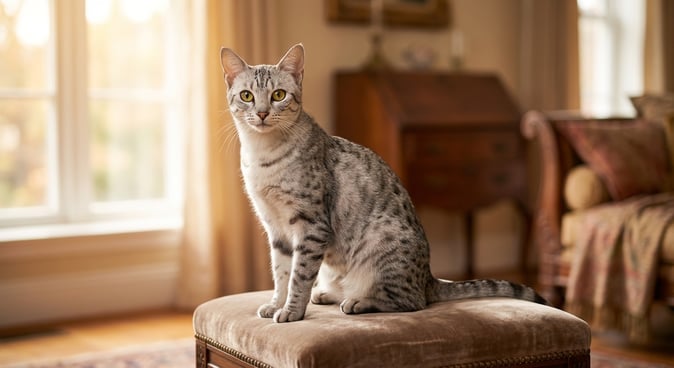
Meet the Egyptian Mau, the only naturally spotted domestic cat whose ancestry is etched into pharaonic frescoes along the Nile. From ancient temples to a mid-century princess’s suitcase, this living relic still wears the royal spots that once captivated pharaohs.
Among the handful of naturally spotted domestic cats, the Egyptian Mau stands alone as a living relic of ancient elegance and athletic prowess. Capable of breathtaking bursts of speed up to 30 mph, this medium-sized shorthair pairs a wild exterior with an affectionate, people-oriented heart. Whether shimmering in silver, bronze, or smoke, the Mau’s gooseberry-green eyes seem to wink at 3,000 years of history while plotting the next spirited game of fetch.
True to its name, the Egyptian Mau ("mau" means "cat" in Egyptian) likely descends from the small African wildcats once revered along the Nile. Spotted cats appear in ancient frescoes and papyri, hinting that the breed’s signature markings are more than coincidence. Modern development began in the mid-20th century when Russian princess Nathalie Troubetskoy fled to Italy with several spotted cats from Cairo. Careful breeding preserved both the naturally occurring spots and the breed’s distinctive gooseberry-green eyes, leading to formal recognition by major registries in the 1950s. Today the Mau remains one of the rarest purebreds worldwide, a living artifact prized by fanciers who value both history and high-octane energy.
Adult Egyptian Maus weigh 2.7–6.5 kg (6–14 lb) and measure 45–60 cm in body length. Their short, resilient coat lies close to the body, creating a satin sheen that accentuates three recognized colors: silver (charcoal spots on icy silver), bronze (dark spots on warm bronze), and smoke (silver undercoat tipped in black, giving a ghostly, misted look). Random spotting appears across the torso, flanks, and belly—no two Maus share the same pattern. Hind legs are slightly longer than forelegs, producing a distinctive "tiptoe" stance that contributes to explosive acceleration. The tail is banded with a dark tip, while the head shows a gentle wedge and medium-large ears set to continue the wedge lines. Eyes are always an electric gooseberry green, outlined by black mascara markings that enhance the breed’s worried-yet-wild expression.
The Egyptian Mau is more than a pretty coat pattern; it is a spirited athlete, a loyal confidant, and a living bridge to ancient civilizations. Expect speed spots, gooseberry-green gazes, and a heart that beats in time with your own. Provide play, affection, and a safe runway, and this rare feline pharaoh will rule your home with grace, speed, and unwavering devotion.
Intelligent (5/5) and lively (4/5), the Mau often behaves like a playful toddler who never quite outgrows kittenhood. Loyalty runs deep: many owners report their cat choosing a favorite human and shadowing that person from room to room, chirping commentary in soft, rolling trills. Affection is abundant—expect head bumps, lap landings, and enthusiastic greetings at the door—yet the breed retains an alert dignity; strangers are observed from a safe perch before being welcomed. Maus generate moderate vocalization (3/5), preferring conversational chortles to demanding yowls. Because they score 4/5 for both playfulness and energy, interactive toys, puzzle feeders, and clicker-training sessions keep their agile minds engaged. Kid compatibility is high (4/5) provided children respect the Mau’s need for gentle handling, while other pets score a neutral 3/5; slow introductions usually produce harmony with cat-friendly dogs or felines that can match their play style.
Despite a shedding level of 3/5, grooming is refreshingly easy. A five-minute weekly rub with a soft slicker brush removes dead hairs and distributes skin oils for maximum shimmer. Baths are rarely needed unless the cat is being shown. Exercise demands (4/5) are higher than average: plan on two daily interactive play sessions—wand toys that mimic bird flight or laser dots that encourage sprinting. Maus excel at feline agility and often invent parkour routes over furniture; cat trees at multiple heights help channel this athleticism. Because they bond intensely, they dislike long periods alone; puzzle feeders, window perches, and timed toy dispensers mitigate boredom when owners work late. A high-protein diet maintains muscle tone, and fresh water is critical given a mild predisposition to urolithiasis.
Overall the Egyptian Mau is hardy, with a life expectancy of 12–16 years. Responsible breeders test for pyruvate kinase deficiency (PKDef), an inherited enzyme shortage that can cause hemolytic anemia; DNA screening has greatly reduced incidence. Urinary crystals are minimized through hydration, so consider a fountain or canned food. Routine dental care prevents gingivitis, while annual vet visits should include baseline cardiac auscultation, as some lines show mild hypertrophic cardiomyopathy. Maintain a lean body condition—those powerful hindquarters can become overweight if sprint time is replaced by snack time.
Choose an Egyptian Mau if you crave an interactive, visually striking companion who will entertain you with aerobatic stunts and greet you like returning royalty. They adapt well to apartment life provided vertical space and daily play are ample. Households with respectful children, retirees who work from home, or singles seeking a devoted sidekick prove ideal. Pass on this breed if you’re away 10 hours daily with no plan for enrichment or pet-sitter interaction, as loneliness can trigger destructive climbing or over-vocalization. Likewise, if you dislike the occasional hair on dark clothing or cannot commit to energetic play, a lower-energy breed may suit you better. For those who cherish history, elegance, and a dash of wild, the Mau rewards dedication with unmatched loyalty and the quiet pride of sharing life with a creature the pharaohs once called divine.
Get AI-powered advice about your cat's health and care. Enter your cat's information and start a conversation with our veterinary assistant.
Start Chat with AIGet expert advice about cat care, behavior, nutrition, grooming, and training. Ask our AI cat care expert anything about your cat and receive professional guidance.
Start Chat with Expert