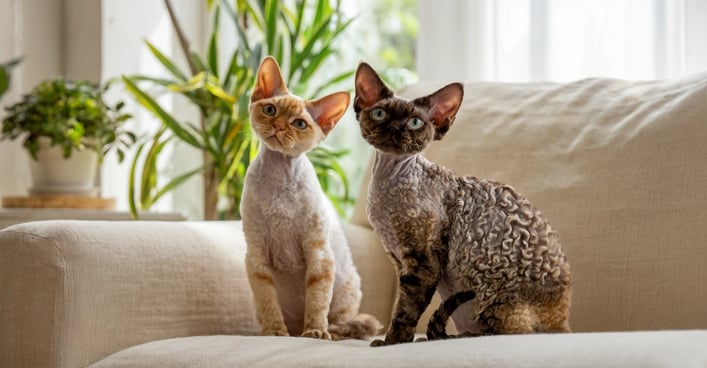
Devon Rex vs Cornish Rex: The 2026 Guide to Curly-Coated Cat Breeds
Discover the key differences between Devon Rex and Cornish Rex cats. Compare their unique personalities, care needs, and health profiles to find your perfect curly-coated companion.
Share this page
Devon Rex vs Cornish Rex: The 2026 Guide to Curly-Coated Cat Breeds
For cat lovers seeking a unique, low-shedding companion with an elfin charm, the Devon Rex and Cornish Rex are captivating choices. While both share a distinctive curly coat and playful spirit, they are genetically distinct breeds with different histories, appearances, and temperaments. This comprehensive 2026 guide provides the essential comparison to help you choose the right pixie-faced feline for your home.
Breed Origins and History
Cornish Rex Origins
The Cornish Rex originated in Cornwall, England, in 1950 with the birth of a curly-coated barn cat kitten named Kallibunker.
Development Timeline:
1950: Kallibunker is born on Bodmin Moor.
1957: The breed is imported to the United States.
1962: Achieves championship status with the Cat Fanciers' Association (CFA).
Today: Recognized and cherished by cat associations worldwide.
The term "Rex" is borrowed from similarly coated rabbits.
Developed through careful, selective breeding programs.
Devon Rex Origins
The Devon Rex emerged independently in Devon, England, approximately a decade later from a litter of stray cats.
Development Timeline:
1960: Kirlee, the foundation cat, is born near Buckfastleigh.
1968: Gains formal recognition in the United Kingdom.
1979: Awarded CFA championship status.
Today: A popular and beloved breed globally.
Genetic Discovery:
Initially mistaken for a Cornish Rex variant.
Proven to be caused by a completely different gene (Gene 2 vs. the Cornish's Gene 1).
Crossing the two breeds produces only straight-coated offspring, confirming their genetic separation.
Key Historical Difference: Despite their similar curly coats, the Cornish and Devon Rex mutations are genetically unrelated. They are distinct breeds that developed independently.
Physical Characteristics
Size and Build Comparison
Feature
Cornish Rex
Devon Rex
Male Weight
6-10 lbs (2.7-4.5 kg)
6-9 lbs (2.7-4 kg)
Female Weight
5-8 lbs (2.3-3.6 kg)
5-8 lbs (2.3-3.6 kg)
Body Type
Long, slender, and tubular
Medium, semi-foreign build
Build
Graceful, greyhound-like
Muscular and surprisingly sturdy
Bone Structure
Fine and delicate
Medium and strong
Coat Differences
Cornish Rex Coat:
Texture & Feel: Exceptionally soft, silky, and close-lying, resembling crushed velvet or lamb's wool.
Pattern: Even, marcel waves distributed uniformly across the body.
Structure: Short with no guard hairs; consists only of the soft undercoat.
Shedding: Minimal to non-existent.
Devon Rex Coat:
Texture & Feel: Soft with loose, tousled curls and a distinctive rippled texture.
Pattern: Less uniform, often appearing more random and "messy."
Structure: Short but can vary in density; more prone to bald spots, especially during seasonal molts.
Shedding: Very minimal.
Head and Facial Features
Cornish Rex:
Head Shape: Long and elegantly egg-shaped.
Ears: Large, set high on the head.
Eyes: Medium to large, oval-shaped.
Profile: Distinct Roman nose with a high bridge.
Expression: Refined, alert, and elegant.
Devon Rex:
Head Shape: Short, broad wedge.
Ears: Enormous, bat-like, and set lower on the head.
Eyes: Large, wide-set, and highly expressive.
Profile: Short nose with a pronounced stop (change of direction).
Expression: Impish, mischievous, and distinctly pixie-like.
Body Conformation
Cornish Rex:
Long, slender legs and an arched back.
Pronounced tuck-up at the waist.
"Greyhound" conformation; feels warm to the touch due to a high metabolism.
Devon Rex:
Medium-length legs with a broad chest.
Sturdy, muscular build with a less extreme tuck-up.
Also warm to the touch, requiring cozy environments.
Temperament and Personality
Cornish Rex Personality
Cornish Rex cats are athletic dynamos known for their boundless energy and graceful movement.
Key Traits:
Energy Level: Extremely high.
Nature: Constantly active, acrobatic, and inquisitive.
Affection: Loving but often too busy for prolonged cuddles.
Intelligence: Highly trainable and quick to learn tricks.
Vocalization: Typically quiet to moderately vocal.
Common Behaviors:
Racing through the house and climbing to the highest vantage points.
Excelling at games of fetch and retrieve.
"Helping" with household activities and following owners from room to room.
Devon Rex Personality
Devon Rex cats are often described as "monkeys in cat suits" due to their impish, people-oriented, and problem-solving nature.
Key Traits:
Energy Level: Very high, retaining kitten-like playfulness for life.
Nature: Extremely devoted, mischievous, and involved.
Affection: Deeply people-oriented; loves to cuddle and sleep with owners.
Intelligence: Exceptionally clever; known for opening doors and cabinets.
Vocalization: Uses a soft, charming trill.
Common Behaviors:
Riding on shoulders and seeking physical contact.
Showing fascination with water.
Getting into everything and displaying food-stealing antics.
Personality Comparison at a Glance
Trait
Cornish Rex
Devon Rex
Activity Level
Extremely high; perpetual motion
Very high; playful and investigative
Affection Style
Brief, energetic visits
Long, devoted cuddle sessions
Shoulder Riding
Occasional
Very common and beloved
Trainability
Excellent for agility
Excellent for problem-solving tricks
People-Focus
High
Extremely high; velcro-cat tendency
Ideal For
Active households that enjoy a spectacle
Owners seeking a constant, interactive companion
Care and Grooming
Coat and Skin Care
Due to their unique coats and potential for oil buildup, both breeds have specific grooming needs.
Cornish Rex:
Routine: Minimal. Wiping with a soft cloth is often sufficient.
Bathing: May require occasional baths (every 4-6 weeks) to manage oil.
Challenge: Skin oils can become visible on the light, silky coat.
Devon Rex:
Routine: Minimal brushing; their coat is not prone to matting.
Bathing: May need bathing every 4-8 weeks, depending on oil production.
Challenge: More prone to seasonal bald patches and sparse coats.
Essential Health Maintenance
Ear Care: Both breeds have large ears that require weekly checks for wax buildup and should be cleaned gently as needed.
Bathing Technique (for both):
Use a gentle, feline-specific shampoo.
Rinse thoroughly with warm water.
Pat dry gently—do not rub.
Keep them in a warm, draft-free area until completely dry.
Estimated Annual Grooming Costs
Item
Cornish Rex
Devon Rex
Brushing Supplies
$10-20
$10-20
Specialty Shampoo
$15-30
$15-30
Ear Cleaner
$10-15
$10-15
Professional Grooming
Rarely needed
Rarely needed
Health Considerations
Cornish Rex Health Profile
Average Lifespan: 12-16 years.
Common Health Considerations:
Hypertrophic Cardiomyopathy (HCM): A genetic heart condition. Screening and genetic testing are recommended.
Patellar Luxation: Kneecap dislocation, which can occur in some lines.
Skin Conditions: Can develop greasy coat (seborrhea) or minor skin infections without regular care.
Hypotrichosis: Thin or absent whiskers and eyebrows; generally cosmetic.
Devon Rex Health Profile
Average Lifespan: 10-15 years.
Common Health Considerations:
Hypertrophic Cardiomyopathy (HCM): As with Cornish Rex, cardiac screening is essential.
Devon Rex Myopathy (Spasticity): An inherited muscle disorder affecting coordination. A genetic test is available.
Congenital Hypotrichosis: Can be more pronounced, leading to very sparse hair or near-hairlessness in some lines.
Skin Issues: Increased susceptibility to yeast infections and oil buildup.
Patellar Luxation: Also a concern, as in the Cornish Rex.
Health Comparison Summary
Factor
Cornish Rex
Devon Rex
Overall Robustness
Generally good
Good with proactive screening
Typical Lifespan
12-16 years
10-15 years
Primary Health Focus
HCM, patellar luxation
HCM, myopathy, skin health
Pre-Breeding Tests
HCM DNA test, cardiac ultrasound
HCM & Myopathy DNA tests, cardiac ultrasound
Ideal Living Environment
Indoor-Only Necessity
Both breeds must be kept exclusively indoors due to:
Minimal coat offering no protection from sun (risk of sunburn) or cold (risk of hypothermia).
High value, making them targets for theft.
A generally trusting nature, lacking "street-smart" instincts.
Environmental Needs
Feature
Cornish Rex
Devon Rex
Ideal Temperature
Warm (72°F / 22°C+)
Warm (72°F / 22°C+)
Bedding Preference
Heated beds, sunny spots
Under covers with owner, heated beds
Vertical Space
Critical—tall cat trees & shelves
Important—loves high perches
Mental Stimulation
High—puzzle toys, agility courses
Very High—interactive toys, training
Sun Exposure
Must be limited/supervised
Must be limited/supervised
Cost of Ownership: 2026 Estimates
Initial Purchase Price
Cornish Rex Kitten:
Quality
Price Range
Pet Quality
$900 - $1,800
Show/Breeding Quality
$1,500 - $3,000
Devon Rex Kitten:
Quality
Price Range
Pet Quality
$900 - $1,800
Show/Breeding Quality
$1,500 - $3,500
Note: Prices vary by breeder reputation, location, color, and bloodline. Always choose a breeder who performs full health testing.
Estimated Annual Costs
Cornish Rex (Annual):
Expense
Estimated Cost
High-Quality Food
$400 - $700
Litter
$150 - $250
Routine Veterinary Care
$300 - $600
Pet Insurance
$350 - $650
Toys & Enrichment
$100 - $200
Total (Approx.)
$1,300 - $2,400
Devon Rex (Annual):
Expense
Estimated Cost
High-Quality Food
$400 - $700
Litter
$150 - $250
Routine Veterinary Care
$300 - $600
Pet Insurance
$350 - $650
Grooming Supplies
$50 - $150
Toys & Enrichment
$100 - $200
Total (Approx.)
$1,350 - $2,550
Pros and Cons Summary
Cornish Rex
Pros:
Elegant, athletic, and entertaining to watch.
Exceptionally low grooming needs.
Minimal shedding (often suitable for allergy sufferers).
Generally healthy with a long lifespan.
Cons:
Extremely high energy can be overwhelming.
May be less inclined to prolonged lap-sitting.
Requires significant vertical space and stimulation.
Sensitive to cold temperatures.
Devon Rex
Pros:
Uniquely affectionate and devoted "velcro" cat.
Playful, mischievous, and highly entertaining personality.
Low shedding coat.
Enjoys interactive play and cuddling.
Cons:
Higher predisposition to certain genetic health conditions.
Can be demanding of attention and get into mischief.
Coat may be very sparse, requiring temperature management.
May exhibit food-seeking behaviors.
Which Breed Is Right For You?
Choose a Cornish Rex If You Want:
An elegant, living piece of art in motion.
A highly athletic cat that entertains with acrobatics.
A companion that is affectionate in energetic bursts.
A low-maintenance grooming routine.
A pet for an active, engaging home.
Choose a Devon Rex If You Want:
A shadow and constant companion.
A mischievous, dog-like personality in a cat's body.
A cat that will sleep under the covers with you.
A highly intelligent, trainable partner in crime.
An intensely people-focused, affectionate pet.
Final Conclusion
Both the Devon Rex and Cornish Rex offer an unparalleled experience for cat enthusiasts seeking a unique, low-shedding companion. While united by their curly coats and elfin charm, they are fundamentally different.
The Cornish Rex is the elegant athlete—graceful, refined, and constantly in motion. The Devon Rex is the impish companion—devoted, clever, and deeply intertwined with your daily life.
Your choice ultimately hinges on lifestyle and personality preference. Both breeds require committed, indoor-only homes, warm environments, and owners prepared for their high intelligence and energy. The most critical step is partnering with a reputable breeder who prioritizes health testing for HCM and, for Devons, myopathy.
Whichever curly-coated pixie you welcome home, you are guaranteed a captivating, affectionate, and unforgettable feline friend who is anything but ordinary.
Get expert advice about cat care, behavior, nutrition, grooming, and training. Ask our AI cat care expert anything about your cat and receive professional guidance.