Cornish Rex vs Devon Rex: A Complete Guide to Curly-Coated Cousins (2026)
Discover the key differences between Cornish Rex and Devon Rex cats. Our 2026 guide compares their genetics, personalities, care needs, and which unique breed might be your perfect match.
Share this page
Cornish Rex vs Devon Rex: A Complete Guide to Curly-Coated Cousins (2026)
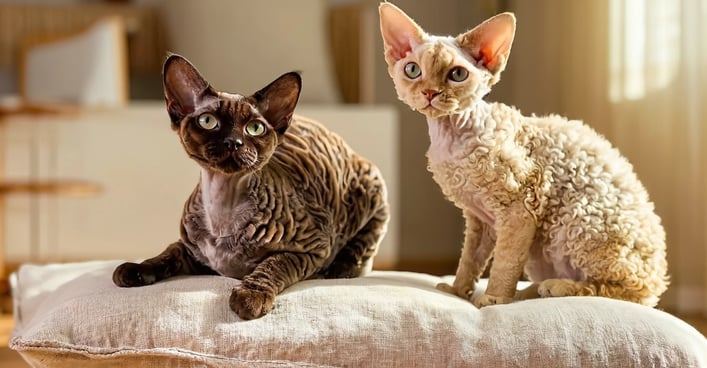
Cornish Rex and Devon Rex cats are celebrated for their distinctive wavy coats, yet they originate from separate genetic mutations and possess remarkably different personalities and physical traits. Often confused by prospective owners, understanding their unique characteristics is essential for finding the ideal feline companion for your lifestyle. This comprehensive 2026 comparison clarifies the distinctions between these captivating, curly-coated cousins.
Genetic Origins: A Tale of Two Mutations
Cornish Rex Background
Origin: Cornwall, England, 1950
Founding Cat: Kallibunker (a natural genetic mutation)
Gene Type: Recessive (distinct from the Devon Rex gene)
Body Type: Elegant, greyhound-like silhouette
Coat Texture: Fine, silky fur with tight marcel waves
Devon Rex Background
Origin: Devon, England, 1960
Founding Cat: Kirlee (a separate natural mutation)
Gene Type: Recessive (on a different gene than the Cornish)
Body Type: Stocky, muscular, and pixie-like
Coat Texture: Soft fur with loose, rippling waves
Despite their similar curly appearance, these breeds cannot produce curly-coated offspring when crossed, as their defining mutations are on entirely different genes.
Cornish Rex: Resembles a sleek, miniature greyhound.
Devon Rex: Possesses a charming, pixie-like or monkey-like appearance.
Coat & Facial Features
Cornish Rex Coat:
Texture: Exceptionally fine, silky, and warm to the touch.
Pattern: Distinct, tight marcel waves (reminiscent of a 1920s hairstyle).
Shedding: Very minimal; often considered hypoallergenic.
Devon Rex Coat:
Texture: Soft with loose, rippling waves.
Pattern: Less uniform than the Cornish; a gentle wave.
Shedding: Minimal.
Facial Feature
Cornish Rex
Devon Rex
Head Shape
Egg-shaped, long profile
Wedge-shaped, short muzzle
Ears
Large and set high on the head
Very large, prominent, and low-set
Eyes
Medium, oval-shaped
Large, wide-set, and expressive
Profile
Roman nose (gently curved)
Short, straight nose
Key Takeaway: The Devon Rex's dramatically large, low-set ears and short muzzle create its iconic "pixie" face, a primary visual differentiator.
Temperament & Personality: Clown vs. Monkey
Cornish Rex Personality
Activity Level: High (9/10) – perpetual kitten energy.
Affection Style: Demanding, persistent, and deeply attached.
Vocalization: Quite talkative and communicative.
Social Nature: People-oriented; dislikes being alone.
Behavioral Traits:
Often called a "clown" for its entertaining antics.
Insists on being the center of attention.
Heat-seeking; will find the warmest spot in the house.
Intelligent and curious; known to open doors and cabinets.
Enjoys playing fetch and climbing to high vantage points.
Devon Rex Personality
Activity Level: Very High (10/10) – intensely acrobatic.
Affection Style: Friendly, mischievously involved, and "in your business."
Vocalization: Uses varied chirps and trills.
Social Nature: Extremely social with people and other pets.
Behavioral Traits:
Famously described as a "monkey in a cat suit."
Acrobatic climber and avid shoulder-rider.
Can be food-obsessed, requiring careful management.
Mischievous and clever, getting into everything.
Learns tricks easily and thrives on interactive play.
Temperament Comparison Table
Trait
Cornish Rex
Devon Rex
Affection Level
9/10
9/10
Activity Level
9/10
10/10
Playfulness
9/10
10/10
Intelligence
9/10
10/10
Independence
3/10
3/10
Child Friendly
8/10
8/10
Pet Friendly
7/10
8/10
Critical Note for Both: These are not independent breeds. They form strong bonds and can suffer from separation anxiety if left alone for long periods. They are best suited for households where someone is home often.
Care & Grooming Requirements
Grooming Needs
Both Breeds:
Brushing: Minimal; use a soft cloth or hands to avoid damaging the delicate coat.
Bathing: Occasional baths may be needed, especially for the Cornish Rex, which can develop oily skin.
Ear Cleaning: Weekly cleaning is essential due to their large ears, which can accumulate wax.
Nail Trimming: Bi-weekly.
Special Care Considerations
Due to their minimal fur, both breeds have specific needs:
Temperature Sensitivity: They lose body heat easily. Provide warm environments, heated beds, and limit exposure to cold drafts.
Sun Protection: Their skin is prone to sunburn. Limit direct sunlight exposure.
Skin Care: Cornish Rex, in particular, may need occasional baths to manage oiliness.
Exercise & Enrichment
Essential for both high-energy breeds:
Multiple interactive play sessions daily.
Ample vertical space (cat trees, shelves).
Puzzle feeders and food-dispensing toys.
Consistent human interaction and companionship.
Health Comparison & Lifespan
Cornish Rex Health Profile
Hypertrophic Cardiomyopathy (HCM): A genetic heart condition. Reputable breeders screen for this.
Patellar Luxation: Kneecap displacement. Can range from mild to severe.
Skin Conditions: Prone to oily skin and acne; sunburn risk.
Average Lifespan: 12-16 years.
Devon Rex Health Profile
Hypertrophic Cardiomyopathy (HCM): Also a concern; screening is crucial.
Devon Rex Myopathy: A hereditary muscle condition. DNA testing is available.
Patellar Luxation: Similar risk as the Cornish Rex.
Hereditary Baldness: Some bloodlines may have sparse fur (cosmetic only).
Average Lifespan: 10-15 years.
Health Factor
Cornish Rex
Devon Rex
Overall Health
Good
Good
Primary Genetic Risk
HCM
HCM & Myopathy
Lifespan
12-16 years
10-15 years
Pro Tip: Always choose a breeder who conducts and provides documentation for health screenings (HCM ultrasound, patellar evaluation, myopathy DNA test).
Cost of Ownership (2026 Estimates)
Initial Costs
Expense
Cornish Rex
Devon Rex
Kitten (Pet Quality)
$800 - $1,800
$800 - $1,800
Kitten (Show Quality)
$1,800 - $3,000+
$1,800 - $3,000+
Annual Ongoing Costs (Per Cat)
High-Quality Food: $600 - $900
Routine Veterinary Care: $400 - $700
Toys, Treats, & Enrichment: $200 - $300
Heating/Warm Bed Supplies: $50 - $150
Estimated Annual Total: $1,250 - $2,050
Special Consideration: Both breeds require an indoor-only lifestyle with climate control for their comfort and safety.
Pros and Cons: Making the Choice
Cornish Rex
Pros:
✅ Elegant & Graceful: Unique greyhound-like beauty.
✅ Entertaining Clown: Playful and amusing lifelong companion.
✅ Devoted Companion: Deeply bonded and affectionate.
✅ Low Shedding: Minimal grooming and less hair around the home.
Cons:
❌ Demands Company: Prone to separation anxiety.
❌ Temperature Sensitive: Always seeking heat; needs a warm home.
❌ Can Be Needy: Requires significant attention and interaction.
Devon Rex
Pros:
✅ Charming Pixie Appearance: Irresistibly cute with huge ears.
✅ Acrobatic & Fun: A hilarious, monkey-like entertainer.
✅ Social Butterfly: Gets along with almost everyone.
✅ Highly Intelligent: Easily trained and loves learning tricks.
Cons:
❌ Food Motivated: Can be obsessive about food; risk of theft and obesity.
❌ Mischievous Explorer: Gets into everything; needs cat-proofing.
❌ Needs Constant Engagement: Like the Cornish, suffers if left alone too long.
Which Breed Is Right For You?
Choose a Cornish Rex If You...
Desire a cat with an elegant, slender physique and tight waves.
Want a devoted "shadow" that follows you everywhere.
Work from home or have a retired lifestyle to provide constant companionship.
Appreciate a vocal, interactive, and clownish personality.
Choose a Devon Rex If You...
Are captivated by the elf-like face and large ears.
Want an acrobatic cat that rides on your shoulders.
Can manage a clever, food-obsessed mischief-maker.
Have another pet or are home often to meet its social needs.
Enjoy a highly intelligent, trick-learning feline.
Final Considerations & Finding a Breeder
For Busy Households
Neither breed is ideal for owners with long, daily absences. Solutions include:
Adopting two cats (often from the same breed) for companionship.
Ensuring a work-from-home arrangement or having a retiree in the home.
Employing a pet sitter for midday visits.
Finding a Reputable Breeder (2026)
Essential Questions to Ask:
Can you provide proof of HCM screening (by a cardiologist) for the parents?
Are the parents evaluated for patellar luxation?
For Devon Rex, is there DNA test proof the parents are clear of Myopathy?
What is your health guarantee?
Do you require kittens to be placed in indoor-only homes?
Major Red Flags:
No health testing documentation.
Multiple litters or breeds available immediately.
Kittens are raised outdoors or in poor conditions.
Unwilling to let you visit the cattery or meet the parent cats.
Information updated for 2026. Both the Cornish Rex and Devon Rex are extraordinary companions that reward dedicated, interactive owners with a lifetime of unique love and entertainment.
Get expert advice about cat care, behavior, nutrition, grooming, and training. Ask our AI cat care expert anything about your cat and receive professional guidance.