Cornish Rex vs Devon Rex: A Complete Guide to Curly-Coated Cats (2026)
Discover the key differences between Cornish Rex and Devon Rex cats. Compare their unique coats, playful personalities, and care needs to find your perfect curly companion.
Share this page
Cornish Rex vs Devon Rex: A Complete Guide to Curly-Coated Cats (2026)
Choosing between these two charismatic, curly-coated breeds? While both the Cornish Rex and Devon Rex share wavy fur and playful spirits, they possess distinct histories, appearances, and temperaments. This comprehensive guide will help you understand their unique qualities and decide which Rex is the perfect match for your home.
Cornish Rex vs Devon Rex: A Complete Guide to Curly-Coated Cats (2026) - Articles
Feature
Cornish Rex
Devon Rex
Origin
Cornwall, England
Devon, England
Weight
6-10 lbs
5-10 lbs
Lifespan
12-16 years
9-15 years
Coat
Short, wavy, marcel wave pattern
Short, curly, tousled appearance
Body Type
Long, slender, athletic, greyhound-like
Compact, muscular, sturdy
Ears
Large, set high on the head
Very large, low-set, bat-like
Personality
Active, playful, kitten-like athlete
Mischievous, impish, loyal clown
Origins and History
Cornish Rex History
The Cornish Rex originated in Cornwall, England, in 1950 with the birth of a cream-colored kitten named Kallibunker. This kitten possessed an unusual curly coat resulting from a spontaneous genetic mutation that produced only the soft undercoat (down hair), lacking the typical guard and awn hairs.
Breeders recognized this unique trait and began a dedicated breeding program. The Cornish Rex achieved championship status in cat associations during the 1960s. It's crucial to note that despite their similar names, the Cornish and Devon Rex mutations are genetically distinct and not directly related.
Devon Rex History
The Devon Rex emerged a decade later in Devon, England, in 1960. A stray cat gave birth to a curly-coated male kitten named Kirlee. Initially assumed to be related to the Cornish Rex, test breedings proved the Devon's curly coat was caused by a completely different genetic mutation.
This mutation affects all three hair types but creates a unique curl. The breed gained recognition in the UK in the 1960s and was accepted in the United States by the 1970s.
Physical Appearance
Cornish Rex Appearance
Cornish Rex cats are often likened to feline greyhounds due to their elegant, athletic build.
Build: Long, slender, and athletic with a distinctly arched back.
Head: Egg-shaped with prominent cheekbones and a Roman nose.
Ears: Large, set high on the head.
Eyes: Oval, medium-sized, and can be any color.
Coat: Very short, soft, and wavy with a consistent marcel wave pattern.
Body: Fine-boned and graceful.
Tail: Long, tapering, and whip-like.
Devon Rex Appearance
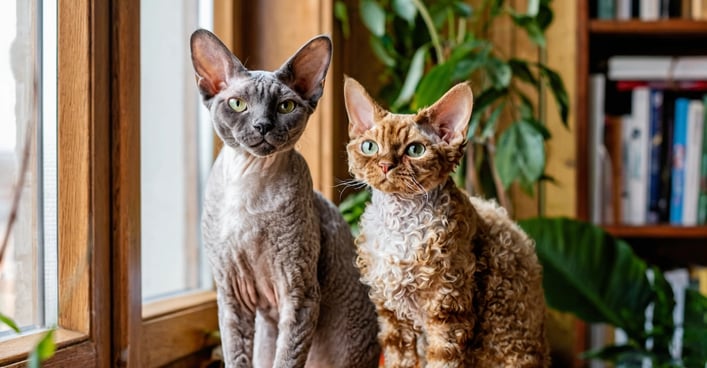
Devon Rex cats have a distinctive, impish look often described as pixie-like or alien.
Build: Compact, muscular, and surprisingly sturdy.
Head: Short, broad wedge shape with full cheeks and a short muzzle.
Ears: Enormous, low-set on the head, giving a bat-like impression.
Eyes: Large, oval, and wide-set.
Coat: Short, curly, and often appears tousled or crinkled.
Body: Medium frame with sturdy legs.
Face: Characterized by high cheekbones and a mischievous expression.
Coat Differences: Texture and Care
Cornish Rex Coat
Texture: Exceptionally soft, wavy, with uniform marcel waves (like a permanent wave).
Hair Types: Consists almost entirely of down hair; lacks guard and awn hairs.
Feel: Incredibly soft, often compared to velvet, crushed silk, or lamb's wool.
Curl Pattern: Even, body-hugging ripples.
Shedding: Very minimal.
Care: Requires gentle handling. Use a soft cloth or your hands for grooming; avoid harsh brushes.
Devon Rex Coat
Texture: Short, curly, with a looser, more random pattern.
Hair Types: Contains all three hair types, but all are mutated and curly.
Feel: Soft, but texture can vary between individuals.
Curl Pattern: Looser, more tousled curls, especially on the body.
Shedding: Very minimal.
Care: Benefits from gentle finger-combing or a very soft brush. Their large ears require regular cleaning.
Important: Both breeds have delicate coats that should never be brushed roughly, as this can damage the hair follicles.
Personality and Temperament
Cornish Rex Personality
Think of the Cornish Rex as a playful athlete.
Active & Energetic: High-energy cats that love to run, jump, and play.
Perpetually Playful: They retain their kitten-like curiosity and playfulness well into adulthood.
Intelligent: Quick learners who enjoy puzzle toys and can even learn tricks.
Social Butterflies: Thrive on human interaction and dislike being left alone for long periods.
Affectionate: Known as "heat-seeking missiles," they love to curl up in warm laps.
Acrobatic: Excellent jumpers and climbers who appreciate tall cat trees.
Devon Rex Personality
The Devon Rex is best described as an impish prankster.
Mischievous & Curious: Into everything, with a talent for opening cabinets and "helping" with tasks.
Entertaining Clowns: Their playful antics and sometimes awkward movements are a constant source of amusement.
Highly Intelligent: Easily trained and enjoy interactive games.
Deeply Loyal: Form strong, dog-like bonds with their favorite people and often follow them from room to room.
Social & Adaptable: Generally get along well with children, other cats, and cat-friendly dogs.
Greeters: Many will happily greet their owners at the door.
Grooming and Maintenance
Cornish Rex Grooming
Commitment: Minimal
Brushing: Occasional, very gentle wiping with a chamois or soft cloth.
Bathing: Rarely needed, as their fine coat doesn't hold much oil.
Skin Care: In dry climates, their skin may benefit from occasional moisturizing.
Nails & Ears: Standard nail trimming and ear checks apply.
Devon Rex Grooming
Commitment: Minimal
Brushing: Gentle finger-combing or using a soft bristle brush is sufficient.
Bathing: An occasional bath can help manage skin oils and keep their coat looking its best.
Ear Cleaning: Essential. Their large, open ears can accumulate wax and need regular cleaning.
Nails: Standard nail trimming.
Health and Lifespan Considerations
Cornish Rex Health
Generally a healthy breed with a lifespan of 12-16 years.
Potential Concerns:
Hypotrichosis: Congenital hair loss in some bloodlines.
Hypertrophic Cardiomyopathy (HCM): A form of heart disease.
Skin Conditions: Can be prone to minor fungal or bacterial infections due to their thin coat.
Temperature Sensitivity: Feel the cold easily and seek out warm spots.
Devon Rex Health
A generally healthy breed with a typical lifespan of 9-15 years.
Potential Concerns:
Patellar Luxation: A kneecap dislocation issue.
Hypertrophic Cardiomyopathy (HCM): Heart disease screening is recommended.
Skin Conditions: Some lines may be prone to a yeast infection called Malassezia dermatitis.
Hereditary Myopathy: A rare muscle weakness condition (now uncommon due to responsible breeding).
For both breeds: Purchasing from a reputable breeder who conducts health screenings is the best way to ensure a healthy kitten.
Cost Comparison (2026 Estimates)
Initial Costs
Expense
Cornish Rex
Devon Rex
Kitten from Breeder
$800 - $2,000
$800 - $2,000
Adoption Fee
Rare, but possible
Rare, but possible
Initial Vet Visit & Vaccinations
$150 - $300
$150 - $300
Initial Supplies
$200 - $500
$200 - $500
Annual Ongoing Costs
Expense
Cornish Rex
Devon Rex
High-Quality Food
$300 - $700
$300 - $700
Routine Vet Care
$200 - $500
$200 - $500
Grooming Supplies
Minimal ($20-$50)
Minimal ($20-$50) + ear cleaner
Litter
$150 - $300
$150 - $300
Pet Insurance
$250 - $600/year
$250 - $600/year
Which Curly-Coated Breed Is Right for You?
Choose a Cornish Rex If You Want:
An elegant, graceful, and athletic feline.
A cat with a consistently wavy, soft coat.
A highly active companion who loves to play.
An affectionate "heat-seeker" who will be your lap cat.
A pet with minimal grooming needs.
Choose a Devon Rex If You Want:
A mischievous, impish, and entertaining clown.
A cat with a unique, pixie-like face and tousled curls.
A loyal, dog-like shadow who follows you everywhere.
A highly social cat that integrates well into a busy family.
A playful companion with a big personality in a compact body.
Final Thoughts
Both the Cornish Rex and Devon Rex offer an unparalleled combination of unique beauty and engaging personality. They share:
Striking Appearance: Their curly coats are sure to turn heads.
Playful, Intelligent Nature: They remain playful and curious throughout their lives.
Strong Affection: They form deep bonds and thrive on companionship.
Low-Shedding Coats: Ideal for many people with mild allergies (though no cat is truly hypoallergenic).
Indoor Lifestyle: Both breeds should be kept exclusively indoors for their safety.
Your decision ultimately comes down to personal preference: the sleek, athletic grace of the Cornish Rex or the impish, loyal charm of the Devon Rex. Whichever you choose, you'll be welcoming a loving, entertaining, and utterly unique companion into your life.
Get expert advice about cat care, behavior, nutrition, grooming, and training. Ask our AI cat care expert anything about your cat and receive professional guidance.