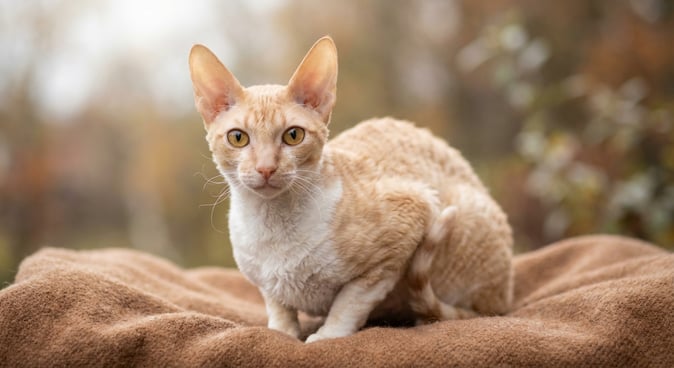
Born from a chance mutation on a windswept Cornish farm, the Cornish Rex spun its curly coat and whippet-like grace into a dazzling new breed. Discover how a single kitten named Kallibunker launched the feline world’s most acrobatic dynasty.
With their impossibly soft, wavy coats and elfin features, Cornish Rex cats look like they’ve stepped straight out of a fairy tale. These elegant, high-energy companions from Cornwall, England, are as affectionate as they are athletic, earning a reputation for being perpetual kittens in sleek, adult bodies. If you’re seeking a cat that will shadow your every move, leap to impressive heights, and snuggle with unwavering devotion, the Cornish Rex may just steal your heart.
The Cornish Rex’s story began in 1950 on a farm in Bodmin Moor, Cornwall, where a spontaneous genetic mutation produced a curly-coated kitten named Kallibunker. Unlike any other British domestic cat, Kallibunker had an ultra-short, wavy coat and long, graceful limbs. Geneticist A.C. Jude recognized the mutation as recessive and, with breeder Nina Ennismore, launched a careful breeding program using Siamese, Burmese, and British Domestic Shorthairs to widen the gene pool while preserving the signature coat. The breed was dubbed "Rex" in homage to the curly-coated rabbits of the same name, and the "Cornish" tag honored its birthplace. Export to the United States in 1957 cemented global popularity, and today the Cornish Rex is cherished worldwide for its unique look and people-oriented personality.
Cornish Rex cats are the ballet dancers of the feline world: fine-boned yet muscular, weighing 2.5–4.5 kg (5–10 lb) and measuring 30–35 cm (12–14 in) in body length. Their most striking feature is the marcelled coat—rows of tight waves lying close to the skin—created by having only the down undercoat and lacking the typical guard and awn hairs. The result is a velvety texture often compared to crushed velvet or warm suede. All coat colors and patterns are accepted, from solid black to pointed, calico, silver tabby, and even colorpoint. Large, bat-like ears sit high on a small, egg-shaped head, while high cheekbones, a pronounced Roman nose, and oval eyes (in shades of gold, green, blue, copper, or odd-eyed) give an eternally alert expression. Long, slender legs and a whippy tail add to the breed’s greyhound-like silhouette.
The Cornish Rex is a living contradiction: delicate in appearance yet sturdy in health, elegant in silhouette yet goofy in personality. Their curly coat is merely the opening act to a performance packed with affection, intelligence, and athletic grace. For those ready to share their home—and their heart—with an eternally playful companion, the Cornish Rex offers a decade or more of purring, pirouetting devotion.
Ask any Cornish Rex guardian to describe their cat in one word and you’ll hear "magnetic." These cats score a perfect 5/5 for affection, friendliness, playfulness, energy, and intelligence. They crave human contact—often perching on shoulders, riding on hips, or burrowing under bedcovers—and will follow you from room to room like a chatty shadow. Their curiosity is legendary: expect help with laptop typing, fridge inspections, and grocery unpacking. Athleticism borders on acrobatic; a Cornish Rex can easily spring six times its height to snatch a feather toy from mid-air. Despite the high-octane antics, they are sensitive souls that dislike being left alone for long stretches. Interactive play, puzzle feeders, and even leash training provide essential mental stimulation.
Grooming a Cornish Rex is refreshingly simple. The coat’s minimal shedding (1/5) and lack of guard hairs mean fewer hairballs and less dander, making the breed a top pick for allergy sufferers. A gentle weekly wipe with a damp microfiber cloth or soft bristle brush removes dead hairs and distributes skin oils. Because their coat is sparse, they can develop greasy skin or seborrhea if neglected, so regular wiping is key. Bathing is rarely needed unless the cat is white and shows oil staining. Their large ears accumulate wax quickly; check and clean monthly with a vet-approved cleanser. Trim nails every two weeks and brush teeth several times a week to prevent periodontal disease.
Exercise needs are maximal (5/5), so invest in tall cat trees, wall-mounted shelves, and rotating toy collections. Cornish Rex cats excel at agility and clicker training; teaching them to fetch, high-five, or weave between poles channels energy constructively. Because they are sensitive to cold, provide heated beds in winter and consider a soft sweater for hairless-bellied individuals. A high-protein diet supports their rapid metabolism, and measured meals prevent the "bottomless pit" grazing that can lead to tubby tummies.
Overall, Cornish Rex cats are robust, living 11–15 years, but a few hereditary issues warrant awareness. Hypertrophic cardiomyopathy (HCM), a thickening of the heart muscle, can occur; reputable breeders screen breeding cats annually via echocardiogram. Hereditary myopathy, a rare muscle weakness, and patellar luxation (slipping kneecaps) also appear in some lines. Sparse coats leave skin vulnerable to sunburn, acne, and fungal infections; limit outdoor time during peak UV hours and treat any scabs or blackheads promptly. Because they lack insulating fur, they can become chilled easily, increasing susceptibility to respiratory infections. Routine veterinary checkups, dental cleanings, and genetic testing of kittens from screened parents mitigate most risks.
Ideal Cornish Rex guardians are home-oriented individuals or families who want an interactive, clown-like companion rather than a decorative couch ornament. They pair wonderfully with children (4/5 kid-friendly) and other pets (4/5 pet-friendly) but may overwhelm toddlers with their exuberance. Apartment dwellers can succeed provided ample vertical space and daily play sessions are offered. If you travel frequently or work long hours, consider adopting two Rexes to keep each other entertained, or choose a more independent breed. Allergy sufferers should spend time with an adult Cornish Rex first; while no cat is 100% hypoallergenic, many Fel d 1–sensitive people tolerate the breed better than others. Ultimately, if you crave a velvety shadow that greets guests at the door, retrieves toys like a dog, and purrs like a tiny outboard motor, the Cornish Rex will reward you with a lifetime of affectionate antics.
Get AI-powered advice about your cat's health and care. Enter your cat's information and start a conversation with our veterinary assistant.
Start Chat with AIGet expert advice about cat care, behavior, nutrition, grooming, and training. Ask our AI cat care expert anything about your cat and receive professional guidance.
Start Chat with Expert