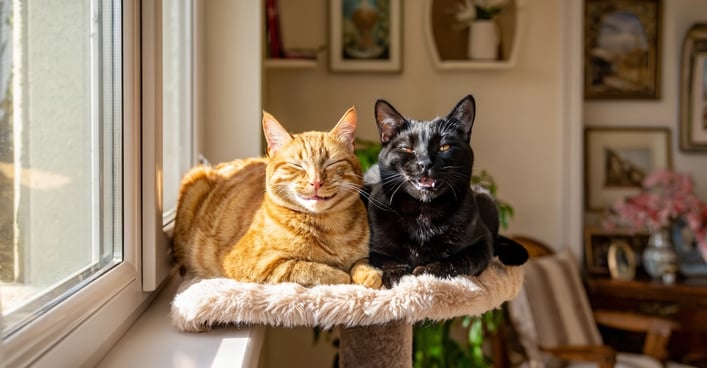
The Complete Guide to a Happy Multi-Cat Household in 2026
Create lasting harmony in your multi-cat home. Learn expert strategies for introductions, resource management, and fostering peaceful feline relationships.
Share this page
The Complete Guide to a Happy Multi-Cat Household in 2026
Living with multiple cats is a uniquely rewarding experience, offering endless companionship and entertainment. However, it also presents distinct challenges that require thoughtful planning and management. A harmonious multi-cat home isn't about luck—it's built on understanding feline social dynamics, providing ample resources, and facilitating positive relationships.
This comprehensive guide provides the essential strategies you need to successfully manage a peaceful and joyful household with two or more cats.
Planning for Multiple Cats
Is Your Home Ready?
Before bringing home another cat, assess your space, finances, and time commitment.
Space Requirements:
Minimum Space: Aim for at least 18 square feet of floor space per cat.
Vertical Territory: Crucial for escape routes and personal space. Install cat trees, shelves, and window perches.
Room Layout: Multiple rooms or defined separate zones help prevent territorial disputes.
The Complete Guide to a Happy Multi-Cat Household in 2026 - Articles
Financial Considerations:
Recurring Costs: Double (or more) the expenses for food, litter, and preventive veterinary care.
Initial Investment: Budget for additional litter boxes, carriers, beds, and scratching posts.
Emergency Fund: Essential for covering unexpected medical bills for multiple pets.
Time Investment:
Individual Attention: Each cat needs daily one-on-one play and affection.
Maintenance: More cats mean more frequent litter scooping, cleaning, and grooming.
Monitoring: Observing interactions is key to catching and resolving issues early.
Choosing Compatible Cats
Compatibility often determines long-term success more than breed or color.
Best Combinations for Harmony:
Littermates or Bonded Pairs: Already have an established, positive relationship.
Similar Age & Energy: A playful kitten and a senior cat may have conflicting needs.
Complementary Personalities: A confident cat can help a shy one, but two highly dominant cats may clash.
Cat-Socialized History: Ensure any new cat has positive past experiences with other felines.
Potentially Challenging Pairings:
Very different life stages (e.g., kitten vs. senior).
Opposite energy levels (hyperactive vs. sedentary).
Introducing an adult cat with no prior cat socialization.
Combining two adult cats with strong territorial tendencies.
The Introduction Process: A Step-by-Step Guide
Rushing introductions is the most common cause of long-term conflict. Patience is non-negotiable.
Phase 1: Pre-Introduction Preparation (Setup)
Create Separate Base Camps:
Equip each space with all necessities: food, water, litter box, scratching post, bed, and toys.
Use a solid door as a visual barrier initially.
Begin scent exchange immediately by swapping bedding or rubbing cats with separate cloths.
Phase 2: Scent Introduction (Days 1-7)
The goal is to create positive associations with the other cat's smell before they ever meet.
Scent Swapping: Daily exchange of blankets, toys, or bedding between rooms.
Feeding Ritual: Feed both cats on opposite sides of the closed door. Gradually move bowls closer over days. This builds the idea that "the other cat's scent predicts good things (food)."
Phase 3: Visual Introduction (Days 7-14+)
Only proceed when both cats are calm and eating comfortably near the door.
Use a Barrier: A baby gate, screen door, or a securely cracked door allows sight without full access.
Keep Sessions Short & Positive: Offer high-value treats or engage in play during visual access.
Watch Body Language:
Good Signs: Relaxed posture, curious sniffing, ignoring each other, play bows.
Warning Signs: Stiff posture, fixed staring, growling, hissing that doesn't subside. If these occur, end the session and return to scent swapping.
Begin with very short, controlled meetings in a neutral space.
First Meetings: 5-10 minutes, fully supervised. Have toys and treats ready to distract and reward calm behavior.
Ensure Escape Routes: Never corner a cat. Provide furniture to jump on or clear paths to leave the room.
End on a High Note: Separate the cats before any tension arises, ideally after a positive interaction like play or treat-taking.
Gradually Increase Time: Slowly extend the duration of supervised visits over days or weeks as they remain calm.
Essential Resource Management
Conflict in multi-cat homes most often stems from competition over resources.
Litter Box Strategy
The Golden Rule:One litter box per cat, plus one extra. For two cats, you need three boxes.
Strategic Placement:
Place boxes in multiple, separate locations—not all in one room or lined up in a row.
Ensure boxes are on different floors if possible.
Choose quiet, low-traffic, but easily accessible areas. Avoid dead ends where a cat could be trapped.
Box Preferences: Offer variety—some cats prefer large, uncovered boxes, while others like the privacy of a hood. Ensure boxes are scooped daily and cleaned thoroughly weekly.
Feeding & Water Stations
Feeding:
Separate Stations are Key: Feed cats in different rooms or far-apart areas to prevent food guarding and stress.
Scheduled Meals vs. Free Feeding: Scheduled meals are generally better for multi-cat homes. They allow for portion control, monitoring of each cat's appetite (an early illness sign), and management of special diets.
For Food-Guarding Cats: Use closed-door separation during meals or consider microchip-activated feeders.
Water:
Provide multiple water stations in different locations, away from food and litter boxes.
Offer variety: ceramic or stainless steel bowls and a cat water fountain can encourage hydration.
Resting & Territory
Vertical Space is Paramount: Cat trees, wall shelves, and window perches allow cats to share a room without being "in each other's space."
Ample Hiding Spots: Each cat should have access to at least one secure, private hiding place (a covered bed, cardboard box, or access to a separate room).
Managing Feline Relationships
Understanding Cat Social Structure
Cats are not pack animals like dogs. They form loose, flexible social groups based on shared resources.
Bonded Pairs: Will sleep touching, groom each other (allogroom), and seek each other out.
Peaceful Cohabitation: Many cats simply "tolerate" each other, sharing space without close interaction. This is a perfectly successful outcome.
Conflict Resolution & Prevention
Minor Spats (Hissing, Swatting): Often resolve on their own. Interrupt with a loud clap or toss a soft toy to redirect attention, but avoid punishing.
Persistent social tension, lack of control over environment.
Review resource availability, create more safe spaces, consider pheromones, vet check.
Cost Management for Multiple Cats
Initial Setup Costs (Estimate for 2 Cats):
Litter Boxes (3): $30 - $75
Food/Water Bowls (4+): $15 - $40
Scratching Posts/Trees (2): $50 - $200
Beds & Carriers: $60 - $150
Estimated Total:$155 - $465
Monthly Ongoing Costs (Estimate for 2 Cats):
High-Quality Food: $80 - $180
Litter: $40 - $70
Preventive Care (Flea/Tick, Savings for Vet): $40 - $80
Treats & Supplies: $20 - $40
Estimated Total:$180 - $370
Cost-Saving Tips:
Buy food and litter in bulk.
Utilize autoship discounts from pet retailers.
Invest in preventive veterinary care to avoid costly emergencies.
DIY enrichment (cardboard boxes, paper bags) can be just as fun as store-bought toys.
Long-Term Success & Maintenance
Daily: Scoop all litter boxes, refresh water, engage in individual play, and do a visual wellness check on each cat.
Weekly: Deep-clean litter boxes, wash bedding, and rotate toys to keep the environment novel.
Monthly: Weigh each cat to monitor health, trim nails, and reassess the household dynamic. Are resources still sufficient? Is any cat showing subtle signs of stress?
When to Seek Professional Help:
Escalating aggression that leads to injuries.
Persistent inappropriate elimination despite medical clearance.
One cat is chronically stressed, hiding, or not eating.
Sudden, severe changes in any cat's behavior.
Frequently Asked Questions
Q: Is it better to have two cats than one?A: For many cats, yes—especially if they are social and left alone for long periods. They provide companionship and mental stimulation for each other. However, some cats are truly solitary and prefer to be the only pet.
Q: Will my resident cat be jealous of a new cat?A: Some adjustment is normal. You can minimize jealousy by ensuring your first cat continues to receive ample individual attention, resources, and by following a slow introduction process that doesn't disrupt their routine.
Q: How many cats is too many?A: This depends entirely on your space, time, financial resources, and the individual cats' personalities. The limit is the point where you cannot provide excellent care, ample resources, and individual attention to each feline member of the household.
Q: Can male and female cats live together peacefully?A: Absolutely, provided all cats are spayed or neutered. Gender is far less important than individual personality, socialization history, and proper introduction.
Q: What if my cats never become "friends"?A: Peaceful coexistence is a completely successful outcome. Not all cats will cuddle or groom each other. If they share your home without conflict, stress, or aggression, you have achieved multi-cat harmony.
Conclusion
Creating a happy multi-cat household is an achievable and deeply rewarding endeavor. Success hinges on meticulous planning, a patient introduction process, and a commitment to providing abundant, well-managed resources. By respecting each cat's individuality and understanding their unique social language, you can foster a home filled with peaceful coexistence and shared contentment.
Remember, the goal is not necessarily feline friendship, but rather a stress-free environment where every cat feels secure and valued. With the strategies outlined in this guide, you are well-equipped to build that harmonious haven for your feline family.
Disclaimer: This guide provides general advice. If you are dealing with severe aggression, persistent behavioral issues, or have concerns about your cats' health, please consult with your veterinarian and a certified cat behavior professional.
Get expert advice about cat care, behavior, nutrition, grooming, and training. Ask our AI cat care expert anything about your cat and receive professional guidance.