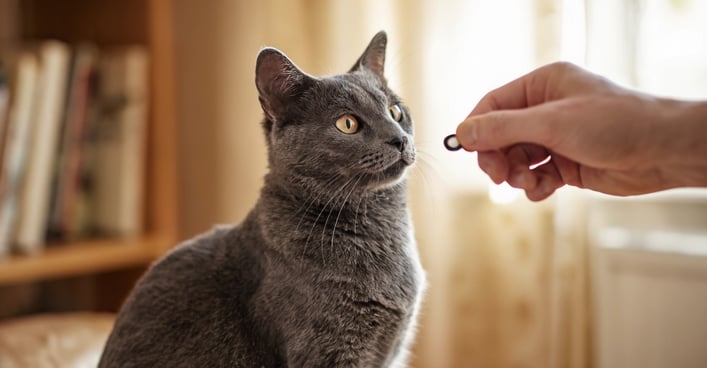
Clicker Training for Cats: Your Complete Guide for 2026
Master clicker training for cats with this science-backed guide. Strengthen your bond, teach impressive tricks, and solve behavior problems using positive reinforcement.
Share this page
Clicker Training for Cats: Your Complete Guide for 2026
Clicker training is a powerful, science-based method for teaching cats new behaviors, solving common problems, and deepening the human-animal bond. By using positive reinforcement and precise timing, you can guide your cat from basic manners to impressive tricks. This comprehensive guide provides everything you need to start your successful training journey.
Understanding Clicker Training
What Is Clicker Training?
Clicker training is a form of operant conditioning that uses a small handheld device to create a distinct "click" sound. This sound acts as a precise marker, telling your cat the exact moment they performed a desired behavior, which is then followed by a reward. The click becomes a clear "bridge" in communication.
The Science Behind It:
Operant Conditioning: Based on the foundational work of B.F. Skinner.
Positive Reinforcement: Rewards desired behavior by adding something pleasant (like a treat).
Clear Communication: Eliminates guesswork for your cat.
Trust Building: Creates a cooperative and positive learning environment.
Bronze Tier (Maintenance Value): Regular kibble or dry treats.
Charging the Clicker: The First Step
Purpose: To teach your cat that the "click" sound always predicts a treat is coming.
The Process:
Sit with your cat in a quiet, distraction-free area.
Click, then immediately give a treat. Don't wait.
Repeat this 10-15 times in a short session.
Conduct 3-5 of these brief sessions over one or two days.
Signs Your Clicker Is Successfully "Charged":
Your cat looks at you or your treat hand immediately upon hearing the click.
Their ears perk up at the sound.
They show anticipation or move toward the treat source.
Core Training Techniques
1. Capturing
Definition: Rewarding your cat for a behavior they offer naturally.
How to Do It:
Observe your cat and wait for the desired behavior (e.g., sitting).
Click the instant the behavior happens.
Quickly deliver a treat.
Great Behaviors to Capture: Sitting, lying down, making eye contact, coming toward you, offering a paw.
2. Luring
Definition: Using a treat to physically guide your cat into a position or movement.
How to Do It:
Hold a treat right at your cat's nose.
Slowly move the treat to guide them (e.g., up and back over the head for a "sit").
The moment they achieve the position, click and give them the treat.
Gradually "fade" the lure by making it less obvious, then using an empty hand.
3. Shaping
Definition: Rewarding small, successive steps that gradually build toward a final, more complex behavior.
How to Do It:
Start by clicking and rewarding any movement toward the final goal.
Once that step is reliable, only click for a slightly closer approximation.
Continue building step-by-step until the complete behavior is achieved.
Example: Shaping "Go to Your Mat"
Step 1: Click for looking at the mat.
Step 2: Click for taking a step toward it.
Step 3: Click for touching it with a paw.
Step 4: Click for placing two paws on it.
Step 5: Click for sitting or lying on it.
Step 6: Add a verbal cue ("place"), duration, and distance.
4. Targeting
Definition: Teaching your cat to touch a specific object (a target stick or your hand) with their nose or paw.
Basic Steps:
Present the target very close to your cat's nose.
Click for any interest (looking, sniffing).
Progress to requiring a deliberate touch.
Once they understand, move the target to guide them (e.g., through a hoop, onto a scale).
Practical Applications: Guiding your cat without picking them up, teaching agility, station training for vet visits.
Teaching Foundational Behaviors
Sit
Luring Method:
Hold a treat at your cat's nose.
Slowly move it up and back, just over their head.
As their head follows up, their rear end will naturally go down.
Click the moment their hindquarters touch the floor, then treat.
Come When Called
Training Steps:
Start very close (2-3 feet away) in a quiet room.
Use an excited, happy voice and say their name + "come!"
Click the moment they move toward you, and give a "jackpot" (several treats) when they arrive.
Gradually increase the distance and add mild distractions.
Pro Tip: Always make coming to you a wonderful experience. Never call them for something they dislike (e.g., a bath, medication) without also pairing it with high-value rewards.
High Five / Paw Shake
Training Steps:
Capture a natural paw lift or wait until they paw at something.
Click and treat for the paw movement.
Present your flat palm near their paw. Click/treat for any movement toward it.
Shape the behavior until they consistently touch your hand.
Add the verbal cue ("high five" or "shake") as they perform the action.
Stay
Training Steps:
Ask for a "sit" or "down."
Give a clear hand signal (flat palm toward them) and say "stay."
Wait just one second, then click, return to them, and treat.
Very gradually increase the duration (time) before clicking.
Separately, practice increasing distance (taking one step back).
Crucial Rule: Always return to your cat to deliver the treat before releasing them with an "okay!" This reinforces that the "stay" lasts until you return.
Advancing to Fun Tricks
Roll Over
Start with your cat in a "down" position.
Use a lure to guide their head toward their shoulder.
Click and treat for small head turns, then shoulder rolls.
Shape the behavior through successive approximations until they complete a full roll.
Give a jackpot for the full behavior!
Jump Through a Hoop
Place a hoop (or your arms in a circle) flat on the ground.
Lure your cat to walk through it. Click/treat.
Gradually raise the hoop an inch at a time.
Add a cue like "through!" as they jump.
Fetch
Start with your cat's favorite lightweight toy.
Toss it a very short distance. Click/treat for any interest in it.
Shape the behavior: click for touching it, then for picking it up, then for bringing it toward you.
Click and offer a treat trade when they drop it near you.
Add the "fetch" cue as they reliably retrieve.
Solving Common Behavior Problems
Counter Surfing
Training Solution:
Teach an "off" cue using targeting (target them to jump down).
Proactively reward them for staying on approved perches or the floor.
Provide attractive, cat-friendly high spaces as alternatives.
Use management: keep counters clean and uninteresting.
Aggressive Play (Biting/Scratching)
Training Solution:
Redirect play to appropriate toys. Click/treat for engaging with the toy.
If teeth or claws make contact, say "ouch!" calmly, freeze, and end the play session for 30 seconds.
Teach a "gentle" cue by clicking/treating for soft paw touches or licks.
Fear or Anxiety
Counter-Conditioning & Desensitization:
Identify the trigger (e.g., carrier, strangers).
Present the trigger at a very low intensity where your cat notices but stays calm (e.g., carrier far away).
Click and give high-value treats for any calm behavior.
Very slowly decrease distance or increase intensity over many sessions.
Important: For litter box issues, aggression, or severe anxiety, always rule out medical causes with your veterinarian first before assuming it's a behavioral problem.
Training Guidelines for Success
Structuring Your Sessions
Duration: Keep sessions very short—2 to 5 minutes is perfect.
Frequency: Multiple short sessions per day are better than one long one.
Timing: Train when your cat is slightly hungry (e.g., before meals). Avoid right after a big meal.
Environment: Start in a quiet, familiar room. Gradually add distractions as skills improve.
Quit While You're Ahead: Always end on a successful repetition, while your cat is still eager for more.
Smart Reward Strategies
New Behaviors: Click and treat for every correct response (continuous reinforcement).
Known Behaviors: Switch to a variable schedule (click/treat only some of the time) to make the behavior stronger.
Jackpots: For a major breakthrough or a perfect performance, give a handful of treats or an extra-special reward.
Life Rewards: Integrate training into daily life. Ask for a "sit" before opening a door, giving a meal, or initiating petting.
Common Mistakes to Avoid
Poor Timing: Clicking too early or too late. The click must be simultaneous with the desired action.
Empty Clicks: Clicking without following up with a treat. This breaks the promise of the click.
Marathon Sessions: Training until your cat walks away. Short and sweet wins the race.
Skipping Steps: Advancing too quickly in shaping. Break behaviors down into tiny, achievable steps.
Inconsistency: Using different words or signals for the same behavior.
Punishing Mistakes: Never scold for an incorrect response. Simply withhold the click/treat and try again.
Troubleshooting Guide
Problem
Likely Solutions
Cat isn't interested.
Use higher-value treats. Train before meals. Shorten sessions. Ensure they aren't tired or stressed.
Cat is startled by the clicker.
Muffle it in your pocket. Use a quieter clicker or a verbal marker like "yes!" Try a clicker app with low volume.
Cat only works when treats are visible.
Keep treats hidden in a pouch. Use variable reward locations (treat from floor, your hand, a bowl). Gradually phase out the visible lure.
Progress has stalled.
Go back a step in your shaping plan. Make the criteria easier for a few repetitions to rebuild confidence. Check your timing.
The Training Journey: A Realistic Timeline
Weeks 1-2: Foundation
Charge the clicker. Master 1-2 simple behaviors (sit, touch). Establish a fun, low-pressure routine.
Weeks 3-4: Building Skills
Add 1-2 new behaviors. Begin adding verbal cues. Start practicing in different, quiet locations in your home.
Month 2 & Beyond: Advancement
Chain behaviors together (sit -> high five). Add duration and distance to known cues. Teach more complex tricks. Practice with mild distractions.
Benefits Beyond Tricks
Practical Life Skills
Carrier Training: Create a positive association, making vet trips less stressful.
Nail Trimming & Grooming: Use desensitization to make handling paws and brushing enjoyable.
Medication Administration: Train your cat to willingly take pills or accept liquid medicine.
Cooperative Vet Care: Teach your cat to be handled, stand on a scale, and allow examination.
Builds confidence, especially in shy or fearful cats.
Offers a constructive outlet for natural instincts and intelligence.
Strengthens the overall human-cat bond through clear, positive communication.
Cost Breakdown
Clicker training is one of the most cost-effective investments you can make in your cat's well-being.
Item
Estimated Cost
Clicker
$2 - $5
Treat Pouch
$10 - $15
Initial Supply of High-Value Treats
$10 - $20
Target Stick (Optional)
$5 - $15
Total Initial Investment
~$27 - $55
Ongoing Monthly Treat Cost
~$10 - $20
Value Comparison: A single private behavior consultation can cost $100-$300. Clicker training empowers you to solve problems and build skills at home for a fraction of the cost.
Conclusion
Clicker training transforms your relationship with your cat from simple coexistence to an active, communicative partnership. The skills you learn—patience, clear communication, and positive reinforcement—will benefit every aspect of your life together.
Remember, every cat learns at their own unique pace. Celebrate every small success, keep sessions fun and positive, and enjoy the journey of discovery with your feline friend. The investment of your time and patience will be rewarded with a more confident, engaged, and well-behaved companion.
Continue Your Learning:
Understanding Feline Body Language: Learn to read your cat's subtle signals.
Creating the Ultimate Indoor Cat Enrichment Plan: Keep your cat mentally and physically stimulated.
Solving Common Litter Box Problems: A step-by-step troubleshooting guide.
Recommended Resources:
Book:Clicker Training for Cats by Karen Pryor
Website: Karen Pryor Clicker Training (clickertraining.com)
Online Channels: Cat School Clicker Training on YouTube
Get expert advice about cat care, behavior, nutrition, grooming, and training. Ask our AI cat care expert anything about your cat and receive professional guidance.