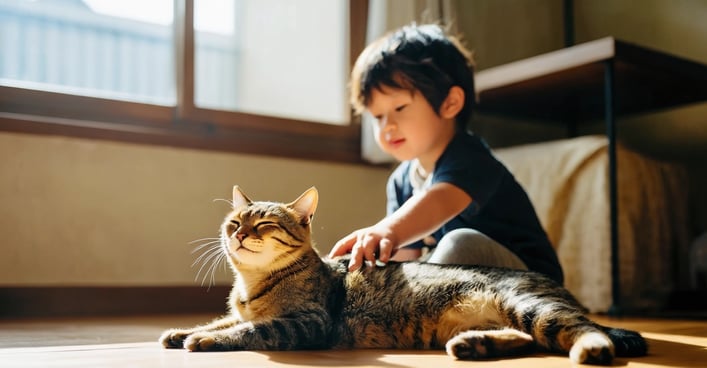
Cats and Children: A Complete Guide to Safe, Happy Relationships
Learn how to build a safe, loving, and respectful bond between your cat and children. Our guide covers age-appropriate rules, safety tips, and creating a harmonious home for everyone.
Share this page
Cats and Children: A Complete Guide to Safe, Happy Relationships
Introducing a cat to a household with children, or welcoming a child into a home with a cat, can create beautiful, lifelong bonds. However, successful relationships between cats and children require intentional effort—education, consistent supervision, and respect for both parties' needs. This comprehensive guide provides parents with the knowledge to foster safe, harmonious, and loving relationships between cats and kids of all ages.
Why Cats and Children Benefit Each Other
Benefits for Children
Emotional Development:
Teaches empathy, compassion, and nurturing
Provides unconditional love and acceptance
Reduces stress and anxiety
Helps children process complex emotions
Creates a sense of responsibility
Social Development:
Improves verbal and non-verbal communication skills
Cats and Children: A Complete Guide to Safe, Happy Relationships - Articles
Physical Health:
Reduced risk of developing allergies when exposed early
Lower blood pressure and heart rate
Encourages gentle, active play
Supports healthy immune system development
Life Skills:
Understanding long-term commitment and daily care
Learning about natural life cycles
Developing healthy coping mechanisms for loss
Instilling respect for all living creatures
Benefits for Cats
Increased socialization and confidence through positive interactions
More consistent interactive play and mental stimulation
Opportunity to form deep, secure bonds with family members
An enriched environment with loving activity
Often receive more dedicated attention and engagement
Age-Appropriate Guidelines
Babies and Toddlers (0-3 Years)
Understanding the Risks:
This age group presents significant risks due to:
Unpredictable movements and loud sounds
Inability to understand "gentle touch"
Instinct to grab, pull, or squeeze
Risk of accidental suffocation if a cat sleeps too close to a baby
Potential for scratches if a cat feels cornered or threatened
Essential Safety Rules:
Never leave a baby or toddler alone with a cat, even for a moment.
Keep the cat out of the baby's sleeping area (crib, bassinet).
Wash hands after handling the cat before touching the baby.
Ensure the cat always has clear escape routes from spaces where the baby is.
Maintain the cat's feeding, play, and quiet-time routines as consistently as possible.
Preparing Your Cat for a New Baby:
Gradually play recordings of baby sounds before the arrival.
Introduce the baby's scent by bringing home a blanket or worn clothing from the hospital.
Set up the nursery early to allow the cat to investigate and adjust.
Stick to established feeding and play schedules.
Create designated private retreat spaces for the cat that are off-limits to the child.
Teaching Early Boundaries:
Model gentle touch from the earliest age.
Use a consistent verbal cue like "gentle hands."
Teach "kitty is sleeping/eating" as a reason to leave the cat alone.
Provide constant, direct supervision for all interactions.
Preschoolers (3-5 Years)
Developmental Abilities:
Can follow simple, clear rules
Beginning to understand empathy but need guidance
Often impulsive, loud, and energetic
Learning gentle touch but require frequent reminders
Naturally curious and eager to interact
Supervision Level: Constant and direct.
Teaching Guidelines:
The "Gentle" Rule:
Demonstrate gentle petting (stroking with the fur, not against it).
Practice on stuffed animals first.
Supervise every single interaction.
Praise gentle behavior enthusiastically.
Appropriate Touch Zones:
Where cats like to be petted:
Top of the head (gently)
Base of the ears
Under the chin
Along the back
Areas to avoid:
Belly (even if the cat rolls over)
Tail
Paws
Whiskers and face
Body Language Education:
Teach clear signs a cat wants to be left alone:
Flattened ears
Swishing or thumping tail
Hissing, growling, or moving away
Establish the rule: "When kitty walks away, we let him go."
Interactive Games:
Wand toys (child holds the wand, adult supervises the string)
Laser pointers (never point at eyes, always end with a physical toy)
Placing treats gently for the cat to find
Never allow chasing, cornering, or scaring the cat.
School Age (6-12 Years)
Developmental Abilities:
Can understand and follow complex rules
Developing better impulse control
Capable of genuine empathy and responsibility
Can participate in structured care tasks
May desire a special "friendship" with the cat
Supervision Level: Intermittent to moderate (check-ins are essential).
Expanding Responsibilities:
Care Tasks by Age:
Ages 6-8:
Filling the water bowl daily
Helping with measured feeding (under supervision)
Gentle brushing sessions with supervision
Putting away cat toys
Ages 9-12:
Responsible for scheduled feedings
Scooping the litter box (with proper hygiene)
Independent brushing/grooming
Initiating appropriate play sessions
Helping track care on a chart or calendar
Teaching Respect and Boundaries:
The cat's needs (safety, food, quiet time) come before the child's wants.
Advanced reading of cat body language.
Understanding and respecting the cat's need for undisturbed alone time.
Proper techniques for approaching, petting, and holding.
How to Hold a Cat (Proper Technique):
Approach calmly and let the cat sniff your hand.
Support the chest firmly with one hand.
Support the hind legs and bottom with the other hand.
Hold the cat close to your body for security.
Watch for signs it wants down (wiggling, tense body).
Gently place the cat on the floor immediately when it indicates it's done.
Teenagers (13+ Years)
Developmental Abilities:
Capable of full responsibility for care
Can form deep, understanding bonds
Understand complex health and behavioral needs
Can assist in medical situations and vet visits
May take a primary or shared caregiving role
Supervision Level: Minimal, based on demonstrated responsibility.
Responsibility Opportunities:
Managing the complete care schedule (feeding, litter, play)
Attending veterinary appointments and asking questions
Performing thorough grooming sessions
Recognizing early signs of health or behavior concerns
Designing and implementing training/enrichment activities
Contributing financially to care costs (if applicable)
Preparing Your Cat for a New Baby
During Pregnancy
Months 1-6:
Address any existing behavior problems (scratching, anxiety) with a vet or behaviorist.
Ensure the cat is spayed/neutered and microchipped.
Update all vaccinations and establish a relationship with a veterinarian.
Begin desensitization by playing baby sounds at a low volume.
Months 7-9:
Set up nursery furniture (crib, changing table) early.
Allow the cat to explore new items safely and at its own pace.
Use baby lotion on your own hands before petting the cat to associate the scent positively.
Install safety gates or door blockers if certain areas will become off-limits.
Consider using Feliway or other calming pheromone diffusers.
After Baby Arrives
The First Weeks:
Maintain the cat's feeding, play, and cuddle routine as strictly as possible.
Give the cat dedicated one-on-one attention when the baby is sleeping.
Allow the cat to sniff the baby's feet or blanket while you hold the baby calmly.
Never force the cat to interact with the baby.
Ensure the cat's quiet retreat space is always available and respected.
Creating Positive Associations:
Give the cat a special treat or meal when the baby is nearby (e.g., during feeding).
Play with the cat with a favorite toy while you're holding a content baby.
Speak softly and kindly to the cat when the baby is in the room.
Teaching Children to Read Cat Body Language
Signs a Cat Is Happy and Comfortable
Body Language:
Relaxed, loose body posture
Slow, deliberate blinking ("cat kisses")
Tail held high, often with a slight curve at the tip
Ears facing forward and alert
Purring (in a relaxed context)
Kneading with paws
Approaching voluntarily for attention
Teaching Points:
"A slow blink is a cat's way of saying 'I love you.' You can blink back slowly!"
"A tail held high like a flag means 'I'm happy and confident.'"
"Purring usually means 'I'm content,' but sometimes cats purr when nervous, so look at their whole body."
Signs a Cat Wants to Be Left Alone
Body Language:
Ears flattened sideways or back
Tail swishing or thumping forcefully
Dilated pupils (big, black circles)
Tense, still body
Turning head or moving away from you
Hiding under furniture
Low growl or hiss
Teaching Points:
"When a cat's ears go back, it's time to back away."
"A swishy, thumpy tail means 'I need space right now.'"
"If kitty goes to their hiding spot, that's their quiet time. We don't follow."
Signs a Cat Is Scared or Threatened
Body Language:
Body crouched low to the ground
Tail tucked tightly underneath the body
Ears pinned flat against the head
Whiskers pulled back
Arched back with fur standing on end (pilorection)
Hissing, spitting, or yowling
Teaching Points:
"A scared kitty needs to be left completely alone. Do not try to comfort it."
"Never, ever corner a scared cat. Always give it a clear path to escape."
"If you see a cat looking like this, quietly tell a grown-up immediately."
Safety Guidelines for a Harmonious Home
For the Child's Safety
Preventing Scratches and Bites:
Never allow a child to approach an unfamiliar cat without adult permission.
Do not disturb a sleeping or eating cat.
Never take food, toys, or other items directly from a cat's mouth or paws.
Let cats initiate contact; don't force interaction.
No pulling on tails, ears, whiskers, or skin.
Do not pick up a cat without demonstrating the proper technique and having permission.
Wash hands with soap and water after playing with or petting the cat.
In Case of a Scratch or Bite:
Wash the wound immediately with soap and running water for several minutes.
Apply an over-the-counter antibiotic ointment.
Cover with a clean bandage.
Monitor closely for signs of infection (redness, swelling, pus, fever).
Consult a doctor for deep punctures, bites on the face/hands, or if the child's vaccinations are not up-to-date.
Ensure your cat's rabies vaccination is current.
Reducing Allergy Risk:
Brush the cat regularly (outside if possible) to reduce loose dander.
Use HEPA air filters in main living areas and bedrooms.
Keep the cat out of the child's bedroom.
Wash the child's hands after play and avoid touching the face.
Consider hypoallergenic breeds if there is a known high risk of allergies.
For the Cat's Safety and Well-being
Creating Essential Safe Spaces:
High perches (cat trees, shelves) that children cannot reach.
Rooms secured with baby gates that have built-in cat doors.
Covered beds, boxes, or cubbies in quiet corners.
Consistent feeding stations in low-traffic areas.
Litter boxes placed in quiet, private, and accessible locations.
Preventing and Managing Stress:
Maintain predictable daily routines for feeding and play.
Provide multiple escape routes in every room.
Never force the cat to interact with guests or children.
Ensure there are enough resources (food bowls, litter boxes, beds) for all pets.
Consider using calming pheromone diffusers (Feliway) during transitions.
When to Intervene Immediately:
A child is chasing the cat.
Any form of rough handling (squeezing, dragging).
Disturbing a cat that is eating, drinking, or using the litter box.
Teasing with toys or laser pointers.
Any visible signs of cat stress (hissing, hiding, flattened ears).
Creating a Cat-Friendly Home with Children
Essential Household Setup
Child Gates with Cat Doors:
Install gates that allow the cat to pass through but restrict the child.
Use them to protect litter box areas, feeding stations, and cat retreat rooms.
Vertical Space is Critical:
Invest in sturdy cat trees with high perches.
Install wall-mounted shelves or walkways.
Provide secure window perches for bird-watching.
Ensure bookshelves and other climbable furniture are securely anchored.
Designated Private Cat Zones:
A spare bedroom, laundry room, or quiet corner of the basement.
Areas that are officially "off-limits" to children, enforced by all adults.
Resource Stations:
Resource
Number Needed
Key Notes
Litter Boxes
One per cat, plus one extra
Place in quiet, low-traffic areas, away from food.
Food Stations
Separate for each pet if multiple
Elevated stations can prevent child interference.
Water Bowls
Multiple locations around the home
Refresh with clean water daily.
Beds/Hiding Spots
Several options in different rooms
Include at least one that is completely child-inaccessible.
Scratching Posts
Several types (vertical, horizontal)
Place near resting areas and in common family spaces.
Household Rules to Establish for Everyone
No chasing the cat—ever. Play is interactive with toys.
Do not disturb the cat while it is eating, drinking, or using the litter box.
We never force the cat to be held, cuddled, or touched.
Always use gentle hands. Pet with the fur, not against it.
The cat's private space (bed, crate, certain room) is always off-limits.
Close doors and gates as designed to keep safe zones secure.
Clean up human food and small toys promptly to keep the cat safe.
When Things Go Wrong: Troubleshooting
Signs of a Problematic Relationship
Cat Stress Indicators:
Inappropriate elimination outside the litter box
Excessive hiding (beyond normal quiet time)
Unprovoked aggression or swatting
Over-grooming to the point of creating bald spots
Significant loss of appetite
Any sudden, dramatic change in behavior
Child Fear or Disinterest:
Reluctance or refusal to be in the same room as the cat
Excessive, lasting fear after a minor incident (like a playful swat)
Complete loss of interest in interacting with or caring for the cat
Frequent complaints about the cat's normal behavior
Addressing Problems Proactively
If the Cat Shows Aggression:
First, consult a veterinarian to rule out pain or illness as the cause.
Seek advice from a certified veterinary behaviorist or cat behavior consultant.
Dramatically increase the number and quality of safe spaces for the cat.
Reinstate constant supervision for all child-cat interactions.
Consider a temporary, gentle separation (e.g., cat in a comfortable room with all amenities) to reset.
Never punish a cat for aggression; it increases fear and makes the problem worse.
If the Child Is Consistently Rough:
Increase supervision and proximity immediately.
Revisit "gentle touch" training with demonstrations and practice on stuffed animals.
Implement a positive reinforcement chart for gentle behavior.
Temporarily limit the child's direct access to the cat, allowing only supervised, structured interactions.
If the behavior is persistent, seek guidance from a pediatrician or child therapist.
If the Relationship Truly Isn't Working:
Consult with professionals (veterinarian, behaviorist, family counselor) first.
Consider temporary rehoming with a trusted friend or family member only as an absolute last resort.
Remember that most problems are solvable with time, patience, and professional guidance.
Rehoming the cat should never be the first option explored.
Selecting the Right Cat for Your Family
Cat Breeds Known for Family-Friendly Temperaments
Breed
Key Traits for Families
Ragdoll
Exceptionally gentle, relaxed, and tolerant of handling. Often go limp when held.
Maine Coon
Patient, playful, and dog-like in their loyalty. Generally good-natured with children.
Birman
Affectionate, gentle, and social. Often form strong bonds with all family members.
British Shorthair
Calm, easygoing, and tolerant. Not overly demanding of attention.
American Shorthair
Adaptable, good-natured, and playful. A robust and patient companion.
Scottish Fold
Sweet-tempered, adaptable, and typically enjoys being part of family activities.
Domestic Shorthair/Longhair
Temperaments vary widely, but many mixed-breed cats are wonderful with kids. Shelter staff can often identify the calm, friendly ones.
Cat Age Considerations
Kittens (Under 1 Year):
Pros: Can grow up with your children, matching their high energy; can be socialized to your family's specific routines.
Cons: Require intense supervision, may play too roughly with tiny hands, need training (scratching, litter box).
Adult Cats (2-7 Years):
Pros: Established personality—what you see is what you get. Often calmer than kittens. Shelters can assess their history with kids.
Cons: May need an adjustment period to adapt to a new, busy home.
Senior Cats (8+ Years):
Pros: Typically low-energy, calm, and affectionate. Perfect for quieter households or gentle, respectful children.
Cons: May have less tolerance for loud noise or rough play; potential for higher veterinary costs.
Adoption vs. Breeder
Shelter/Rescue Adoption:
Pros: Staff can match you with a known, child-friendly cat; you save a life; adult cats have observable personalities; lower cost.
Cons: Unknown genetic history for mixed breeds; may have some unknown behavioral baggage.
Responsible Breeder:
Pros: Predictable traits, size, and temperament; early kitten socialization; health testing and guarantees.
Cons: Significantly higher cost; often long waitlists for popular breeds; does not address pet overpopulation.
Cost Considerations for 2026
Initial Setup Costs (One-Time)
Item
Estimated Cost Range
Adoption Fee / Purchase Price
$0 - $2,500
Initial Veterinary Visit & Vaccinations
$250 - $600
Spay/Neuter Surgery (if not already done)
$200 - $500
Microchip & Registration
$50 - $100
Litter Box, Scoop, & Initial Litter Supply
$75 - $150
Food & Water Bowls (Sturdy, Tip-Proof)
$30 - $80
Bed, Carrier, & Basic Hiding Spots
$80 - $200
Cat Tree & Scratching Posts
$100 - $400
Initial Toy & Enrichment Kit
$40 - $100
Safety Gates with Cat Doors
$80 - $250
Total Estimated Initial Investment
$905 - $4,880
Annual Ongoing Costs
Expense
Estimated Annual Cost
High-Quality Food
$400 - $1,000
Cat Litter
$200 - $400
Routine Veterinary Care (Check-ups, Preventatives)
$300 - $700
Pet Insurance Premium
$300 - $800
Replacement Toys, Scratching Posts, & Supplies
$100 - $250
Professional Grooming (if needed for long-haired breeds)
$0 - $400
Total Estimated Annual Cost
$1,300 - $3,550
Frequently Asked Questions (FAQs)
At what age can children start helping with cat care?
Children as young as 3 can help with simple tasks like filling a water bowl. Ages 6-8 can begin supervised feeding and brushing. By 10-12, many children can reliably manage feeding, litter scooping, and playtime with appropriate guidance.
Should I get a kitten or an adult cat for my children?
Both are excellent options. Kittens grow with your family but need more supervision. An adult cat (especially from a shelter) has a known, calm temperament, making matching easier. Consider your family's energy level and patience.
What if my child is allergic to cats?
First, consult an allergist for testing and advice. Management strategies include allergy medications, immunotherapy (allergy shots), rigorous cleaning (HEPA filters, frequent vacuuming), choosing a hypoallergenic breed, or, as a last resort, deciding a cat isn't the right pet for your family.
How do I keep my cat safe from my toddler?
The mantra is supervision and sanctuary. Always supervise interactions. Provide your cat with plenty of elevated, child-free sanctuaries (cat trees, shelves, gated rooms) and ensure it always has an escape route. Teach your toddler gentle touch from day one.
My cat scratched my child. Do we need to rehome the cat?
Usually, no. Most scratches are a reaction to being frightened, hurt, or handled improperly. It's a learning opportunity. Analyze what led to the scratch (was the cat cornered? Was its tail pulled?), teach the child safer interaction, and ensure the cat has more safe spaces. Consult a professional if aggression becomes a pattern.
Conclusion
Cats and children can form profoundly rewarding relationships that teach empathy, responsibility, and unconditional love. The foundation for this success is built on education, supervision, and respect for both the child's developmental stage and the cat's innate needs.
The key takeaways are:
Teach appropriate interaction from the earliest age, modeling and praising gentle behavior.
Provide your cat with non-negotiable safe spaces and escape routes in every room.
Supervise all interactions based on the child's age and the cat's comfort level.
Protect your cat's routine for feeding, play, and quiet time to minimize stress.
Be patient. Trust and deep friendship can take months or even years to fully blossom.
Every child and every cat is unique. By following the guidelines in this comprehensive guide, you're not just ensuring peaceful coexistence—you're cultivating an environment where genuine, lifelong interspecies friendship can flourish, enriching your entire family's world with joy, companionship, and invaluable life lessons.
Get expert advice about cat care, behavior, nutrition, grooming, and training. Ask our AI cat care expert anything about your cat and receive professional guidance.