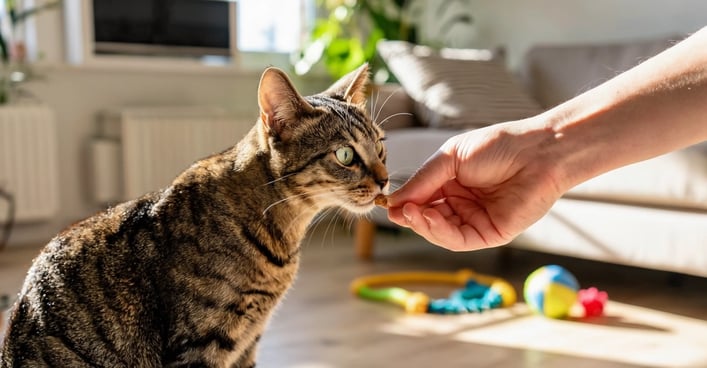
Cat Training: The 2026 Guide to Positive Reinforcement Methods
Unlock your cat's potential with our science-backed guide to positive reinforcement training. Build a stronger bond, solve behavior issues, and teach fun tricks using force-free methods.
Share this page
Cat Training: The 2026 Guide to Positive Reinforcement Methods
By Dr. Patricia Williams, Certified Animal Behaviorist | Updated: March 15, 2026 | Reading Time: 18 minutes
Introduction
Dispelling the myth of the untrainable cat, modern behavioral science confirms that felines are highly intelligent and responsive learners. While their motivation differs from dogs, cats excel with positive reinforcement techniques that align with their independent nature. Training your cat offers profound benefits: it deepens your mutual bond, provides essential mental enrichment, addresses unwanted behaviors, and can equip your cat with life-saving skills.
This definitive guide provides a complete roadmap for force-free training, from foundational principles to advanced tricks, all designed to work with your cat's unique instincts.
Crucial: Never call your cat for something unpleasant (like a bath or medication) without also providing a high-value reward.
Always make coming to you a positive experience.
Emergency Recall:
Train a separate, unique cue (e.g., "Here!" or a whistle) reserved for critical situations.
Pair this cue exclusively with the absolute highest-value reward (e.g., tuna, salmon).
Practice this recall sparingly but regularly to keep it reliable. This can be life-saving.
3. High Five / Shake
Prerequisite: Your cat should reliably know "Sit."
Training Steps:
With your cat sitting, hold a treat in a closed fist just above paw level.
Most cats will paw at your hand to try to get it. The moment a paw lifts, CLICK and treat.
Gradually shape this by only clicking for paw movements closer to your open palm.
Finally, present your open hand and add the cue "High Five!" as they touch it.
4. Stay
Training Steps:
Ask your cat to "Sit."
Give a clear hand signal (flat palm toward them) and say "Stay."
Wait just one second, then CLICK, treat, and release.
Gradually increase the duration (count to 2, then 3, then 5) before the click/treat.
Only after duration is solid, begin taking one small step back to add distance.
The Importance of a Release Cue:
Always use a release word like "Okay!" or "Free!" to signal the end of the "Stay."
This prevents confusion and teaches the cat exactly when the behavior is complete.
It creates a clear contract: "Stay until I say the release word."
Modifying Common Behavior Issues
Litter Box Problems
Positive Retraining Protocol:
First: Rule out any medical issues with a veterinarian.
Clean soiled areas thoroughly with an enzymatic cleaner to remove odor.
Provide ample resources: The rule is one litter box per cat, plus one extra.
Use positive reinforcement: When you see your cat use the box appropriately, calmly praise and reward them.
Never punish accidents. This creates fear and worsens the problem.
Redirecting Furniture Scratching
Training an Alternative Behavior:
Provide appealing, appropriate scratchers (vertical, horizontal, sisal, cardboard) placed directly next to the problem furniture.
Make the scratcher rewarding: Use catnip, treats, and praise when they use it.
Make the furniture temporarily unattractive (apply double-sided tape or a plastic sheet).
Consistently reward scratching the correct object. Keep nails trimmed regularly.
Deterring Counter Surfing
Management and Training Combo:
Manage the environment: Never leave food unattended on counters.
Provide an alternative: Install a cat tree or shelf with a better view.
Reward the behavior you want: Click and treat when your cat chooses to stay on their tree instead of the counter.
Use passive deterrents like motion-activated compressed air (SSSCAT) to startle, not punish.
Critical: Punishment after the fact does not work. Cats associate punishment with you, not with the action minutes prior.
Addressing Overstimulation or Aggression
Recognizing Early Warning Signs:
Twitching or lashing tail
Flattened ears
Rippling skin on the back
Dilated pupils, stiff posture
Training-Based Response:
At the first sign, immediately stop all petting or play.
Allow the cat to leave the situation without blocking them.
Reward calm, relaxed behavior when you see it.
Keep future petting/play sessions short and positive, ending before signs appear.
Never physically punish or yell, as this will increase fear and aggression.
Advancing to Complex Training
Harness and Leash Training for Safe Exploration
A Patient, Step-by-Step Process:
Week 1: Desensitization
Leave the harness near your cat's bed or food area so it becomes a neutral object.
Place treats on and around the harness.
Week 2: Positive Association with Wearing
Buckle the harness loosely for just 1-2 minutes during a fun activity (like mealtime).
Immediately provide high-value treats. Gradually increase wearing time over days.
Always supervise while the harness is on indoors.
Week 3: Introducing the Leash Indoors
Attach the leash to the harness and let your cat drag it around under supervision.
Later, hold the leash and follow your cat, letting them lead. Treat for calm movement.
Week 4: First Outdoor Adventures
Choose a quiet, secure time (like early morning) in a calm backyard or patio.
Let your cat explore at their own pace. Your job is to follow and ensure safety.
Generously reward confident, curious behavior.
Introduction to Agility
Getting Started at Home:
Introduce one obstacle at a time (e.g., a tunnel made from a cardboard box).
Use your target stick to guide your cat through or over the obstacle.
Click and treat for any interaction, then gradually shape the full behavior.
Keep it fun and pressure-free to build confidence.
DIY Home Obstacles:
Tunnel: Cardboard box with both ends open.
Jump: A broomstick resting on two books.
Pause Table/Platform: A sturdy stool or small table.
Weave Poles: A line of upright water bottles.
Fun Trick Training
Spin/Twirl:
Hold a treat at your cat's nose.
Slowly lure them in a full circle.
Click and treat upon completion.
Add the verbal cue "Spin" as you start the lure.
Jump Through a Hoop:
Start with a small hoop (or your arms in a circle) on the ground.
Use a target stick to guide your cat through the center. Click/treat.
Gradually raise the hoop an inch at a time as they succeed.
Play Dead/Bang!:
Start with your cat in a "Down" position.
Lure their head around toward their side until they roll onto one hip.
Click and treat for any movement toward the side, then for holding the position.
Add a dramatic cue like "Bang!" and a hand signal.
Solving Common Training Challenges
"My Cat Isn't Food Motivated!"
Solutions:
Experiment with ultra-high-value rewards: tuna juice, sardine, or baby food (meat-only, no onions/garlic).
Train right before a scheduled mealtime when they're hungry.
Use a favorite toy or play session as the reward instead.
Discover their non-food motivator: access to a window, a brushing session, or catnip.
Managing a Short Attention Span
Effective Strategies:
Embrace micro-sessions! Two minutes of focused training is more productive than ten minutes of frustration.
Always end a session on a successful repetition.
Use the highest-value treats exclusively for training.
Choose times when your cat is naturally alert (not right after a big meal or nap).
Training a Fearful or Shy Cat
The Gentle Approach:
Progress at a pace set by the cat, not by a training schedule.
Use even higher-value rewards to create powerful positive associations.
Never force interaction or progress. Let the cat choose to participate.
Celebrate tiny victories. Simply taking a treat from your hand may be the first major goal.
Training in a Multi-Cat Household
Successful Strategies:
Train cats separately initially to prevent competition, jealousy, or treat-stealing.
Use distinct marker sounds (different clickers or words) for each cat if training in the same room later.
Ensure each cat gets individual, focused attention during their session.
Group training can be a fun advanced activity once all cats know the basics well.
Creating a Sustainable Training Routine
Sample Daily Integration
Morning (3-5 minutes):
Use part of breakfast as rewards for a quick "Sit" or "Touch" session.
Evening (5-10 minutes):
Dedicated session for learning a new skill or polishing an old one.
Follow with a play session as a "jackpot" reward.
Throughout the Day:
Capture training: Randomly reward (with a click/treat or just verbal praise) good behaviors you see naturally, like using a scratcher or resting calmly.
Suggested 8-Week Progression Plan
Weeks 1-2: Foundation
Charge the clicker. Master target "Touch." Teach "Sit."
Weeks 3-4: Core Commands
Solidify "Stay" and release cue. Teach "Come" from short distances. Introduce "High Five."
Weeks 5-6: Distraction & Duration
Practice commands with mild distractions. Increase "Stay" duration. Start a simple trick like "Spin."
Weeks 7-8: Advanced Skills & Generalization
Begin harness desensitization. Chain behaviors (e.g., Sit → Touch → High Five). Practice in different rooms.
Clicker vs. Verbal Marker: Choosing Your Tool
Advantages of a Clicker
Provides a perfectly consistent, unique sound that stands out from everyday noise.
Allows for millisecond-precise marking of behavior.
Emotionally neutral, so your frustration or excitement doesn't color the signal.
Often leads to faster initial learning.
Advantages of a Verbal Marker
You always have your voice with you—no tool to forget.
Allows for a seamless transition from training to maintenance in daily life.
Can feel more natural for some trainers and cats.
Effective Verbal Markers: "Yes!" "Good!" "Nice!" (Always use the same word with the same enthusiastic tone.)
When to Seek Professional Guidance
Indicators for Expert Help
Severe aggression (biting, attacking) toward people or other pets.
Extreme fear, anxiety, or phobias that don't improve with gentle training.
Persistent, complex behavior problems like inappropriate elimination with no medical cause.
You've followed protocols diligently for weeks with no measurable progress.
You feel overwhelmed or unsafe.
Seek a Certified Professional: Look for a Certified Cat Behavior Consultant (CCBC) or a Veterinary Behaviorist (a veterinarian with a behavior specialty). Initial consultations typically range from $100 to $250.
Training for Stress-Free Veterinary Care
Creating a "Happy Carrier"
Positive Association Protocol:
Leave the carrier out permanently as a cozy bed, not a scary closet object.
Feed your cat their meals inside the carrier.
Randomly drop high-value treats inside for them to discover.
Add a soft, familiar blanket.
Practice closing the door for 30 seconds while feeding treats, then opening it.
Preparing for Handling and Exams
Desensitization Exercises:
Paws: Gently touch paws, briefly applying light pressure (simulating nail trim). Click/treat for calm acceptance.
Mouth: Briefly touch the side of the mouth/gums. Reward.
Ears: Gently handle and look in ears. Reward.
Restraint: Practice brief, gentle hugs or holds that mimic an exam. Keep sessions extremely short and positive.
Conclusion
Training your cat with positive reinforcement is a journey that profoundly enriches both of your lives. It is a practice built on mutual respect, clear communication, and shared enjoyment. By starting with simple steps, maintaining patience, and keeping sessions positive, you will unlock your cat's remarkable ability to learn.
Remember, each cat is an individual. Progress is not a race. The true rewards are found in the strengthened bond, the solved behavioral puzzles, and the joy of communicating with your feline companion in a new way. The investment you make in training today pays endless dividends in companionship, safety, and mutual understanding for years to come.
Get expert advice about cat care, behavior, nutrition, grooming, and training. Ask our AI cat care expert anything about your cat and receive professional guidance.