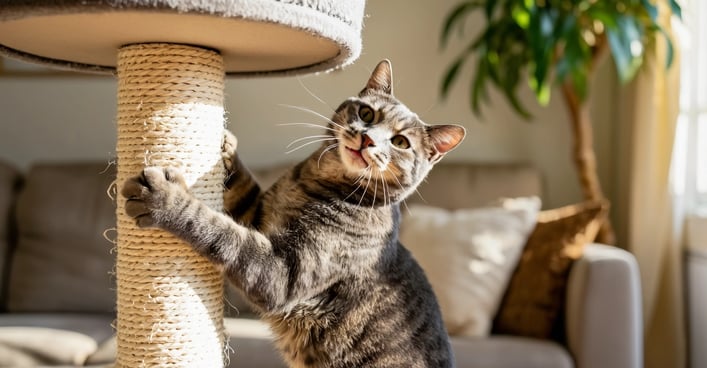
Cat Scratching Posts Review: The Complete 2026 Buying Guide
Find the perfect scratching post for your cat. Our expert guide compares materials, reviews top products, and shares placement strategies to save your furniture.
Share this page
Cat Scratching Posts Review: The Complete 2026 Buying Guide
Scratching is an innate and essential feline behavior for claw health, stretching, and territory marking. Providing appropriate scratching surfaces protects your furniture while satisfying your cat's natural instincts. This comprehensive guide reviews the best scratching posts, pads, and furniture to help you make an informed and effective choice for your home.
Understanding Cat Scratching Behavior
Why Cats Scratch
Scratching serves several critical biological and emotional functions for cats:
Claw Maintenance: Removes the dead outer sheath of the claw, keeping them sharp and healthy.
Stretching: Allows for a full-body stretch, engaging muscles from paws to spine.
Scent Marking: Paws contain scent glands; scratching deposits pheromones to mark territory.
Visual Marking: Leaves visible scratches as a territorial declaration.
Stress Relief: Provides an outlet for emotional release and excitement.
Often include integrated perches, condos, or toys.
High entertainment value but require more floor space.
Horizontal Scratchers
Flat Pads:
Typically made of corrugated cardboard.
Inexpensive and easily replaceable.
Perfect for cats with a horizontal scratching preference.
Incline Scratchers:
Angled design (neither fully vertical nor horizontal).
Some cats show a strong preference for this angle.
Often wall-mounted or free-standing.
Wall-Mounted Options
Space-Saving Solutions:
Vertical panels or shelves covered in sisal or carpet.
Height is fully customizable.
Excellent for apartments or homes with limited floor space.
Furniture Protectors
Corner Guards & Wraps:
Designed to attach directly to furniture corners.
Made of sisal, carpet, or other appealing materials.
Effectively redirects scratching behavior away from your sofa or chair.
Top Product Reviews for 2026
Best Overall: SmartCat Ultimate Scratching Post
Key Features:
32 inches tall for a full stretch.
Dense, fibrous sisal rope wrapping.
Extra-wide 16x16 inch sturdy base for superior stability.
Simple, effective, and durable design.
Performance Analysis:
Aspect
Rating
Notes
Stability
10/10
Excellent base design prevents tipping.
Durability
9/10
High-quality sisal lasts for years.
Cat Appeal
9/10
The ideal height attracts most cats.
Aesthetics
7/10
Functional design; not overly decorative.
Value
9/10
A worthwhile long-term investment.
Price: $45–$60
Best For: Most households, cats who prefer tall scratching surfaces, and priority on stability.
Best Budget & Space-Saver: 4CLAWS Wall-Mounted Scratcher
Key Features:
Wall-mounted design requires zero floor space.
26-inch long sisal fabric surface.
Multiple units can be mounted to create a scratching wall.
All necessary hardware included.
Performance Analysis:
Aspect
Rating
Notes
Space Efficiency
10/10
Perfect for small apartments.
Stability
10/10
Once secured to a stud, it's immovable.
Cat Appeal
8/10
Good height for stretching.
Installation
8/10
Requires a drill and basic DIY skills.
Value
10/10
Excellent price for the quality.
Price: $20–$30
Best For: Small spaces, apartments, renters, and cats who scratch at walls.
Best Premium Design: PetFusion Ultimate Cat Scratcher Lounge
Key Features:
Curved, modern lounge design made of dense cardboard.
Large, reversible scratching surface doubles its lifespan.
Doubles as a comfortable resting spot.
Attractive aesthetic that complements home decor.
Performance Analysis:
Aspect
Rating
Notes
Design
10/10
A beautiful piece of functional cat furniture.
Cat Appeal
9/10
The curve and cardboard are highly attractive.
Durability
7/10
Cardboard will wear down but is reversible.
Reversibility
9/10
Effectively doubles the usable life.
Aesthetics
10/10
Looks like modern furniture, not a pet product.
Price: $70–$90
Best For: Design-conscious homes, cats who love cardboard, and felines who enjoy lounging.
Best for Multi-Cat Households: Frisco 72-Inch Cat Tree
Key Features:
Over 6 feet tall with multiple sisal-wrapped posts.
Includes perches, condos, and dangling toys.
Provides vertical territory, crucial in multi-cat homes.
Sturdy construction to handle active cats.
Performance Analysis:
Aspect
Rating
Notes
Multi-Cat Suitability
10/10
Ample space for several cats to coexist.
Entertainment Value
9/10
Combines scratching, climbing, hiding, and playing.
Durability
7/10
Fabric may show wear, but the structure is solid.
Assembly
7/10
Requires time and patience to put together.
Value
9/10
Excellent feature set for the price.
Price: $80–$120
Best For: Households with two or more cats, active climbers, and providing vertical space.
Best Cardboard Scratcher: Omega Paw Scratch'n Massage
Key Features:
Curved cardboard scratching surface with built-in grooming combs.
Design encourages lounging while scratching.
Very affordable with replacement pads available.
Performance Analysis:
Aspect
Rating
Notes
Cat Appeal
9/10
Cardboard is a favorite for many cats.
Massage Feature
7/10
Some cats enjoy it; others ignore it.
Durability
6/10
Cardboard will fray but is replaceable.
Replacement Ease
8/10
Refill pads are readily available.
Value
9/10
Extremely affordable entry point.
Price: $15–$25
Best For: Cats with a proven love for cardboard, budget-conscious owners, and loungers.
Best Compact & Starter Post: Amazon Basics Cat Scratching Post
Key Features:
Compact design (15.75 inches tall) with a small footprint.
Wrapped in natural jute rope.
Extremely affordable price point.
Performance Analysis:
Aspect
Rating
Notes
Size
9/10
Ideal for very small spaces or as a secondary post.
Stability
7/10
Adequate for kittens and small cats.
Durability
6/10
Basic construction; best for light use.
Price
10/10
One of the most inexpensive options available.
Starter Option
9/10
Perfect for testing your cat's interest with minimal investment.
Price: $15–$20
Best For: Kittens, small cats, limited space, tight budgets, or testing preferences.
Essential Feature Comparison
Height Requirements
Cat Size
Minimum Height
Ideal Height
Reason
Kitten / Small Cat
20 inches
26–30 inches
Allows for a full stretch as they grow.
Average Cat
26 inches
30–36 inches
Accommodates a complete stretch for most adults.
Large Cat (e.g., Maine Coon)
30 inches
36+ inches
Necessary for their larger frame and stretch.
General Rule
—
Taller is Better
Cats prefer to stretch as high as possible.
Base Stability Guide
Post Height
Minimum Base Size
Stability Rating
Under 20"
12x12 inches
Good for small cats
20–30"
16x16 inches
Good for average cats
30–40"
18x18 inches
Better for stability
Over 40"
20x20+ inches
Best to prevent tipping
Material Durability & Cost
Material
Expected Lifespan
Long-Term Cost Analysis
Sisal Rope
3–5 years
Lower (one-time quality purchase)
Sisal Fabric
2–4 years
Moderate
Carpet
1–2 years
Higher (requires more frequent replacement)
Cardboard
3–12 months
Higher (ongoing cost of refills/replacements)
Seagrass
2–3 years
Moderate
Strategic Placement for Success
Optimal Locations
High-Traffic & Social Areas:
Near your cat's favorite sleeping spots (they often scratch upon waking).
Close to family gathering areas like the living room.
By windows or other favorite resting places.
Redirective Placement:
Directly next to furniture they are currently scratching.
In front of items you want to protect, offering an immediate alternative.
Multiple Posts Rule:
Provide at least one scratching option per floor of your home.
Offer a mix of vertical and horizontal options in different rooms.
Consider a combination: a large cat tree in the main room and a simple post in the bedroom.
Locations to Avoid
Isolated, unused corners or rooms.
Directly beside the litter box.
Immediately in front of food and water bowls.
On unstable surfaces like thick rugs that can cause wobbling.
Training Your Cat to Use the Scratching Post
Introduction Techniques
Scent Attraction:
Rub catnip or silver vine on the post's surface.
Use synthetic feline facial pheromone spray (like Feliway).
Place treats or food puzzles on the base to create positive associations.
Attach interactive toys to encourage play that leads to scratching.
Positive Demonstration:
Gently take your cat's paws and simulate a scratching motion on the post.
Use your own nails to make a scratching sound on the material.
Immediately reward any interaction (sniffing, pawing) with praise and a high-value treat.
Redirecting Unwanted Scrouting
From Furniture to Post:
Place the new post directly against the scratched furniture corner.
Make the furniture temporarily unappealing with double-sided sticky tape or a citrus-scented spray.
Lavishly reward your cat every time they use the post instead.
Never punish scratching—it's a natural behavior. Punishment creates fear, not learning.
Gradually move the post a few inches away from the furniture each week once the new habit is established.
Maintenance and Longevity
Extending the Life of Your Post
Sisal Posts:
Periodically trim long, loose fibers with scissors.
Rotate the post if all sides aren't equally worn.
Vacuum to remove loose debris and fur.
Replace when the sisal is worn through to the core.
Cardboard Scratchers:
Flip them over when one side is worn smooth.
Vacuum out cardboard shreds regularly.
Replace entirely when both sides are smooth or the structure weakens.
Keep away from moisture to prevent mold and warping.
When to Replace
Replace a scratching post when you observe:
The scratching material is worn through to the wood, plastic, or other core.
Sisal or rope is unraveling and creating loops that could trap a paw.
The structure is wobbly or unstable, even after tightening.
Your cat has completely lost interest because the surface is too smooth.
Sharp edges, staples, or broken parts are exposed.
Cost Analysis: Investment vs. Value
Initial Investment Ranges
Type
Budget
Mid-Range
Premium
Basic Vertical Post
$15–$25
$30–$50
$50–$80
Cat Tree / Condo
$50–$80
$100–$200
$200–$400
Cardboard Scratcher
$10–$20
$20–$40
$50–$90 (designer)
Wall-Mounted System
$15–$30
$30–$50
$50–$100
Lifetime Cost of Ownership
Product Example
Initial Cost
Expected Lifespan
Annual Cost
Quality Sisal Post
$50
4 years
$12.50
Cardboard Refills
$20 (every 6 mos)
Ongoing
$40
Basic Carpet Post
$40
2 years
$20
Premium Cat Tree
$150
5+ years
$30 or less
DIY Scratching Post Ideas
Simple Sisal-Wrapped Post
Materials:
4x4 wooden post (3–4 feet tall).
100+ feet of 3/8" sisal rope.
2x2 foot plywood base (3/4" thick).
Wood screws, drill, and staple gun.
Instructions:
Securely screw the post to the center of the base from underneath.
Starting at the bottom, wrap the sisal rope tightly around the post, securing the start with a staple.
Continue wrapping, ensuring no gaps, and secure the end with another staple.
Sand any rough edges on the wood.
Estimated Cost: $30–$40
Cardboard Incline Scratcher
Materials:
Corrugated cardboard sheets (from moving boxes).
Non-toxic wood glue or hot glue gun.
Optional: Simple wooden frame for stability.
Instructions:
Cut cardboard into identical long, rectangular strips.
Stack and glue the strips together tightly to form a solid block.
For an incline, glue the block to a slanted wooden frame or simply lean it against a wall.
Place in a favored cat area.
Estimated Cost: $10–$20 (mostly free if using recycled boxes)
Final Recommendations & Quick Picks
Best Overall for Most Homes:SmartCat Ultimate Scratching Post. A proven, no-frills design that offers exceptional stability and longevity.
Best Budget & Starter Pick:Amazon Basics Cat Scratching Post. An inexpensive way to discover your cat's preferences without a big commitment.
Best for Style & Function:PetFusion Ultimate Cat Scratcher Lounge. A furniture-grade piece that satisfies scratching instincts and complements your decor.
Best for Apartments & Small Spaces:4CLAWS Wall-Mounted Scratcher. Saves every inch of floor space while being highly effective.
Best for Multi-Cat Families:Frisco 72-Inch Cat Tree. Provides essential vertical territory and multiple scratching outlets in one unit.
Conclusion
Choosing the right scratching post is an investment in your cat's well-being and your home's integrity. The ideal post matches your cat's material and orientation preferences, is placed strategically, and is introduced with positive reinforcement.
For the majority of cat owners, the SmartCat Ultimate Scratching Post represents the best value, combining critical height, robust stability, and high cat appeal. Remember, multiple, well-placed options often yield better results than a single expensive post hidden in a corner.
Ultimately, observe your cat. A well-used, worn-looking scratching post is a sign of success. It means you've provided an appropriate outlet for a natural, healthy behavior, protecting your bond and your furniture for years to come.
Guide Updated: March 2026 Remember: Scratching is natural—providing the right outlet is your key to harmony.
Get expert advice about cat care, behavior, nutrition, grooming, and training. Ask our AI cat care expert anything about your cat and receive professional guidance.