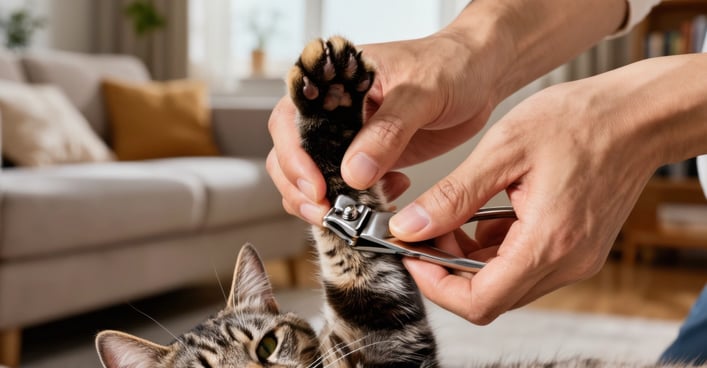
Cat Nail Trimming Guide: Stress-Free Techniques for Owners
Master cat nail trimming with our step-by-step guide. Learn safe techniques, choose the right tools, and build a positive routine for your feline friend.
Share this page
Cat Nail Trimming Guide: Stress-Free Techniques for Owners
Nail trimming is a crucial yet often intimidating aspect of cat care. Overgrown claws can lead to health issues like ingrown nails and infections, while also causing damage to your home and discomfort during cuddles. This comprehensive guide will help you transform nail trimming from a stressful chore into a calm, manageable routine for both you and your cat.
Pros: Offers good control and leverage; suitable for most nail sizes.
Cons: Requires proper positioning to avoid splintering.
Best For: Most cats, especially beginners.
Price Range: $8 - $18
2. Guillotine-Style Clippers
Pros: Provides a quick, clean cut with a familiar mechanism.
Cons: Can crush the nail if it's too large for the opening; harder to see the cutting point.
Best For: Cats with small to medium nails; experienced users.
Price Range: $6 - $15
3. Nail Grinders
Pros: Creates a smooth edge; allows for gradual, precise shortening; ideal for dark nails.
Cons: The noise and vibration can frighten some cats; the process takes longer.
Best For: Patient cats, dark nails, or owners seeking a polished finish.
Price Range: $20 - $50
4. Human Nail Clippers (Not Recommended)
Pros: Readily available in a pinch.
Cons: Not designed for cat nail curvature; can easily split or crush the nail.
Best For: Emergency use only when proper tools are unavailable.
Recommended Products
Type
Recommended Brand
Key Feature
Price
Scissor-style
JW Pet Gripsoft
Non-slip, ergonomic handles
$10-$15
Guillotine
Resco Original
Durable, stainless steel blade
$12-$18
Grinder
Dremel Pet Nail Grooming
Variable speed, quiet operation
$30-$40
Styptic Powder
Kwik Stop
Stops bleeding quickly
$6-$10
Essential Supplies Checklist
Quality nail clippers or grinder
Styptic powder or cornstarch (to stop bleeding if the quick is nicked)
High-value treats for immediate rewards
A soft towel for gentle restraint (if needed)
Good, direct lighting
Optional: A helper to provide comfort or distraction
Preparation Phase: Setting the Stage for Success
Choosing the Right Time & Mood
Factor
Ideal Condition
Cat's State
Relaxed, sleepy, or post-meal.
Time of Day
During a calm period in your cat's routine.
Environment
Quiet, familiar room with minimal distractions.
Your Demeanor
Patient, calm, and unhurried. Your cat will sense your energy.
Creating Positive Associations (A 4-6 Week Plan)
Weeks 1-2: Desensitization
Gently handle and massage your cat's paws during petting sessions.
Touch individual toes and apply slight pressure to extend the claws.
Do not attempt to trim yet.
Reward with a treat and praise after each positive interaction.
Weeks 3-4: Tool Introduction
Leave the clippers or grinder in your cat's view during calm times.
Let your cat sniff and investigate the tools.
Gently touch the tool to their paws (without cutting).
Continue to pair all interactions with high-value treats.
Week 5+: Gradual Trimming Begins
Aim to trim just the very tip of one nail.
Immediately follow with a treat and enthusiastic praise.
End the session on a positive note. Gradually build up to more nails per session.
Step-by-Step Trimming Technique
The Process
1. Position Your Cat Comfortably
Position
Best For
How-To
On Your Lap
Calm, trusting cats.
Have your cat face away from you, with their back against your chest.
On a Table
Squirmy or anxious cats.
Place a non-slip mat or towel on the surface. Gently hold your cat in place.
On the Floor
Larger or more resistant cats.
Sit on the floor with your cat between your legs, facing away.
The "Burrito"
Very resistant or fearful cats.
Gently wrap your cat in a towel, exposing only one paw at a time.
2. Extend the Claw
Gently press the pad above the nail with your thumb and forefinger.
The claw will extend automatically. Hold the paw firmly but gently.
Ensure you have excellent lighting to see the nail structure.
3. Identify the Quick (The "No-Cut" Zone)
For Light Nails: Look for the pinkish triangle (the quick) inside the nail. Only cut the clear/white tip.
For Dark Nails: Proceed with extreme caution. Trim only the sharp, hooked tip. Look for a dark, grayish dot in the center of the nail after a small cut—this indicates you are nearing the quick.
4. Make the Cut
Position the clippers perpendicular to the nail (straight across, not at an angle).
Make a quick, confident cut, removing only the sharp tip.
Golden Rule: When in doubt, cut less. It's better to trim more frequently than to cut the quick.
5. Reward & Release
Immediately give a treat and verbal praise.
Release the paw and allow your cat to relax for a moment.
Keep initial sessions short and positive.
How Much to Cut: A Visual Guide
For Light-Colored Nails:
Cut approximately 2-3 mm away from the visible pink quick.
You should only be removing the clear or white portion of the nail.
For Dark-Colored Nails:
Trim only the sharp, translucent hook at the very end.
Take multiple tiny cuts, examining the cross-section after each one.
If you see a small, dark/black dot appear in the center of the nail, STOP. The quick is close.
Handling Difficult Cats: Low-Stress Strategies
Proven Techniques
1. The Gradual Approach
Trim just one nail per day. This builds tolerance without overwhelming your cat.
Consistency and positive reinforcement are key.
2. The "Burrito" or Towel Wrap Method
Securely but gently wrap your cat in a towel, leaving one paw exposed at a time.
Trim the visible nails, then re-wrap to access the next paw.
This method minimizes movement and can make a nervous cat feel more secure.
3. The Two-Person Team
One person focuses solely on comforting, holding, and distracting the cat.
The other person is dedicated to the quick, precise trimming.
Use clear, calm communication.
4. Strategic Distraction
Use a lickable treat mat or tube held by a helper.
The cat focuses on the food, not the procedure.
This works exceptionally well for food-motivated cats.
Knowing When to Stop
It is crucial to recognize your cat's stress signals. Stop the session immediately if you observe:
Intense Struggling or Hissing
Heavy Panting or Drooling
Ears Pinned Flat Against the Head
Dilated Pupils
You becoming frustrated or anxious
Remember: Successfully trimming one nail is a victory. Forcing a full trim can damage trust and make future sessions harder.
Troubleshooting Common Problems
If You Accidentally Cut the Quick
Immediate First Aid:
Stay Calm. Your cat will react to your energy.
Apply Pressure. Use styptic powder, a styptic pencil, or cornstarch directly to the tip of the nail.
Hold Firmly. Maintain gentle pressure for 30-60 seconds.
Comfort Your Cat. Speak softly and offer a treat once the bleeding stops.
End the Session. Do not attempt to trim any more nails that day.
Aftercare:
The quick may be tender for 24-48 hours but typically heals quickly.
Monitor for signs of infection (swelling, redness, discharge), though this is rare.
Be extra gentle and patient during the next trimming session.
Dealing with Resistance
Problem
Potential Solution
Hides at the sight of clippers
Keep clippers in plain view (not before trimming) to desensitize. Always pair their presence with treats.
Becomes aggressive when paws are touched
Go back to basic desensitization over several weeks. Consult a veterinarian or cat behaviorist for severe cases.
Too wiggly to hold still
Try a different restraining position (e.g., the "burrito"). Ensure your cat has had recent playtime to burn energy.
Bites or swats during the process
Use a towel wrap for safety. Consider if professional grooming is a better option for your safety and your cat's well-being.
Vocalizes loudly (meows, cries)
Keep sessions incredibly short (one nail). Ensure you are not causing pain and that you are providing high-value rewards.
Alternatives for Truly Uncooperative Cats
1. High-Quality Scratching Posts & Pads:
Encourages natural nail shedding through scratching.
Does not replace trimming but helps maintain length between trims.
Provide vertical and horizontal options.
2. Professional Grooming Services:
Groomers are experienced in handling and trimming cat nails quickly.
Typical cost: $10 - $25 per session.
Can significantly reduce owner stress.
3. Veterinary Assistance:
Your vet or vet tech can perform the trim, often during a routine wellness visit.
For extremely fearful or aggressive cats, sedation may be a safe option discussed with your vet.
Ensures the procedure is done safely and correctly.
4. Soft Nail Caps (e.g., Soft Paws®):
Vinyl caps are glued over the trimmed nail, blunting the sharp tip.
Typically last 4-6 weeks before falling off with natural nail growth.
Must be applied correctly to avoid discomfort; your vet can demonstrate.
An excellent solution for cats who scratch furniture or people.
Frequency and Maintenance Schedule
How Often to Trim
Cat Lifestyle
Recommended Frequency
Reasoning
Indoor-Only
Every 2-3 weeks
Lack of rough outdoor surfaces leads to faster overgrowth.
Indoor/Outdoor
Every 3-4 weeks
Outdoor activity provides some natural wear.
Senior Cats
Every 2 weeks
Nails often grow thicker and faster, with less natural wear due to reduced activity.
Polydactyl Cats
Check weekly, trim as needed
Extra toes mean extra nails, some of which may not touch the ground and can overgrow quickly.
Signs It's Time for a Trim
You hear a distinct click-click-click on hard flooring.
Claws are visibly extended even when your cat is at rest.
Your cat's nails get caught on blankets, carpets, or your clothing.
You notice an increase in furniture scratching.
Playful interactions result in more frequent accidental scratches.
Special Situations & Considerations
Kittens
Start Early! Begin handling paws and introducing clippers as soon as you bring your kitten home.
Use small, kitten-sized clippers.
Nails grow very quickly, so check them weekly.
Establishing a positive routine early prevents future battles.
Senior Cats
Nails may become thicker, drier, and more brittle.
Arthritis can make restraint painful. Be extra gentle with their joints.
They may be less tolerant of lengthy sessions. Opt for shorter, more frequent trims.
Polydactyl Cats (Cats with Extra Toes)
Carefully check between the toes for hidden extra nails (especially dewclaws).
These "hidden" nails are prone to overgrowth and curling into the pad.
Incorporate checking these nails into your regular routine.
Cats with Dark/Black Nails
This requires the most caution. Always err on the side of trimming too little.
Take multiple tiny cuts and examine the nail's cross-section after each snip.
Consider using a nail grinder for more control and visibility.
If you're uncomfortable, a professional groomer or veterinarian is an excellent resource.
Cost Analysis: DIY vs. Professional
DIY Trimming (Annual Estimate)
Item
Initial/Recurring Cost
Quality Clippers (one-time)
$15
Styptic Powder (lasts years)
$8
High-Value Treats
~$60/year
Total First Year
~$83
Subsequent Years
~$60/year (treats only)
Professional Trimming (Annual Estimate)
Service
Cost Per Visit
Annual Cost (Bi-Weekly Trim)
Veterinary Clinic
$15 - $30
$390 - $780
Professional Groomer
$10 - $20
$260 - $520
Mobile Groomer
$25 - $40
$650 - $1,040
Note: Professional costs add up quickly, making DIY care a significant long-term savings while strengthening your bond with your cat.
Building a Lifelong, Stress-Free Routine
Making It a Habit
Schedule It: Set a recurring reminder on your phone or calendar.
Consistency is Key: Perform trims at the same time and in the same calm environment.
Tool Accessibility: Keep your clippers, treats, and styptic powder together in an easily accessible kit.
Track Your Progress: Note the date and which paws you trimmed to stay on schedule.
Reward Yourself Too: Acknowledge your patience and success in caring for your cat.
Training Progress Checklist
Week
Primary Goal
Notes/Success
1-2
Cat accepts gentle paw handling without pulling away.
3-4
Cat remains calm when clippers are present and touched to paws.
5
First nail tip is successfully trimmed with a treat reward.
6
One full paw can be trimmed in a single, calm session.
8
A full trim (all paws) is achieved with minimal stress.
Frequently Asked Questions (FAQ)
Q: Can I use human nail clippers on my cat?A: It is not recommended. Human clippers are designed for a different nail shape and can splinter or crush a cat's curved claw, causing pain and potential injury. Invest in proper pet clippers.
Q: My cat has completely black nails. How do I know where to cut?A: Extreme caution is required. Trim only the sharp, hooked tip. After a tiny cut, look at the nail's cross-section. If you see a whitish/pale ring with a dark gray or black dot in the center, you are approaching the quick and should stop. When in doubt, trim less more often.
Q: Do indoor cats really need their nails trimmed more than outdoor cats?A: Yes. Outdoor cats naturally wear down their nails on rough surfaces like concrete, tree bark, and pavement. Indoor cats lack these abrasive surfaces, so their nails grow longer and sharper without intervention.
Q: My cat is limping slightly after a trim. Should I be worried?A: A brief period of mild sensitivity (a few hours) can occur, especially if you were near the quick. Provide a quiet space for your cat to relax. If limping persists beyond 24 hours, or if you notice swelling, redness, or your cat is vocalizing in pain, contact your veterinarian to rule out injury or infection.
Q: Is it okay to trim my cat's nails while they're sleeping?A: This is a common tactic, but it has risks. A startled awake cat may develop a negative association with nail trimming. If you attempt this, do so with a very heavy sleeper and be prepared to stop immediately if they wake up stressed. Building positive, awake associations is generally more effective long-term.
Q: What about declawing as an alternative to trimming?A: Declawing (onychectomy) is not a "manicure." It is the surgical amputation of the last bone of each toe, equivalent to removing your fingertips at the first knuckle. It is illegal in many countries and cities due to the high risk of chronic pain, nerve damage, lameness, and behavioral problems like inappropriate elimination. Regular nail trimming is the safe, humane, and responsible alternative.
Guide Updated for 2026. Patience, positive reinforcement, and consistency are the foundations of stress-free nail care. If you encounter persistent difficulties, your veterinarian or a certified cat behaviorist can provide personalized guidance.
Get expert advice about cat care, behavior, nutrition, grooming, and training. Ask our AI cat care expert anything about your cat and receive professional guidance.